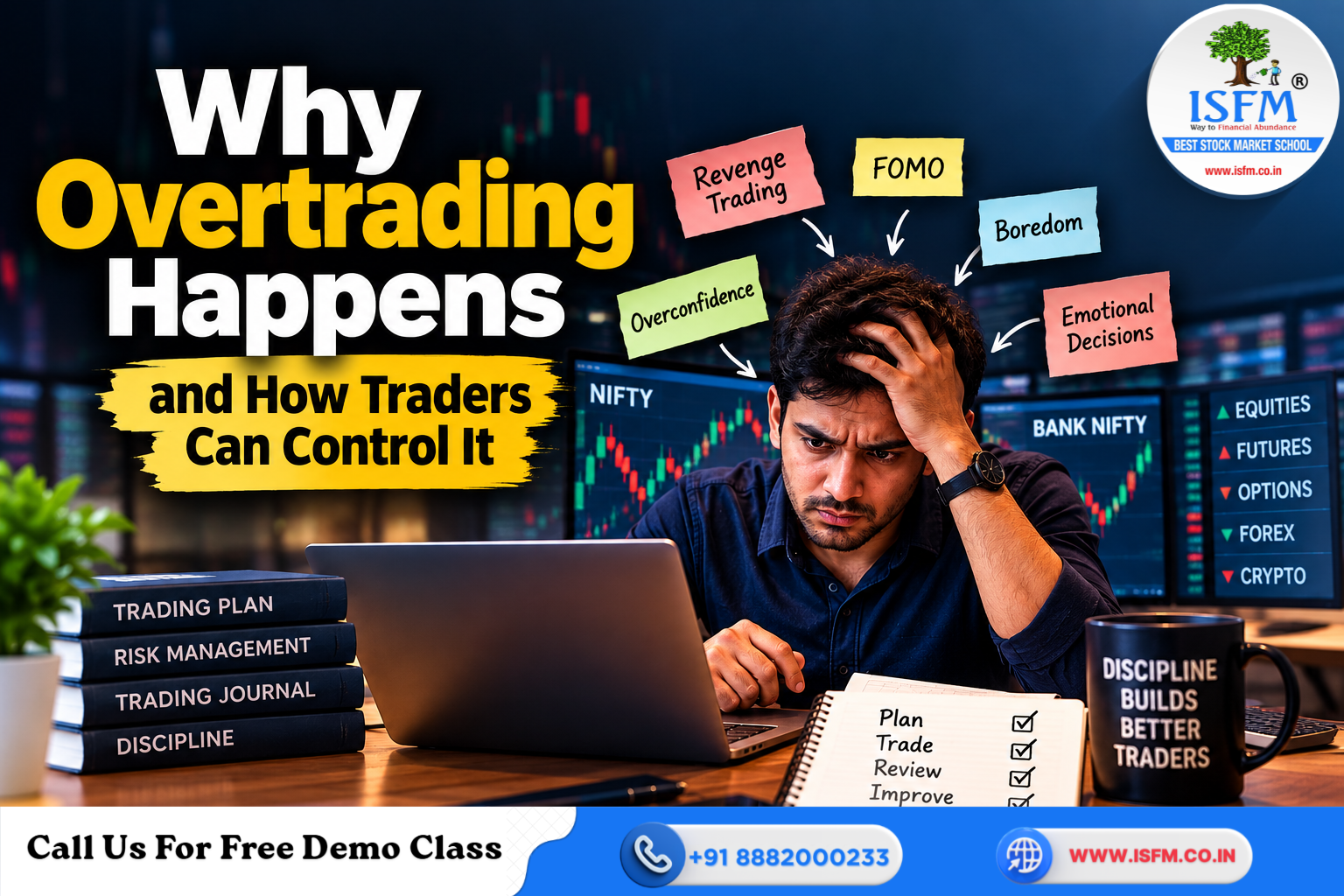
Imagine an Indian trader taking five trades in one session. Three result in small losses, one breaks even, and the last creates a bigger loss. After hours of watching charts, trading Nifty or Bank Nifty options, and paying brokerage and other charges, the trader finishes the day in the red.
This raises an important question: If trading is about finding good opportunities, why do so many traders keep taking trades that do not meet their plan?
According to Sushil Alewa, SEBI Registered Research Analyst (INH100009433), understanding trading psychology is essential for recognising why traders make impulsive decisions despite having market knowledge. Traders should focus on identifying emotional triggers, following a structured trading plan, managing risk, and reviewing their decisions to develop better trading discipline.
The answer often lies in trading psychology. Overtrading is a common behavioural pattern driven by emotions, habits, and the pressure to act. It does not mean a trader is weak or incapable. With clear rules and consistent self-awareness, it can be managed.
What Is Overtrading?
Overtrading occurs when traders execute more trades, use larger positions, or accept lower-quality setups than their strategy and risk plan justify.
It is not simply about the number of trades. A trader taking ten planned trades may be following a tested strategy, while another taking just three impulsive trades may be overtrading.
The real question is whether every trade has a valid reason, predefined risk, and a place in the trading plan. Learning the fundamentals of technical analysis can help traders understand market structure and develop objective entry and exit criteria.
Revenge Trading After Losses
One of the biggest reasons why traders overtrade is the desire to recover losses quickly.
Consider a trader whose Bank Nifty options position hits its stop-loss. Frustrated, the trader immediately enters another position. When that trade also loses, the trader increases the position size to recover the money.
This creates a dangerous cycle: a loss triggers frustration, frustration creates urgency, and urgency leads to impulsive entries. Larger positions can then increase potential losses.
This behaviour is known as revenge trading. The trader begins acting as if the market owes them a recovery. However, the market does not know about previous losses. Every new trade must justify its risk independently.
A structured understanding of futures and options trading can help traders better understand leverage, position sizing, and the risks associated with derivatives.
Overconfidence After Winning Trades
Overtrading does not always follow losses. Sometimes, a winning streak creates the same problem.
After several profitable trades, a trader may believe they have understood market movements perfectly. They might increase their position size, enter more frequently, or ignore signals that previously kept them out of the market.
A trader who profits from two Nifty trades may start entering every small breakout. Confidence gradually turns into overconfidence, and trade quality deteriorates.
A winning streak does not eliminate market uncertainty. Traders should follow their risk limits regardless of recent performance.
FOMO and Fast Market Movements
FOMO, or the fear of missing out, pushes traders to enter because they believe an opportunity is disappearing.
A stock suddenly rallies, Nifty breaks a resistance level, or a cryptocurrency trends on social media. Seeing others discuss potential profits, a trader enters without checking the setup.
By then, much of the move may already have occurred. Entering late can produce an unfavourable risk-reward ratio, leaving little room for profit and substantial room for loss.
A missed trade is not automatically a missed opportunity. Waiting for the next valid setup is often better than chasing an extended move.
Boredom and the Need for Action
Markets can remain quiet for hours. Traders who feel they must earn something every day may interpret inactivity as wasted time.
They start watching every candle, switching between equities, futures, forex, and crypto, searching for something to trade.
However, trading is not about remaining constantly active. Waiting for suitable market conditions is part of the process. No trade can be a perfectly valid decision.
No Clear Trading Plan
Without predefined rules, every market movement can appear to offer an opportunity.
A practical trading plan should specify:
- Markets and timeframes to trade.
- Entry conditions and exit rules.
- Stop-loss placement and position sizing.
- Maximum trades per day.
- Maximum daily loss.
- Conditions for avoiding the market.
These rules reduce the need to make emotional decisions during fast-moving sessions. Traders who want to build a stronger foundation can explore an investment and stock market course to improve their understanding of market participation and investment principles.
The Real Cost of Overtrading
Frequent trading increases brokerage, exchange charges, applicable taxes, bid-ask spreads, and slippage. It can also increase emotional fatigue and exposure to unnecessary risks.
Consider a trader who executes 20 trades in a day and incurs an average of ₹100 in transaction costs per trade.
20 trades × ₹100 = ₹2,000 in costs.
The trader must overcome these costs before generating a net profit. If the strategy has only a small statistical edge, excessive trading can significantly reduce its effectiveness. Actual costs vary by broker, instrument, and transaction.
How to Stop Overtrading
Building trading discipline requires practical systems, not just willpower.
- Set a trade limit: Define the maximum number of trades allowed in a session.
- Establish a daily loss limit: Stop trading when your predefined threshold is reached.
- Keep risk consistent: Use a fixed, appropriate risk allowance for each trade.
- Pause after losses: Step away instead of immediately seeking recovery.
- Avoid impulsive position increases: Do not increase size simply because you are winning.
- Use a checklist: Confirm that every entry meets your rules.
- Recognise emotional triggers: Avoid trading when frustrated, bored, or desperate to recover money.
These measures cannot eliminate losses, but they can help prevent avoidable decisions. Developing practical knowledge through ISFM’s stock market courses can also help learners build a more systematic approach to trading and risk management.
Use a Pre-Trade Checklist
Before entering any trade, ask yourself:
- Does this trade match my strategy?
- Are market conditions suitable?
- Have I defined my entry, stop-loss, and target?
- Is my position size within my risk limit?
- Am I acting on analysis or emotion?
- Have I reached my daily trade or loss limit?
- Would I take this trade if I were calm and objective?
If a trade fails your essential rules, skip it.
How a Trading Journal Helps
A trading journal makes behavioural patterns easier to recognise. Record the reason for each entry, position size, planned risk, outcome after costs, and emotions before and after the trade.
Review 30–50 trades to identify whether losses frequently follow revenge trading, whether winning streaks lead to excessive activity, or whether boredom causes unnecessary entries.
Use these findings to improve your rules rather than blaming yourself for every mistake.
Frequently Asked Questions
What is the main reason traders overtrade?
Emotions such as fear, greed, FOMO, boredom, and the desire to recover losses can push traders to take unnecessary positions.
How can I stop overtrading in intraday trading?
Follow a written trading plan, set daily trade and loss limits, and avoid entering positions that do not meet your predefined criteria.
Is overtrading common in Nifty and Bank Nifty options?
Yes. Rapid price movements and short-term opportunities can encourage impulsive entries, particularly when traders try to recover losses or chase breakouts.
Can a trading journal help control overtrading?
Yes. A journal helps identify emotional triggers, unnecessary trades, repeated mistakes, and the impact of transaction costs on overall results.
Conclusion
Overtrading is often a behaviour and discipline problem rather than a lack of market knowledge. Understanding your triggers, following a structured plan, and reviewing your decisions can help you develop more consistent habits.
The goal is not to trade more. The goal is to trade only when the market offers a setup that matches your plan—and to stay out when it does not.