
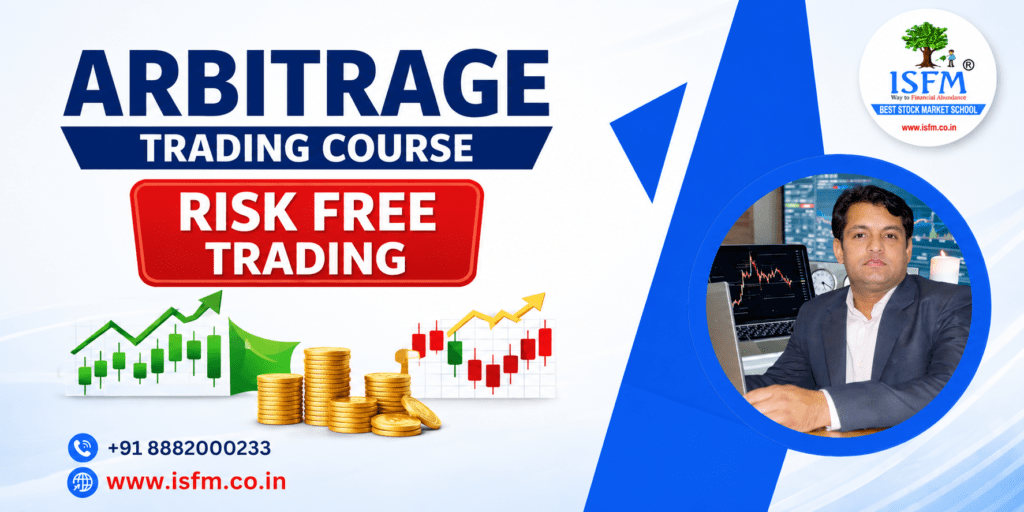


The Arbitrage Trading Course offered by ISFM is a specialized professional training program designed for traders, investors, portfolio managers, HNI investors, finance professionals, and aspiring market participants who want to learn low-risk, opportunity-based trading strategies used in modern financial markets.
Arbitrage trading is one of the most fascinating concepts in financial markets because it focuses on identifying price inefficiencies and exploiting temporary differences in asset pricing across markets, exchanges, instruments, or time periods.
This course provides practical training in:
Whether you are a trader looking to diversify your strategies, an investor seeking lower-risk opportunities, or a finance professional wanting to understand institutional trading techniques, this course provides a structured framework for learning arbitrage trading.
₹30,000 /One Time.
₹35,000 /3 Months.
Our Trainer are not just faculty members, they are full time professional traders.





EXCELLENTTrustindex verifies that the original source of the review is Google. I joined ISFM as an absolute beginner with zero knowledge about the stock market. The faculty and trainers do a phenomenal job breaking down complex topics—like candlesticks, chart patterns, and risk management—into easy-to-understand concepts. I highly recommend their courses to anyone looking to build a strong, practical foundation in trading!Posted on GoogleTrustindex verifies that the original source of the review is Google. ⭐⭐⭐⭐⭐ I had a fantastic experience learning at ISFM. Mr. Sushil Alewa and Mr. Anil Mor are outstanding mentors with deep knowledge of the stock market and financial industry. Mr. Sushil Alewa’s expertise in Technical Analysis, Investment Management, and market research is exceptional. His teaching style is simple, practical, and easy to understand, even for beginners. His real market examples and trading insights helped me build confidence in trading and investing. Mr. Anil Mor brings years of practical experience in portfolio management, equity, commodity, currency, and mutual fund markets. His guidance on market psychology, risk management, and trading strategies has been extremely valuable. The combination of theoretical knowledge, live market training, and personal mentorship makes ISFM one of the best stock market institutes in Gurgaon and Delhi NCR. I highly recommend ISFM to anyone who wants to learn stock trading, investing, technical analysis, and financial market skills from experienced professionals.Posted on GoogleTrustindex verifies that the original source of the review is Google. My humble beginning for the Stock & Options course at ISFM, Gurgaon started a months back and it has been a truly rewarding and enriching learning experience. What impressed me most was the way complex concepts were simplified and explained through practical and real life examples that are easy to remember and apply. The faculty Mr. Sushil Alewa, Mr. Anil Mor, and Mr. Yashwavi brought tremendous clarity to the subjects ranging from option basics, strategies, Greeks and many related concepts. Market psychology was highlighted with practical examples. The importance of events, market volatility, externalities are taught in a very impressive manner relating to the current volatile market scenario. Their emphasis on risk management and evaluating each trade through a risk-reward lens was particularly valuable. A special mention for Ms. Deepali at the welcome desk, whose warmth and professionalism made the entire journey smooth from admission to completion. This course has strengthened my understanding of the markets with respect to technical analysis, deciphering charts, handling strategies enhancing confidence as a trader. It was highly thrilling to back test the strategies as well deploying in the live market. Got a comprehensive insight of the Algo Trading, which is gaining its momentum day by day and it is quite thrilling to back test on Algo platform. Overall, my experience with ISFM has been exceptional. I feel myself much more confident and well-equipped with the multiple nuances of stock and options trading. This program is valuable for both beginners and pro traders, offering something for every level of traders and investors. My sincere thanks to the entire ISFM team for a wonderful learning experience. With My Best Regards — Jha Bidhan ChandraPosted on GoogleTrustindex verifies that the original source of the review is Google. ISFM Gurugram distinguishes itself through its remarkable fiscal ROI and immediate market pragmatism. Their curriculum seamlessly bridges the chasm between labyrinthine market theory and tactical execution. The live-market tracking sessions provide incandescent, data-driven insights, particularly for mastering sophisticated derivatives strategies, stringent risk mitigation, and Fibonacci-based price action. Far from peddling generic platitudes, the mentorship focuses entirely on fostering institutional-grade discipline and systematic trading protocols. For retail market participants seeking to transition from erratic, reactive trading to a fastidious, strategically sound market execution, ISFM delivers superlative utilitarian value. Highly recommended.Posted on GoogleTrustindex verifies that the original source of the review is Google. I had a great learning experience at this institute. The faculty explains stock market concepts, finance, and derivatives in a very practical and easy-to-understand manner. The classes are well-structured and helpful for both beginners and intermediate traders. I especially liked how they focus on real market analysis and practical knowledge instead of only theory. The mentors are supportive and always ready to clear doubts. Highly recommended for anyone who wants to learn trading, investing, and financial markets professionally.Posted on GoogleTrustindex verifies that the original source of the review is Google. Great experience at ISFM institute. Thanks to Sushil Sir, Yashashwai Sir and Anil Sir for giving the in-depth knowledge on stock market.Posted on GoogleTrustindex verifies that the original source of the review is Google. Maine isfm school sai share market aur trading seekhna start kiya tha aur mera experience bahut accha raha. Yahan concepts ko simple aur practical way mein samjhaya jata hai, jis se beginners ko bhi easily understanding ho jati hai. Teachers supportive hain aur live market examples ke saath sikhate hain, jis se confidence build hota hai. Environment bhi professional aur motivating hai. Agar koi share market aur trading seriously seekhna chahta hai, to ye ek acchi place hai learning ke liye.Posted on GoogleTrustindex verifies that the original source of the review is Google. If you want to build a solid career Or secondary income in financial markets then join this game changer ISFM inst. Market trading sirf tukkebazi nahi, sahi skill ka khel hai jo ISFM join karke maine practical karke seekha. Uttar Pradesh ke Prayagraj se itna door gurugram aana Sarthak+Successful+Fruitful raha. "earning while learning" pahle kewal suna tha ab khud kar raha hu with lots of fun in ISFM's friendly environment. Thanks a lot to the team ISFM...!!Posted on GoogleTrustindex verifies that the original source of the review is Google. Great institute for learning stock market concepts and practical skills. Supportive mentors, easy teaching style, and a positive learning environment. Highly recommended!Posted on GoogleTrustindex verifies that the original source of the review is Google. I must say, your market understanding and the way you share it with others is really admirable. Learning from you always feels valuable. I’m genuinely happy and grateful to be learning from you.Verified by TrustindexTrustindex verified badge is the Universal Symbol of Trust. Only the greatest companies can get the verified badge who has a review score above 4.5, based on customer reviews over the past 12 months. Read more
₹30,000 /One Time.
₹35,000 /3 Months.
WhatsApp us