
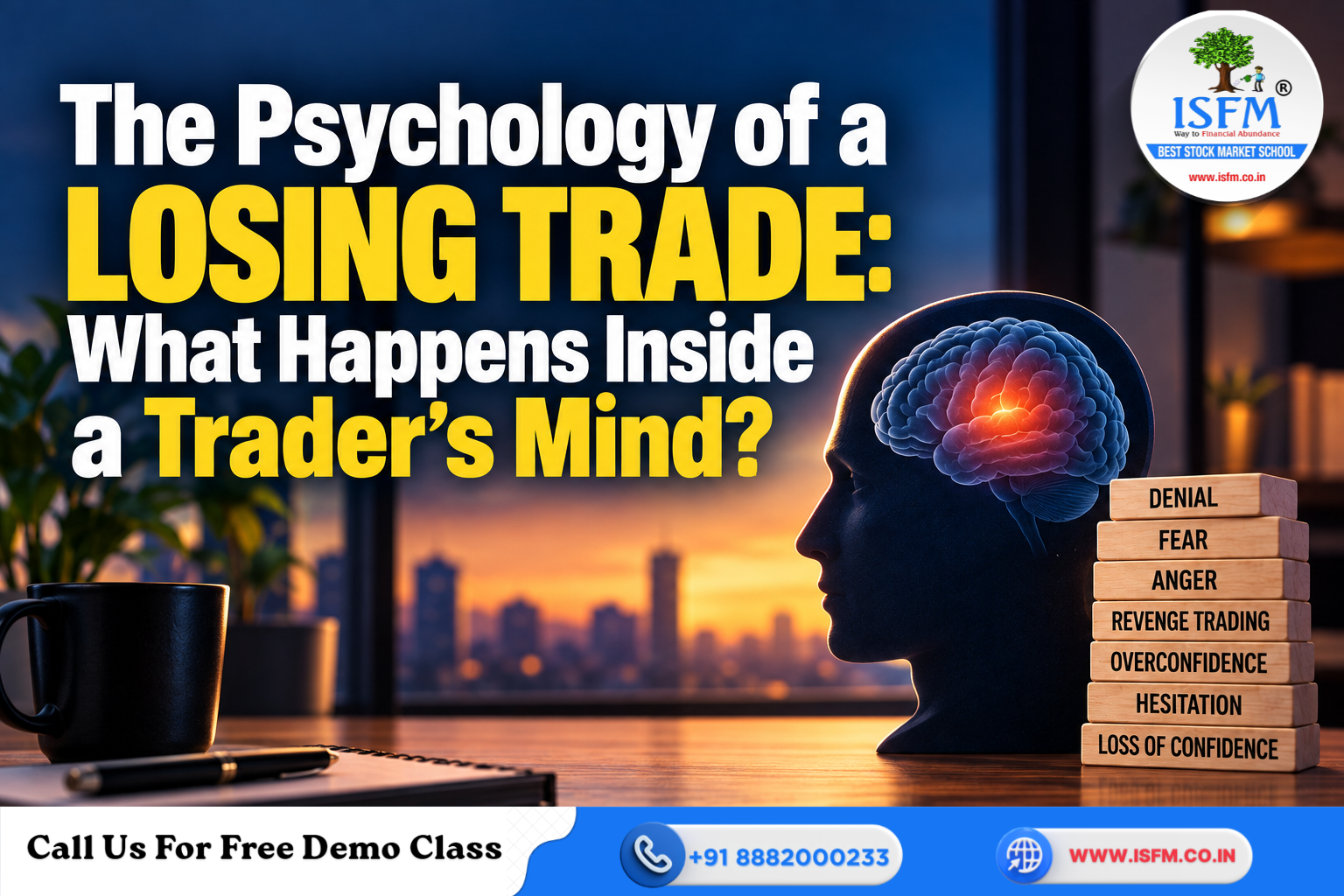
A trader enters a position after analysing the chart, defining a target, and placing a stop-loss. The market moves against the trade, the stop gets hit, and the position closes at a loss.
Technically, the trade is over. Psychologically, however, it may not be.
For Sushil Alewa, SEBI Registered Research Analyst (INH100009433), MBA and CFP, who has extensive experience in trading, financial education and market analysis, trading psychology is an important part of understanding why traders behave differently after similar market outcomes.
The market event may be over, but the emotional reaction can continue. This is why understanding the psychology of a losing trade matters.
Behavioural finance studies how emotions, mental shortcuts and cognitive biases influence financial decisions. Prospect theory suggests that people evaluate outcomes relative to a reference point, such as their entry price, and may become more willing to take risks when facing losses.
The First Reaction: Disbelief and Denial
After a losing trade, the first response may be disbelief.
A trader might think:
- “The market will reverse.”
- “My analysis was correct.”
- “The stop-loss was just hunted.”
- “I should have given the trade more room.”
This can lead to confirmation bias—looking for information that supports the original view while ignoring evidence that contradicts it.
But a losing trade does not automatically mean the analysis was poor. A valid setup can fail because markets operate through probabilities, not certainty.
For traders who want to understand how charts, market structure, indicators and risk management can support a more systematic decision-making process, ISFM’s Technical Analysis Course covers areas including chart reading, price action, stop-loss management and trading psychology.
The important question is not “Was I right?” but “Did I follow my process?”
Loss Aversion and the Pain of Losing
Loss aversion describes the tendency for losses to carry greater psychological weight than comparable gains.
For traders, this can appear as:
- Holding losing positions for too long.
- Closing profitable trades too early.
- Avoiding the next valid setup.
- Taking excessive risk to recover money quickly.
The danger is that the trader stops thinking about the probability of the next trade and starts thinking about the money lost on the previous trade.
This becomes particularly important in leveraged markets. Traders dealing with Nifty, Bank Nifty and other derivatives need to understand both the mechanics of the instrument and the emotional consequences of risk. ISFM’s Options Trading Strategy Course covers options, Greeks, volatility, risk management and trading psychology.
Anger, Ego, and the Need to Be Right
A losing trade can also challenge a trader’s ego.
Instead of treating the loss as one outcome in a probabilistic process, the trader may interpret it personally:
- “The market is against me.”
- “I need to prove my analysis was right.”
- “I cannot finish today with a loss.”
This attachment to being right can become dangerous. The trader may remain attached to a prediction instead of responding to changing market information.
The market does not know the trader’s entry price, opinion or confidence level. It simply continues to move.
Revenge Trading: When Recovery Becomes the Goal
Revenge trading occurs when a trader enters another position primarily to recover a previous loss rather than because a valid setup exists.
Consider a simple example.
A trader loses ₹2,000 on a planned trade. Frustrated, they immediately enter another position and decide to risk ₹5,000, thinking, “I will recover the ₹2,000 quickly.”
If that trade fails, the original ₹2,000 loss has now become part of a much larger problem.
The cycle often looks like this: Loss → emotional discomfort → anger/denial → urge to recover → impulsive trade → larger loss
Revenge trading is therefore not a strategy. It is an emotional attempt to remove the discomfort created by the previous result.
The Opposite Reaction: Fear After a Loss
Not every trader becomes aggressive after losing.
Some become afraid.
They may skip the next valid setup, exit profitable trades too early, reduce position size irrationally, or completely change their strategy after a small series of losses.
This creates another problem: inconsistent execution.
A tested trading plan cannot produce meaningful results if it is followed only when the trader feels confident.
The goal is not to eliminate fear. It is to prevent fear from making the trading decisions.
Overconfidence Can Create Another Psychological Trap
Interestingly, the psychological problem can also begin after a winning trade.
A trader who experiences several successful trades may increase position size too quickly, take lower-quality setups, or assume that recent success proves superior skill.
Research on behavioural biases has associated overconfidence with increased trading activity and risk-taking.
This is one reason systematic approaches can be useful. Traders interested in reducing the role of impulsive decisions through rules, automation and systematic execution can explore ISFM’s Algo Trading Course.
So both sides can be dangerous:
- Loss → fear or revenge
- Win → overconfidence
How to Handle a Losing Trade?
A healthier response begins with separating the result from the quality of the decision.
After a loss:
- Accept the predefined risk.
- Avoid immediately entering another trade.
- Take a short cooling-off period.
- Record the entry, stop-loss, exit and market context.
- Ask whether the trade followed the plan.
- Separate a good trade with a bad result from a bad trade with a lucky result.
- Resume only when another valid setup appears.
A trading journal can be particularly useful because it replaces emotional memory with actual records.
For traders who want to develop broader understanding beyond charts and short-term price movements, ISFM’s Fundamental Analysis Course focuses on financial statements, valuation, company analysis and investment decision-making.
Build Systems That Protect Your Mind
Discipline should not depend entirely on willpower.
Practical safeguards can include:
- Fixed risk per trade.
- A maximum daily loss.
- A maximum number of trades.
- A cooling-off period after a loss.
- Never moving a stop-loss farther away simply to avoid booking a loss.
- No averaging down unless it is part of a tested plan.
- Clearly defined entry and exit conditions.
- Regular trading-journal reviews.
Small, controlled losses are generally easier to process than oversized losses that threaten the trader’s overall capital.
For traders interested in more structured approaches to market risk and price relationships, ISFM’s Arbitrage Trading Course introduces concepts around arbitrage, derivatives, risk management and systematic trading frameworks.
The Right Meaning of a Loss
A losing trade can provide useful information.
Ask: Was the setup valid? Was the market condition appropriate? Was the position too large? Was the entry late? Was the stop logical? Did emotion influence the decision?
The objective of trading psychology is not to make losses disappear. Losses are unavoidable in a probabilistic market approach. The objective is to prevent one loss from controlling the next decision.
Conclusion
A trader’s real psychological challenge is often revealed after a losing trade, not after a winning one.
The market event may last only a few minutes, but the emotional reaction can influence hours, days or even weeks of decisions. A losing trade is only one outcome. The trader’s reaction to it determines whether it remains a small business expense or becomes the beginning of a much larger problem.
Financial Risk Disclaimer
Trading and investing in equities, futures, options, forex and crypto involve substantial market risk, including the possible loss of capital. This article is intended for educational purposes only and should not be considered investment, trading or financial advice. Past performance does not guarantee future results. Readers should evaluate their own financial circumstances and risk tolerance before making any market-related decision.