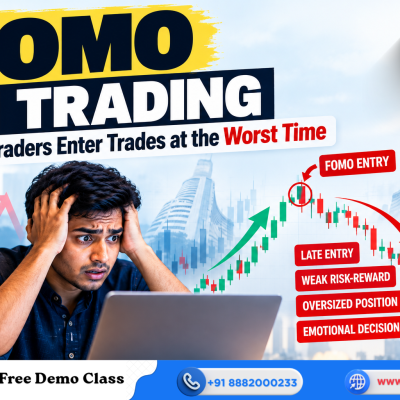
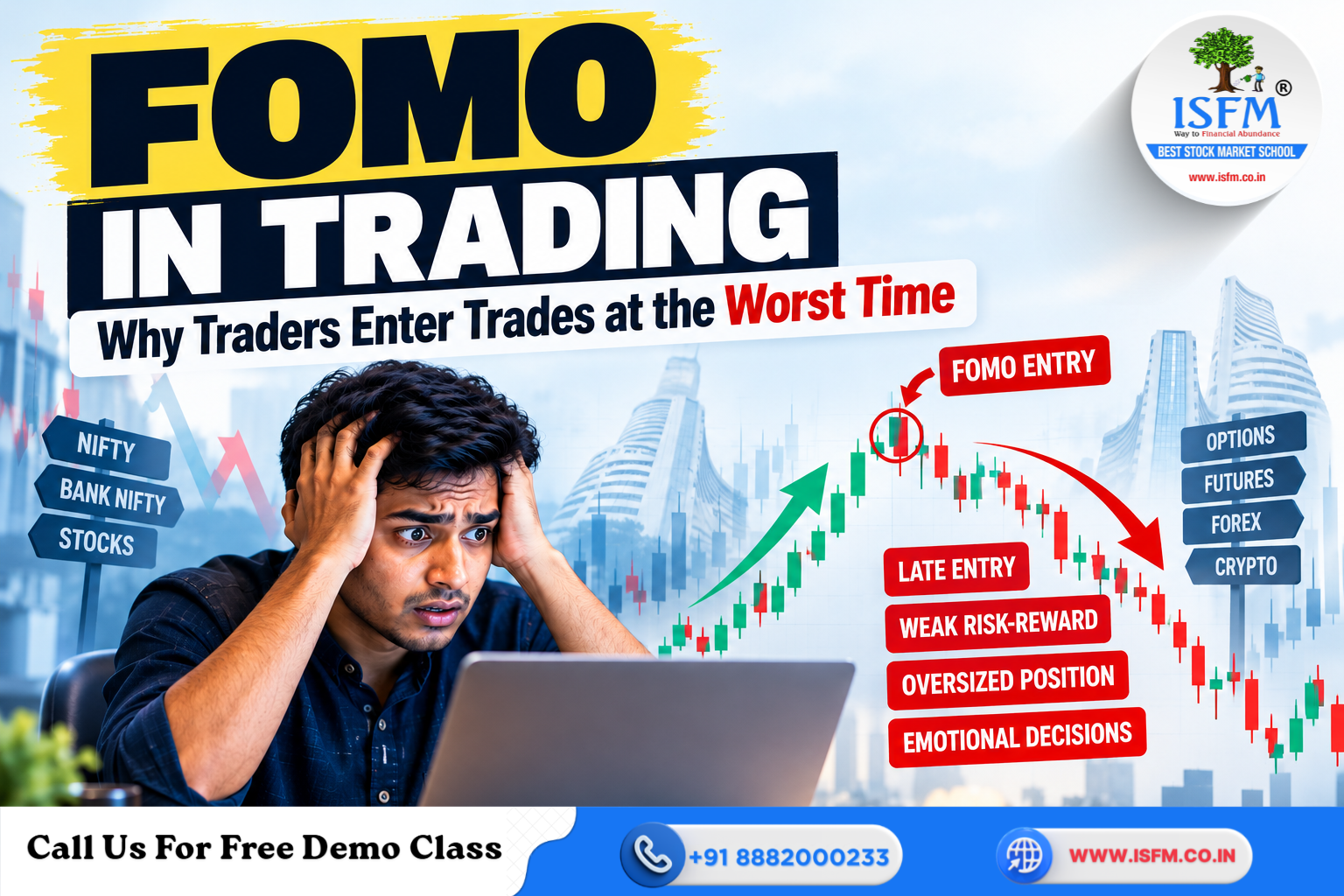
Imagine watching a stock break above resistance. You wait for confirmation, but the price keeps rising. Another strong green candle appears, and you fear missing the opportunity. Finally, you enter near the top. Minutes later, the stock pulls back and hits your stop-loss.
According to Sushil Alewa, SEBI Registered Research Analyst (INH100009433), understanding FOMO in trading helps traders recognise how emotional reactions can lead to late entries, unfavourable risk-reward ratios, oversized positions, and impulsive decisions. However, avoiding FOMO does not guarantee profitable trades, as market volatility, entry timing, liquidity, and risk management also influence trading outcomes.
Why did the trader enter exactly when the probability of profit was lowest?
This is a common example of FOMO in trading. Instead of following a predefined plan, the trader allows the fear of missing a move to control the decision.
What Is FOMO in Trading?
FOMO, or fear of missing out, is the anxiety traders experience when they believe they are about to miss a profitable opportunity. It often occurs during rapid price movements, strong breakouts, major news events, or when social media highlights someone else’s winning trade.
Indian traders may experience FOMO while trading equities, Nifty, Bank Nifty, futures, options, forex, or cryptocurrencies. A losing streak can intensify this feeling because traders may try to recover losses quickly.
FOMO is an emotional reaction rather than a calculated decision. It compresses analysis time and encourages traders to enter before checking whether a setup meets their trading rules.
Why FOMO Leads to Late Entries?
Traders often hesitate when a move begins because they want confirmation. However, as the price continues rising, their fear of missing out becomes stronger than their original caution.
They eventually enter after an extended candle, when much of the immediate price movement may already have occurred. The market can then experience profit-booking, a pullback, or a false breakout.
Consider a stock trading near ₹500 that breaks above resistance at ₹505. A trader waits, but the price reaches ₹520. Fearing that the rally will continue without them, the trader buys at ₹520. If the stock falls to ₹512, the trader faces an ₹8-per-share loss before costs.
The original breakout may have been genuine, but the late entry created an unfavourable risk-reward situation. Learning to identify price structure and confirmation through ISFM’s Technical Analysis Course can help traders develop a more systematic approach to evaluating potential entries.
The Psychology Behind FOMO
A rapidly moving market makes recent candles appear more important than the broader price structure. Traders begin assuming that a rising price will continue rising.
Missing a rally can also feel like losing money, even though no actual financial loss has occurred. This creates urgency to participate at almost any price.
How FOMO Damages Risk-Reward
Late entries can create several problems:
- Reduced reward potential: The price may already be approaching resistance or short-term exhaustion.
- Wider stop-losses: A suitable stop may be far from the entry, increasing potential losses.
- Oversized positions: Traders may increase quantity to compensate for missing an earlier move.
- Emotional exits: Small pullbacks trigger panic, premature exits, or stop-loss changes.
- Unplanned averaging: Traders add to losing positions without a tested method.
Even a correct market prediction can produce a poor trade when the entry price and risk parameters are unfavourable. ISFM’s Options Trading Course can help learners understand how timing, volatility, and option pricing affect trading risk.
Common FOMO Situations in Indian Markets
FOMO can appear when traders chase a large breakout candle in Nifty, buy Bank Nifty options after a sudden spike, or enter futures following a news-driven rally without assessing follow-through.
Others buy trending stocks because an influencer recommends them or jump into an extended cryptocurrency rally after seeing impressive returns posted online.
After a losing streak, traders may take additional trades to recover their losses. They ignore confirmation, abandon position-sizing rules, and chase breakouts without considering the potential downside.
However, not every breakout entry is a FOMO trade. A planned entry that satisfies predefined conditions is different from an impulsive decision driven by urgency.
FOMO and Overtrading
FOMO can turn one missed opportunity into a series of unnecessary trades. A trader misses a breakout, enters the next move impulsively, suffers a loss, and immediately searches for another trade to recover.
This cycle increases transaction costs and can lead to excessive exposure in the same direction.
Learning structured trade management through ISFM’s Advanced Derivatives Course can help traders better understand derivatives risk. Meanwhile, the Algo Trading Course introduces learners to rule-based execution and systematic testing. Neither approach eliminates market risk or guarantees better results.
How to Recognise and Avoid FOMO Trades
Watch for these warning signs before placing an order:
- You feel compelled to enter immediately.
- You are skipping your trading checklist.
- You cannot clearly explain your entry, stop-loss, and target.
- You are increasing position size beyond your normal risk limits.
- You are trading because someone else posted a winning position.
To reduce FOMO, define entry conditions before the session, avoid chasing extended moves, set daily trade limits, and take a break after missing an opportunity. Maintain a trading journal to identify recurring emotional mistakes.
ISFM’s Fundamental Analysis Course can also help investors evaluate businesses using financial information rather than relying solely on market excitement.
What to Do After Missing a Trade
Accept that missing trades is normal. Record the opportunity, identify why you did not enter, and check whether the setup actually met your rules.
If the setup was unclear, waiting may have been the correct decision. If it was valid but you hesitated, review the decision after the session rather than chasing the price.
Wait for the next valid opportunity instead of forcing a replacement trade. Your goal is not to catch every market movement but to follow a repeatable process.
Conclusion
FOMO is dangerous because impulsive decisions can feel rational in the moment. A rapidly rising market creates urgency, but urgency is not evidence of a good entry.
The best defence against FOMO is not a better indicator. It is a clear plan, predefined entries, and the willingness to let a move pass if it does not meet your rules.
Financial Risk Disclaimer: Trading in equities, futures, options, forex, and cryptocurrencies involves significant risk. Leverage can magnify losses. This article is for educational purposes only and does not constitute investment advice or a recommendation to buy or sell any financial instrument.
Frequently Asked Questions (FAQs)
What does FOMO mean in trading?
FOMO means fear of missing out. It occurs when traders enter a market impulsively because they fear losing a potential profit opportunity.
Why do traders enter trades late?
Traders often wait for confirmation and then become anxious when prices move rapidly. This can lead them to chase extended candles without reassessing risk and reward.
How can I avoid FOMO in Nifty and Bank Nifty trading?
Define entry conditions, stop-losses, position sizes, and daily loss limits before trading. Avoid chasing sudden moves and wait for setups that meet your plan.
Is FOMO responsible for overtrading?
FOMO can contribute to overtrading by encouraging unnecessary entries, revenge trading, and excessive position sizes. A trading journal and predefined limits can help identify and control these behaviours.