
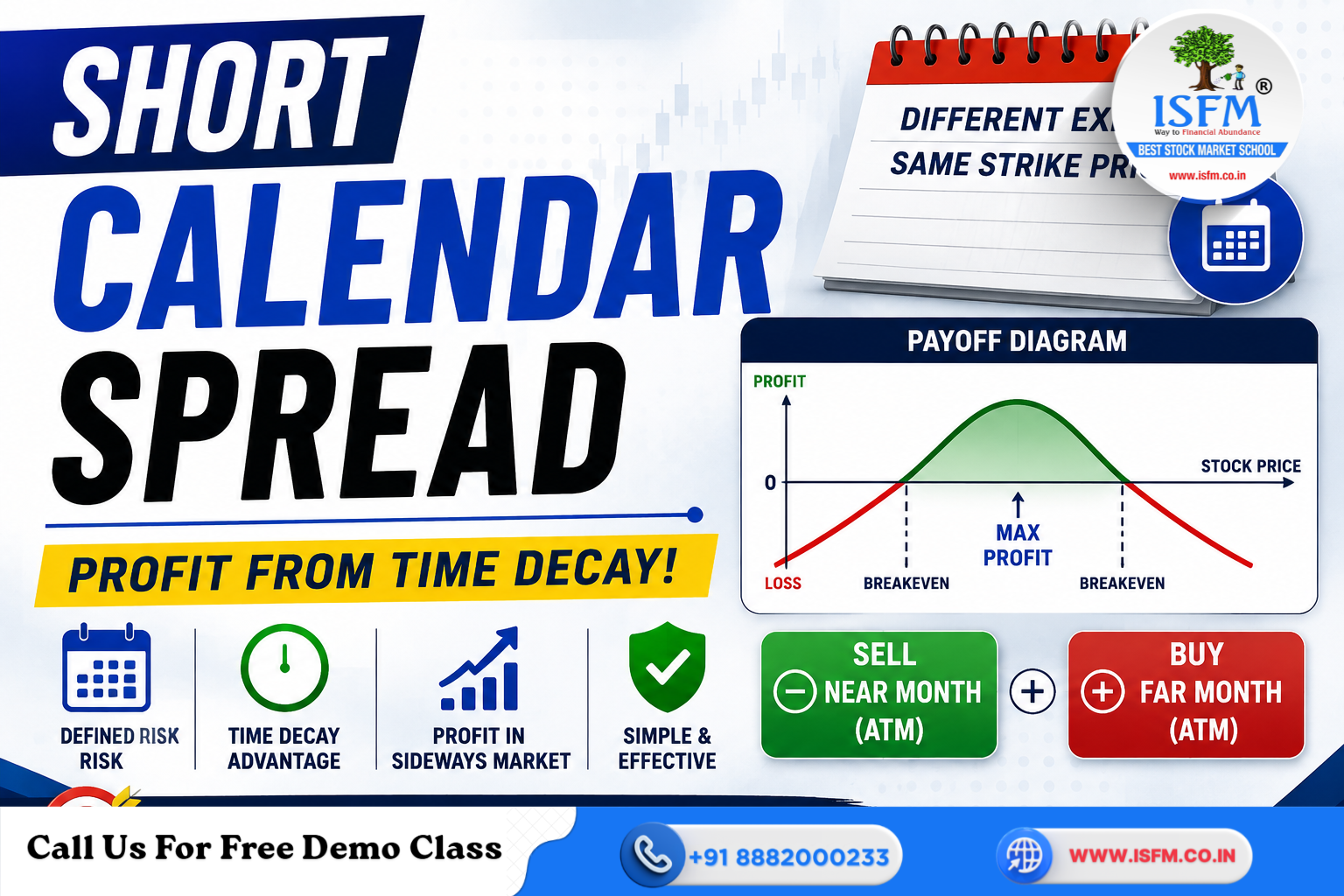
Most options traders are familiar with the long calendar spread, but fewer understand its opposite: the short calendar spread, also called a reverse calendar spread or short time spread.
A short calendar spread is designed for a very different market view. Instead of expecting the underlying to remain relatively stable, traders generally use it when they anticipate a large price move or a decline in far-month implied volatility (IV).
In this guide, we explain the short calendar spread options strategy, its setup, payoff, risks and practical use in Indian markets.
According to Sushil Alewa, SEBI Registered Research Analyst (INH100009433), understanding volatility, expiry dynamics and risk management is essential before using advanced options strategies such as the short calendar spread.
What Is a Short Calendar Spread?
A short calendar spread involves buying a near-month option and selling a far-month option at the same strike price and on the same underlying.
Buy Near-Month Option + Sell Far-Month Option = Short Calendar Spread
Because the far-month option generally carries more time value, the position is typically entered for a net credit.
This is the reverse of a long calendar spread, where the trader buys the far-month option and sells the near-month option.
Traders looking to build stronger options knowledge can explore the ISFM Options Trading Strategy Course, which covers option Greeks, volatility analysis and advanced strategies.
How to Construct a Short Calendar Spread?
There are two common versions:
Short Call Calendar Spread
- Buy 1 near-month call
- Sell 1 far-month call
- Same strike price
- Different expiry dates
Short Put Calendar Spread
- Buy 1 near-month put
- Sell 1 far-month put
- Same strike price
- Different expiry dates
For example, a trader may buy a near-month ATM call with 25 days to expiry and sell a far-month ATM call with 55 days to expiry.
When Do Traders Use a Short Calendar?
The reverse calendar spread trading strategy is generally considered in two situations.
1. Expecting a Sharp Move
The trader expects the stock or index to make a significant move before the near-month expiry.
If the underlying moves substantially away from the strike, the values of the two options can converge, potentially allowing the trader to close the spread profitably.
2. Expecting Far-Month IV to Fall
Implied volatility represents the market’s expectation of future price movement. Far-month options can be sensitive to changes in volatility.
If far-month IV declines significantly, the short far-month option may lose value, potentially benefiting the spread.
Short Calendar Spread Example
Suppose XYZ is trading at ₹100.
A trader creates a short call calendar at the ₹100 strike:
- Buy near-month ₹100 Call = ₹3
- Sell far-month ₹100 Call = ₹6
- Net Credit = ₹3
If XYZ makes a sharp move toward ₹110 or ₹90 before near-month expiry, the trader may be able to close the spread at a profit depending on option prices and volatility conditions.
However, if XYZ remains close to ₹100, the near-month call can lose most or all of its value while the far-month short call retains substantial time value.
Payoff and Risk
The short calendar spread is not a simple low-risk neutral strategy.
Potential gain is generally limited to the initial credit or the amount by which the two option values converge favourably.
The major risk occurs when the underlying remains near the strike. The near-month option may expire with little value while the far-month option still has significant value.
If the near-month option expires and the far-month short option remains open, the trader can effectively be left with a naked short option, creating potentially large risk.
Breakeven levels are dynamic because they depend on the underlying price, implied volatility and time remaining.
Short Calendar vs Long Calendar Spread
| Feature | Long Calendar | Short Calendar |
| Near-month | Sell | Buy |
| Far-month | Buy | Sell |
| Entry | Net Debit | Net Credit |
| Market View | Relatively stable | Large move / volatility change |
| Main Risk | Debit paid | Potentially large |
| Volatility Focus | Time spread | Far-month IV movement |
Understanding this difference is essential when comparing a calendar spread vs reverse calendar strategy.
Practical Tips for Indian Markets
For traders considering options trading strategies in India:
- Prefer liquid instruments such as Nifty, Bank Nifty and liquid F&O stocks.
- ATM or near-ATM strikes can provide cleaner trade dynamics.
- A common structure may use around 20–35 DTE for the near month and 45–60 DTE for the far month.
- Monitor the position closely as near expiry approaches.
- Consider closing the entire spread before near-month expiry to avoid unintended naked exposure.
- Define a profit target and stop-loss before entering.
- Use spread orders where available instead of executing both legs independently.
Understanding price action can also help traders develop a more structured market view. Learn more through ISFM’s Technical Analysis Course.
For additional learning resources, traders can explore ISFM’s Options Trading Study Material, which includes an Options Trading Strategy resource.
When Should You Avoid a Short Calendar?
Avoid the strategy when you strongly expect the underlying to remain range-bound and quiet, particularly around the strike.
It may also be unsuitable if you cannot monitor the position regularly or are uncomfortable with the risk created by the far-month short option.
For a neutral, low-volatility view, a long calendar spread may be more appropriate.
Build Broader Trading Skills
A short calendar spread is only one part of advanced derivatives trading. Traders who want broader exposure to derivatives, technical analysis, risk management and trading strategies can explore ISFM’s Algo Trading Course, which includes options trading, technical analysis and risk-management concepts.
Frequently Asked Questions
1. What is a short calendar spread?
A short calendar spread involves buying a near-month option and selling a far-month option at the same strike price. It is also called a reverse calendar spread.
2. Is a short calendar spread bullish or bearish?
It is not purely bullish or bearish. The strategy is generally associated with an expectation of a significant price move or a favourable change in implied volatility.
3. What is the biggest risk of a short calendar spread?
If the underlying remains near the strike and the near-month option loses its value, the far-month short option can retain substantial value. Holding the position too close to near expiry can create significant or potentially unlimited exposure depending on the option sold.
4. Is a short calendar spread suitable for beginners?
Generally, it is better suited to experienced options traders who understand Greeks, implied volatility, expiry behaviour and position management.
Final Takeaway
According to Sushil Alewa, SEBI Registered Research Analyst (INH100009433),The short calendar spread options strategy is an advanced strategy built around differences in expiry, price movement and implied volatility.
It can be considered when a trader expects a significant move or a decline in far-month IV, but it comes with meaningful risk if the underlying remains near the strike and the position is not managed correctly.
The key lesson is simple: Expect stability? Consider a long calendar. Expect a major move or far-month IV contraction? A short calendar may fit the view—but risk management is essential.
For traders who want a broader foundation across equity, derivatives and trading strategies, ISFM also offers a Stock Trading Course.