
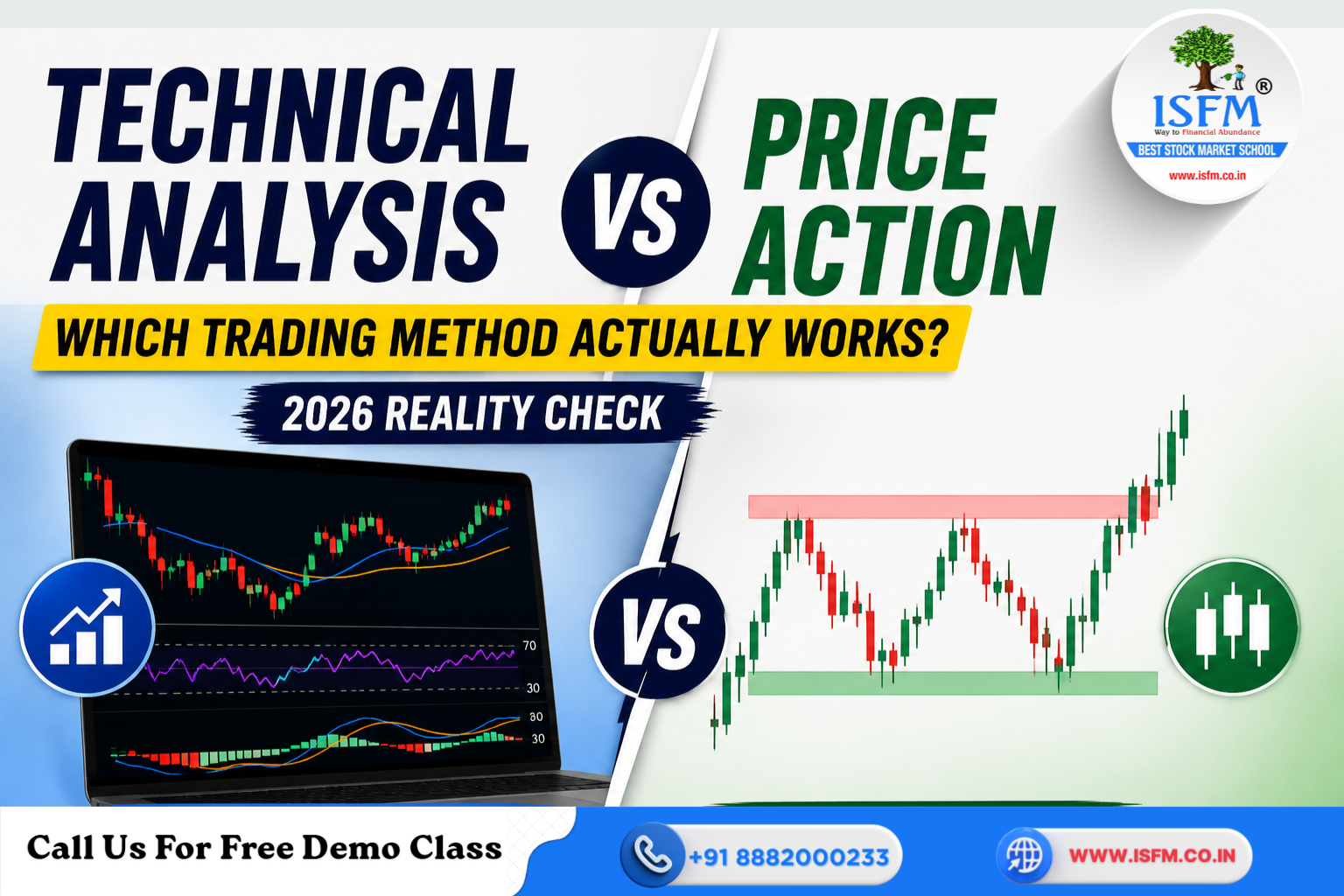
Open any trading YouTube channel or forum and you will find the same debate: “Indicators are useless—only price action works” versus “You need technical indicators to trade properly.”
The reality is much more practical.
Both technical analysis and price action are tools for understanding markets and making better trading decisions. The real question is not which method is magical, but which approach fits your trading style and how you use it.
According to Sushil Alewa, SEBI Registered Research Analyst (INH100009433), successful trading is less about finding a perfect indicator or pattern and more about developing a repeatable process supported by discipline, risk management and continuous learning.
What Is Technical Analysis?
Technical analysis uses price, volume and mathematical indicators to identify market trends, momentum and potential trading opportunities.
Popular indicators include:
- Moving Averages
- RSI
- MACD
- Bollinger Bands
- Stochastic
- ADX
- VWAP
For example, a trader might use a 20 EMA and 50 EMA to identify a trend and RSI to assess momentum.
Indicators can make trading rules more structured and easier to backtest. However, most indicators are calculated from historical data, meaning many signals can lag behind price.
For traders who want to build a stronger foundation, explore ISFM’s Technical Analysis Course.
What Is Price Action Trading?
Price action trading focuses primarily on what price itself is doing rather than relying heavily on indicators.
Traders study:
- Candlestick patterns
- Support and resistance
- Breakouts
- Pullbacks
- Higher highs and higher lows
- Lower highs and lower lows
- Market structure
For example, instead of waiting for an RSI signal, a price-action trader may watch how price reacts when it reaches an important support level.
Price action can provide a cleaner chart and more immediate market context, but it is also more subjective. Two traders can look at the same chart and interpret it differently.
Technical Analysis vs Price Action
| Factor | Technical Analysis | Price Action |
| Main Focus | Indicators + price | Raw price movement |
| Signals | Rule-based | Context-based |
| Learning | Easier initially | Requires practice |
| Charts | More indicators | Cleaner charts |
| Subjectivity | Lower | Higher |
| Backtesting | Easier | More difficult |
| Best Fit | Systematic traders | Discretionary traders |
Where Technical Indicators Work Well
Technical indicators can be particularly useful for trend identification, momentum confirmation and systematic trading.
For example:
- Moving averages can help identify trends.
- RSI can indicate momentum conditions.
- MACD can help analyse trend and momentum.
- VWAP can help intraday traders assess price relative to the session’s average traded level.
Another advantage is that indicator-based strategies can often be converted into clear rules and backtested.
The problem begins when traders put five or ten indicators on one chart. Conflicting signals can create confusion rather than clarity.
Where Price Action Works Well
Price action can be useful when traders want to understand market structure and behaviour around important levels.
It can help traders identify:
- Breakouts
- Rejections
- Pullbacks
- Support and resistance
- Changes in momentum
The major advantage is context. Instead of asking only what an indicator says, the trader asks:
“What is price actually doing here?”
The limitation is that price action requires experience. Seeing a candlestick pattern does not automatically make it a valid trade.
So, Which Trading Method Works Better?
The honest answer is: both can work. Neither is a guaranteed money-making system.
A profitable strategy depends on much more than the method itself:
- Risk management
- Position sizing
- Stop-loss discipline
- Trading psychology
- Market conditions
- Strategy testing
- Consistency
A trader with an excellent indicator but poor risk management can lose money. Similarly, someone who understands price action but takes random trades can also fail.
This is why many experienced traders use a hybrid approach.
For example:
- Price Action → Identify Level & Setup
- Indicator → Confirm Trend/Momentum
- Risk Management → Define Entry, Stop & Target
Which Method Should Beginners Choose?
Choose indicator-based technical analysis if you prefer clear rules, structured systems and eventually want to backtest or automate strategies.
Choose price action if you enjoy reading charts, understanding market behaviour and making context-based decisions.
A practical middle path is to use price action as the foundation and only one or two indicators as confirmation.
If you are interested in combining technical analysis with derivatives strategies, you can explore ISFM’s Options Trading Strategy Course.
Traders interested in systematic and automated strategies can also explore the Algo Trading Course.
Common Mistakes Traders Make
Indicator Traders
- Using too many indicators
- Taking every signal blindly
- Constantly changing indicator settings
- Ignoring market context
Price Action Traders
- Finding patterns everywhere
- Forcing trades
- Ignoring larger trends
- Becoming overconfident after a few successful trades
In both cases, poor risk management is often a bigger problem than the choice of method.
Frequently Asked Questions
1. Is price action better than technical analysis?
No method is automatically better. Price action and indicator-based technical analysis can both be useful when applied with proper risk management and a tested process.
2. Is technical analysis suitable for beginners?
Yes. Indicators can provide beginners with structured rules, but traders should first understand what an indicator measures instead of blindly following signals.
3. Can I use price action and indicators together?
Yes. A practical approach is to use price action for market structure and entries, while using one or two indicators for confirmation.
4. Which is better for intraday trading?
Both can be used for intraday trading. The better choice depends on the trader’s experience, strategy, time frame and ability to manage risk.
Final Takeaway
Stop searching for the “holy grail” of trading.
According to Sushil Alewa, SEBI Registered Research Analyst (INH100009433), Technical analysis and price action are simply different ways of reading the market. What matters more is whether you understand your method, can apply it consistently and have a strong risk-management framework.
Don’t ask, “Which method works better?”
Ask: “Which method fits my personality, trading timeframe and risk tolerance—and how can I turn it into a simple, repeatable process?”
That is where a genuine trading edge begins.