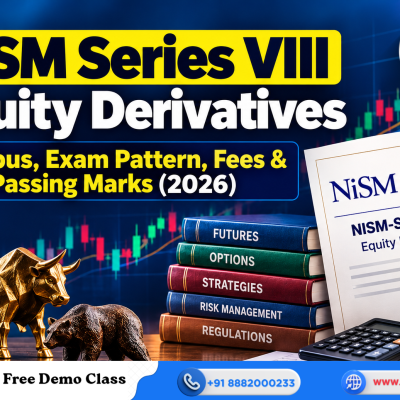
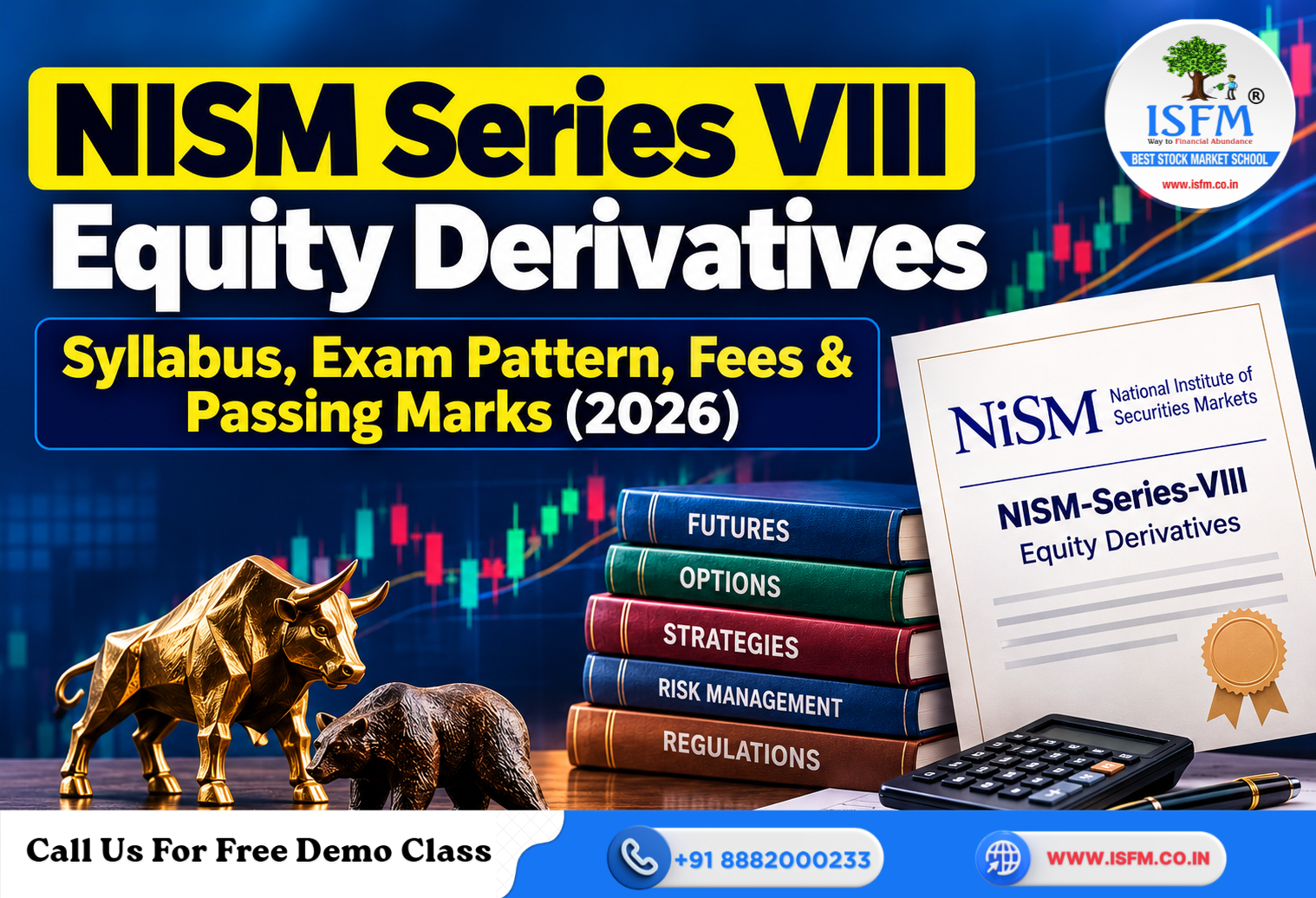
If you want to build a career in equity derivatives, stock broking, trading, dealing, or capital markets, the NISM-Series-VIII: Equity Derivatives Certification Examination is one of the important certifications to understand.
The examination is designed to create a common minimum knowledge benchmark for approved users and sales personnel associated with equity-derivatives trading members. It is also open to interested students, professionals and other individuals who want to strengthen their understanding of futures and options.
In this guide, we explain the NISM Series VIII syllabus, exam pattern, fees, passing marks, negative marking, certificate validity, and preparation strategy and career relevance in 2026.
What Is NISM Series VIII Equity Derivatives?
NISM Series VIII: Equity Derivatives is a certification examination conducted by the National Institute of Securities Markets (NISM).
The examination focuses on the practical and conceptual aspects of the Indian equity derivatives market, including:
- Futures
- Options
- Index derivatives
- Trading mechanisms
- Option strategies
- Clearing and settlement
- Risk management
- Regulatory framework
- Accounting and taxation
- Investor protection
According to NISM, the examination is intended to help candidates understand equity derivatives products, trading strategies, clearing and settlement mechanisms, associated risks and the regulatory environment.
NISM Series VIII Exam Pattern 2026
The NISM Series VIII examination follows a relatively straightforward structure, but negative marking makes accuracy important.
| Particulars | Details |
| Examination | NISM-Series-VIII: Equity Derivatives |
| Mode | Computer-Based Examination |
| Questions | 100 |
| Maximum Marks | 100 |
| Marks per Question | 1 |
| Duration | 2 Hours |
| Passing Score | 60% |
| Passing Marks | 60/100 |
| Negative Marking | 25% of marks assigned to the question |
| Exam Fee | ₹1,500 + applicable payment gateway charges |
| Certificate Validity | 3 Years |
These details are based on NISM’s current examination information available for 2026.
How Does Negative Marking Work?
Each question carries 1 mark and an incorrect answer attracts a penalty of 0.25 marks.
For example:
- 70 correct and 20 incorrect = 70 − 5 = 65 marks
- 65 correct and 20 incorrect = 65 − 5 = 60 marks
- 60 correct and 10 incorrect = 60 − 2.5 = 57.5 marks
Therefore, simply attempting a large number of questions does not guarantee success.
Accuracy is more important than blind guessing.
NISM Series VIII Passing Marks 2026
The minimum passing requirement is 60%.
Since the examination carries 100 marks, candidates need at least: 60 marks out of 100 to pass the examination. NISM also applies 25% negative marking for incorrect answers.
A Practical Target Score
Although 60 marks is the official passing score, candidates should ideally target 75–80+ marks in mock tests before appearing for the examination.
Why?
Because a mock-test score of 60 leaves very little margin for:
- Calculation mistakes
- Misreading questions
- Negative marking
- Confusing similar concepts
- Unexpected questions
Aiming above the minimum passing score provides a useful safety margin.
NISM Series VIII Syllabus 2026
The NISM Series VIII syllabus covers 10 major units. The curriculum includes the fundamentals of derivatives as well as practical areas such as futures, options, trading, clearing, settlement, regulations and investor protection.
Unit 1: Basics of Derivatives — 8%
This section establishes the foundation of the examination.
Important areas include:
- Meaning of derivatives
- Evolution of derivatives markets
- Indian derivatives market
- Market participants
- Types of derivatives markets
- Importance of derivatives
- Risks associated with derivatives
Real-Life Example
Suppose an investor owns shares of a company worth ₹10 lakh and is worried that the market may decline.
Instead of immediately selling the entire portfolio, the investor may use derivatives to hedge some of the downside risk.
This demonstrates one of the key purposes of derivatives: risk management.
How to Prepare for NISM Series VIII
1. Start With the Official NISM Workbook
The official workbook should be your primary preparation source.
NISM provides study material associated with the examination and also provides access to study material through its certification resources.
2. Prioritise High-Weightage Chapters
A smart preparation strategy should allocate more time to:
Forwards & Futures → Options → Regulatory Environment → Clearing & Settlement → Basics
The two largest units alone—Futures and Options—account for 50% of the published syllabus weightage.
3. Practise Calculations
Do not only read formulas.
Practise questions involving:
- Futures pricing
- Profit and loss
- Option premium
- Intrinsic value
- Payoffs
- Break-even
- Margin-related concepts
4. Understand Payoff Diagrams
Payoff diagrams can make options much easier to understand.
For every major option position, ask:
- What happens if the market rises?
- What happens if the market falls?
- What is the maximum profit?
- What is the maximum loss?
Where is the break-even point?
This approach is generally more useful than memorising definitions.
Final Verdict: Is NISM Series VIII worth It in 2026?
Yes, particularly if your career or learning objective is connected with equity derivatives.
The certification offers a structured foundation covering the complete lifecycle of derivatives—from understanding futures and options to trading, clearing, settlement, risk management and regulation.
The key numbers to remember are:
₹1,500 Fee | 100 Questions | 100 Marks | 120 Minutes | 60 Marks to Pass | 25% Negative Marking | 3-Year Validity
The most important preparation areas are Futures, Options, Regulatory Environment, and Clearing & Settlement.
For a serious stock-market learner, the real value of NISM Series VIII is not simply obtaining a certificate. It is developing the ability to understand how derivatives work, how risk is transferred or managed, and how futures and options are actually used in the Indian securities market.
Inspired by this story? Learn to trade the markets yourself
Join a Free Demo Class in Live Market Trading at ISFM – 16+ years of experience, 30,000+ students trained. Leave your details and our counsellor will call you.
Prefer to talk now? Call +91 88820 00233 or WhatsApp us