October 19, 2022

Blog, Stock Market

Career in Stock Market- SGT Gurgaon Seminar by ISFM

Succesfully conducted Seminar in SGT University Gurgaon. Seminar Title   : ” Career in Stock Market ”Key Speaker     : Sushil Alewa from ISFM – GurgaonKey Speaker     : Mr. Sukumaran from – NISM – MumbaiAudience           : MBA, M.Com & BBA studentsVenue                 : SGT University Gurgaon, Haryana Note : To get the ppt of this seminar kindly find the link below this post :– International School of Financial Market – ISFM organize a seminar on “Career in Stock Market ”  in SGT University Gurgaon, for Management students. ISFM invite NISM’S Dean Mr. Sukumaran Sir to aware the students and faculty members of SGT on this topic. Participants show massive response to make career in the field of financial market.Mr. Sukumaran sir explain golden rules of investment for beginners and nitty gritty things of the securities market and what has been changed in last 25 years in our country. How a beginner investor can start investing by a little amount of money every month. Students also get informed by Sushil Alewa how NISM Certification  can help them to boost their career in securities market with easy placement. Some important certification features also has been explained during seminar. Eco Reforms& Indian Securities Market

Blog, Stock Market

Hero Moto Corp – Gurgaon Seminar on -Investment Awareness

SEBI’S Seminar in Hero Moto Corp, Gurgaon on “Alternatives of Investment for Investors”  Seminar Title : ” Alternatives of Investment for Investors ” Key Speaker   : Sushil Alewa from ISFM – Gurgaon Key Speaker   : Mr. Devinder Singh from – UTI MF Audience      : Managers, Sr. Manager, Dept. Heads Venue         : Hero Moto Corp, Sec -34, Gurgaon, Haryana Note :  To get the advance  ppt on Mutual Fund analysis and Myth  kindly find the link below this post :- SEBI organize a session in Hero Moto Corp Gurgaon, Haryana on “Alternatives of Investment for Investors”. Mr. Sushil Alewa from ISFM, Stock Market School Gurgaon has clear all the myth about the securities market and explain how to start investment from a little amount of the money in life. Mr. Devinder Singh from UTI mutual fund explain importance of the mutual fund in our life and how we can get big return using little SIP in life. Audience show enthusiasm to start the investment but also explain how difficulties they are facing in life during starting of investment without knowledge. Everyone thanks to SEBI for such kind of informative session.  UTI  Hero  Motocrop  Gurgaon ppt

Blog

How to be a SEBI Reg. Investment Advisers

What is SEBI Advisers Act 2013 ? How to Enroll for SEBI’s Certification ? What is SEBI Investment Advisers  Act  2013 ? SEBI has mandated to all the agents who are working in financial market that they must have the minimum standards of knowledge before giving advise to the clients. Although insurance and pension agents are not falling in this category. If you will check out of India like UK or others developed nations  there is  RIA model applicable to sell / advise in the financial market. But it is dilemma of our country that agents who are selling financial products to us they are not well educated, mature to give the advices.  Even they oneself  don’t have the deep knowledge about the product. As per this act agent and financial advisers must be two person. A person who has became the financial advisor he / she can get the advisory fee from the client but can not became a agent of any intermediaries. SEBI Notification for RIA                    How to Enroll for SEBI RIA Certifications : SEBI’s having a sister concern name NISM which is taking care of all the securities market education in India. NISM has launch his own certification at different levels. Any one who want to be a part of the securities market can grab that certification according to the requirement and can legally  work . SEBI RIA Certification FAQ            SEBI RIA Certification : There are  two way to get  these certifications : NISM Certifications NISM-Series-X-A: Investment Adviser (Level 1) NISM Series-X-B: Investment Adviser (Level 2) NISM accredited Certifications: CIEL  Advance Wealth Management Certifications AAFM wealth Management Certifications CFP course by FPSB India Chartered Institute for Securities and Investment Click here for online registration:- To know more about these certification & enrollment  fill inquiry form we will get back you.

ISFM
Blog, Stock Market

What is Bank Nifty in Stock Market ?

Most popular strategy to trade in Bank Nifty ? Bank Nifty is an index which is representing the banking sector in Nifty. It is comprises of top 12 banking stock of stock market. Bank nifty calculated on free float market capitalization in the market. Now a days Bank Nifty in most volatile index in our country which is favorite among traders. Brief details of Bank Nifty are giving below :- Index Name  Bank Nifty Current Market Price 25000 as on dated 4th Oct. 2018 Date of Inception 15th September 2018 Base Value 1000 as on Jan 1, 2003 Expiry Monthly and Weekly 5 Years Return 19.55 % Total Return (Since Inception) 21 % PE Ratio 58 Total no. of Bank 12 Banks Lot Size 40 Margin Required 10% Approx. Daily Movement Expected 1% to 2% Average. Means 250 to 500 points Bank Nifty Weight-age by Banks : HDFC Bank Ltd. 33.27 ICICI Bank Ltd. 17.29 Kotak Mahindra Bank Ltd. 13.48 State Bank of India 9.11 Axis Bank Ltd. 8.77 IndusInd Bank Ltd. 7.64 Yes Bank Ltd. 4.97 RBL Bank Ltd. 1.84 Federal Bank Ltd. 1.26 Bank of Baroda 1.14 How to trade in Bank Nifty :- Bank Nifty is a derivatives contract so first you need to activate F&O segment in your demat a/c. Trader ensure that minimum 2 lakh should be in your portfolio before trade so that if  you  face MTM pressure your position would be safe. We frequently can buy sell the nifty as per signal given by the technical analysis. Bank nifty trading strategy  for intraday and deliver are based on the news also because whenever  the RBI change the interest rate in the country it react a lot due to direct connectivity of the banking sector to the interest rate. So we have to keep eye on monetary policy of RBI time to time. Bank Nifty also have huge volume in option trading. Because of the weekly expiry trader are always attractive towards to the bank nifty options. Traders are getting nice opportunity every week because its easy to arrange cash flow for one week rather than a month. Bank Nifty Trading Strategy :- If the volatility is high :- Long Strangle Short Call butterfly If the volatility is low Short Strangle Long Call butterfly Note:  Use stop loss always in Bank Nifty Trading because it is high volatile index and simultaneously check open interest time to time of current month future contract. Risk and reward ratio must be 1:4 in bank nifty and but in certain condition it can not go below 1:2 level. Disclaimer :  Post is only for education purpose kindly invest at your own risk with expert advise.

ISFM
Blog, Stock Market

Top 25 Mutual Fund terms you must know

 Mutual Fund is a panacea for all the investors who don’t have the these top 3 investment traits : Don’t have enough fund to invest in stock market Don’t have enough time to study the market Don’t have enough knowledge to understand the market Indian Mutual fund industry in growing very fast and as of now total 25 Trillion AUM having with 43 AMC from top 30 cities of India. Thanks to all doctor, engineers, lawyer’s, teachers and other professional due to their SIP, Mutual fund market is now 12.5% of the GDP. Although it is low as compare to the developed nation but it will cover all the deficiency very soon in future. SEBI and AMFI is also doing endless efforts to make Mutual Fund transparent and easy but still now a common man is not able to understand pros and cons of the fund. So here ISFM – Stock Market training institute in Gurgaon trying to make easy to the Mutual fund terminology. Net Assets Value means unit price of the Mutual Fund. It can be calculated with total Assets / total no. of units AMC :  Assets Management Company which manage the capital of the Investor. The role of the AMC is to manage investor’s money on a day to day basis. Thus it is imperative that people with the highest integrity are involved with this activity. AMFI:– All India Mutual Fund Association is a association of the mutual fund amc. It is not constitutional authority by its play a significant role to regulate the market apart from SEBI. ARN Holders : AMFI issue a unique number to every agent who want to sell the mutual fund in the market. First person have to clear NISM distributor certification then can approach to the AMFI. NFO :-  New Fund offer by a mutual fund company to the investors. AMC launches new schemes, under the name of the Trust, after getting approval from the Trustees and SEBI. The launch of a new scheme is known as a New Fund Offer (NFO) Folio no. : Folio number like a bank a/c which is used to keep the mutual fund in electronic form. Offer Documents : Official detailed information about mutual fund given by sponsor. The investor must read the Offer Document (OD) before investing in a mutual fund scheme. KIM : Key information Memorandum is small document which provide snapshots of the important information to the investor in a brief view. Open Ended Fund :-  open ended scheme allows the investor to enter and exit at his convenience, anytime except under certain conditions. Close Ended Fund : Close ended scheme don’t allow the investor to enter or exit any time but they give some lock in period to the investor. Total AUM :- How much fund manager have the total amount collected by all the investors in his scheme called AUM. Load :  Load means Charges to entry or exit in mutual funds. There are two kind of charges Entry load : When u invest in Mutual fund then you have to pay some amount to the AMC but from 2009 itself it is free of cost in India.  Exit load : When a investor sell the mutual fund the he have to pay few charges to the AMC called exit load. For example, Suppose you are selling a fund of 50000 Rs and exit load is 1% then you have to pay 500 rupees being a brokerage. Expenses Ratio : It is a Annual fee charge by fund master to the investor to manage the fund of the investor. Now a days SEBI is trying to reduce the fee from 2.5% which is maximum slab from 1% so that investors can get relief. Portfolio : – Where the fund master have investment the money of the investors.  As per rule of the SEBI Mutual fund manager must have to show his portfolio to the public on his website so that investor can know where he has invested.  Portfolio Turnover:- It is define as ‘Lesser of Assets bought or sold/ Net Assets’. A scheme with Rs. 200 cr as net assets sells Rs 40 cr of its investments. Thus its Portfolio Turnover Rate would be 40/ 200 = 20%. If this scheme’s net assets increase to Rs. 220 cr and the fund manager decides to churn the entire portfolio by exiting all stocks, then the Portfolio Turnover would be 220/ 220 = 100% CAGR : Compounding Annual Growth return of the Fund year on year, its showing actual growth of the fund in the market. Churning : How a fund manger can switch his portfolio from one securities to other securities time to time.  Even there is no cap how many time a fund manager can switch but they generally use value investing strategy for investment. Rating of Mutual fund : How credit rating company giving him rating after checking his position in the market. Although now a days it is not a matter of proud for anyone Fund of Fund :  When a investor invest his fund in a others mutual fund special to the foreign funds then it called fund of fund.  ELSS Scheme : Equity Linked Savings Schemes (ELSS) are equity schemes, where investors get tax benefit upto Rs. 1.5 Lakh under section 80C of the Income Tax Act Redemption : When investor sell his mutual fund to the AMC not to the other investor called redemption. The redemption  NAV would be the latest NAV of yesterday. 22. Indexation Benefits: Indexation is a procedure by which the investor can get benefit from the fact that inflation has eroded his returns. 23. LTCG on MF:Long term capital gain tax is applicable on mutual fund now a days, but it is free up to 1 lakh rupees within a financial year. If you are earning more than 1 lakh you have to 10% if you redeem. 24. CAN number: Common A/c number is a unique number provided by the MF utilities to invest in direct plan of mutual  at one place. It is provided after opening a/c on mfuindia. We can bring all the investment under one roof.

ISFM
Blog, Stock Market

How Wipro 100 Share grow your wealth to 3.84 Crores

Stock Market is full of example where your wealth multiplied by stocks with the passage of time. Wipro is one of them. Before study the case  we need to know few things about Wipro: Suppose you have purchase the stock in 1990 at 10 Rupees and bought 100 Shares. Wipro is giving bonus to its shareholder and quantity of the share increasing with passage of time. After investment in Wipro you have hold the share like other assets and didn’t sell till 27 years ( 2017) Bonus Details of the Wipro :       1990: 100 shares        1992: 200 shares (1:1 bonus on 12-08-1992)        1995: 400 shares (1:1 bonus on 24-02-1995)        1997: 1,200 shares (2:1 bonus on 20-10-1997)        1999: 6,000 shares (5:1 split on 27-09-1999)        2004: 18,000 shares (2:1 bonus on 25-06-2004)        2005: 36,000 shares (1:1 bonus on 22-08-2005)        2010: 60,000 shares (2:3 bonus on 15-06-2010)        2017: 1,20,000 shares (1:1 bonus on 13-06-2017) Note :  Finally 100 Wipro Share has been converted 120000 at the end of 2017 Value appreciated at the end of 2017 Total no. of Share : 120000 Price as on 29th Dec 2017 : 320 Total Value : 120000*320 = 3.84 Crore Dividend is also a Tax free income up to 10 lakh per year : Now hope you are clear about Why to invest in to Stock Market : We are also giving few more reason to think : Liquidity Flexibility of amounts invested Operated under high level of regulatory framework to safeguard investor rights Technology based Investment High return Capital growth Dividend   Annual dividend per share by WIPRO for last 4 years– 2014: Rs 8.00 2015: Rs 12.00 2016: Rs 6.00 2017: Rs 4.00 Note : Please don’t forgot you have 1.20 lakh share of Wipro and you are getting dividend accordingly.

Blog

Top 5 Facts about Indian Stock Market

Stock Market is very interested and full of mystery in this world. Only few people have understanding how market behave in a certain circumstances or a particular event. People are coming here to check their fate but in real it is battle ground rather any lucky chance.But everyone who have dream to became a crorepati in life or wan to create the empire of the wealth must try to understand that it is best place in the world to earn passive income. ISFM – Best Stock Market School, have collected top 5 interested fact about Indian Stock Market which is give you surprise, motivation about investment world. 1. Total no. of listed companies in India is more than 5000. Which is the highest number in the world. 2.  Total no. of Demat in India is 3.38 lakh as on Sept. 2018 as per SEBI bulletin of Nov. 2018NSDL have 177 lakh and CDSL have 161 lakh account.Mumbai is having maximum no. of Demat account Gujrat is the second one. 3. Indian Software giant Tata Consultancy company market capitalization is more than the whole company listed in Karchi Stock Exchange. TCS market cap is 6 lakh crore or $ 100 billion which is more than GDP of 128 country in this world. There are 559 stocks are listed on Pakistan Stock Exchange which value is $ 80 Billion and TCS alone is $ 100 billion more than 25% of all. 4. Mumbai city is alone having 60% turnover of the Indian Stock Market. 5. Total no. of  Mutual fund folio in India is Only 8 Cr.out of 132 Cr. population as of 31st Oct. 2018.Indian mutual fund market assets under management is 25 lakh cr. which 12 % of our total GDP of India $ 2 trillion. Conclusion : Indian Stock market is showing a lot of potential for growth. It is only starting phase where only few intellectual people are sought for investment. The real phase is remaining where everyone will invest like in banks products. So big think and think first.

Stock Market

Major Stock Exchange in the world

What is Stock Exchange:-Stock Exchange is a platform where listed securities are traded. Investors who want to buy and sell the shares put their orders online and when orders match with price and quantity executed. India have 2 major stock exchange in Equity segment name NSE & BSE. Stock Exchange are pvt entity promoted by corporate players, mnc companies etc. There are two kind of method where stock are working the first one is equal share for all companies in index calculation. Second is as per the market capitalization of the companies. Indian Stock exchange are using market capital formula to calculate the exchange level.National Stock `Exchange is running a index name Nifty which is computing on top 50 companies in the market. TCS is the biggest one having market cap of more than 7 lakh crores that is equal to whole companies register in Karachi stock exchange. Bombay Stock Exchange is running Sensex as a index which is calculating on behalf of the top 30 companies. Sensex is a oldest stock exchange in Asia and top in no. of listed companies in the world.Stock exchange around the world is working approx 06:30 hours in all country. ISFM – Best Stock Market School have collected list of major stock exchange opening and closing time as per Indian Standard Time zone. Only few stock exchange having lunch time during trading hours.

Blog

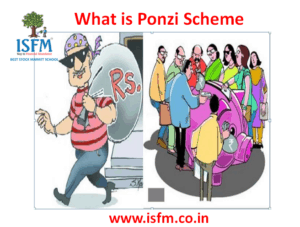
What is Ponzi Scheme & How its work in market

How Ponzi scheme work to earn money ? How to save yourself from fraudulent scheme. What SEBI rules & regulation for Ponzi scheme. Ponzi schemes are the fraudulent activities to collect the money from investor without getting approval from the regulators. The scheme promoter pretend to investor that he is running a registered company but in real life he did not get approval from anyone like : RBI, SEBI, IRDA, PFRDA etc. He just lure the investor to provide  high return on the capital and innocent investor give money to them. Promoter of the scheme also give some money back the the person who helps them to get more clients for the scheme. How Ponzi Schemes popular in the  World : – Ponzi scheme is named after Mr. Charles Ponzi use money making techniques by giving 50% return promise to the investor in 1920. He promised clients a 50% profit within 45 days, or 100% profit within 90 days, by buying discounted postal reply coupons in other countries and redeeming them at face value in the United States as a form of arbitrage.In reality, Ponzi was paying earlier investors using the investments of later investors. While this type of fraudulent investment scheme was not originally invented by Ponzi, it became so identified with him that it now is referred to as a “Ponzi scheme”. His scheme ran for over a year before it collapsed, costing his “investors” $20 million. Ponzi may have been inspired by the scheme of William F. Miller, a Brooklyn bookkeeper who in 1899 used the same scheme to take in $1 million. Source :- Wikipedia How Ponzi Schemes Work to make money :-  Ponzi scheme also known as – collective investment schemes (CIS). What is CIS Scheme  as per SEBI regulation: – Any scheme or arrangement which satisfies the conditions referred to in sub-section (2) or (2A) shall be a collective investment scheme. “(2) Any scheme or arrangement made or offered by any person* under which,— (i)  the contributions, or payments made by the investors, by whatever name called, are pooled and utilized for the purposes of the scheme or arrangement;- (POOLING OF CONTRIBUTIONS) (CONTRIBUTIONS WITH A  VIEW  TO RECEIVE PROFITS (SCHEME PROPERTY IS MANAGED ON BEHALF OF INVESTORS) (INVESTOR HAS NO CONTROL OVER DAY -TO – DAY MANAGEMENT/OPERATIONS (2A)* – “Provided that any pooling of funds under any scheme or arrangement, which is not registered with the Board or is not covered under sub-section (3), involving a corpus amount of one hundred crore rupees or more shall be deemed to be a collective investment scheme”.             *inserted by The Securities Laws (Amendment) Act, 2014 What is the Nature of Ponzi Schemes :- Plantation Food Processing Dairy Farming & Livestock Hotel and Resorts FMCG sectors Information Technology Which schemes are exempted from PONZI / CIS by law :- Co-operative society registered under the Cooperative Societies Act,1912 NBFC as defined in clause (f) of S.45-I of the RBI Act,1934 Contract of insurance to which the Insurance Act, 1938 applies Any scheme, Pension Scheme or Insurance Scheme under Employee Provident Fund and Miscellaneous Provisions Act, 1952 Deposits u/s 58A of the Companies Act, 1956 Chit business as defined in clause (d) of Section 2 of the Chit Fund Act, 1982 Nidhi or a Mutual Benefit Society u/s 620A Companies Act ISFM Recommendation:- Investors should not belive in such kind of scheme, and never give money to anyone agent who belongs to PONZI activities. If anyone want to know about weather the scheme is valid or not then you can call to the SEBI helpline number which are 1800227575, 1800267575 to know exact information. We must use  govt authorized scheme for investment and tax planning. Please note :  Only one scheme is registered as a CIS with SEBI, name GIFT but the scheme never work. October 2008 – GIFT Collective Investment Management Company Ltd. a joint venture between Gujarat Urban Development Company and IL& FS


Blog, Stock Market

Top 10 ways to earn from stock market

How to Earn from Stock Market ? Top 10 ways to earn from stock market ? Stock Market is a ocean of money.  It is favorite destination for those who want to create passive income source for long term. Everyone in this world wants easy money in his / her life. Some people believe in miracles, lottery, gambling etc. But these things happen only in movies or in dreams not in real life. We in our country very often hear that stock market is a gambling its not work in real life. If anyone have the passion about the market then his near and dear demotivate him by showing so many drawback of market, they never show the positive side of this business. If you just Google, total no. of billionaire in this world and how they earned money in life. You will find USA is on top, second is Europe then UK and China. You will surprise that most of them have earned money from stock market especially from “Hedge Fund”. So how this things can be wrong in India. If you will check the list of Indian billionaire then you will surprised to know that everyone have the participation in the stock market directly or indirectly. If you also want to earn the money from stock market you have to know top 10 ways to earn from stock market: – Your investment must be 40% to entire life in financial assets rather than physical assets. Mostly people fails to identify who they are ? A Trader or Investor. You must be decide first then you can invest in to the market. There are two way to analyze the stock market, first one is Fundamental Analysis and second one is technical analysis. If you are investor then you choose first one and if you are a trader choose second one. Stocks is like your friends, So always work with limited number of stocks not more than 10 -15. Because in real life your good friends list can not exceed more than this. Always check fours point to trade in stock for better profitability in short term :  Volume, Price Movement, Volatility and Trend. Your portfolio must be well diversified as per the market trend but it should not be broad diversified. You can add five to six sectors in you portfolio. You must be know the business of company, products, promoter and financial health before buying the stock in your portfolio. If you want to know the minimum check point of the stock you can download portfolio management sheet. Never dependent only on Equity market because you can’t expect it evergreen every time. Be cause assets class always move in cycle only. Before 2014 equity return was negative but Gold has give very good ROI. Currency market also give good return when Dollar rally from 40 to 75 Rupees. Never take advise from external source like advisory services or paid services not because they might be wrong every time but they will make you dependent on them and your mind will never work for research. Must remember “PPP” concept in the market and always work on it.  First P means: Paisa,  you must have to maintain liquidity in your portfolio.           Second P means : Patience, after buying the stocks or trade in the market you must wait for it target, stay away from intraday trading.           Third P means:  Preparation : being a investor or traders you must be always ready to learn new things and mistakes of others traders in the market so that you can avoid them. Disclaimer : –  Post is only for education purpose kindly take expert advise also before actual investment in to stock market.

Scroll to Top