
October 19, 2022

What is Arbitrage
Blog, Stock Market

What is Arbitrage Trading in Stock Market ?

What is Arbitrage Trading in Stock Market ? What is Risk free model to work in stock market ? What is arbitrage strategies in stock market. How to understand it. How to learn arbitrage in stock market? What is Arbitrage in stock market :- Arbitrage means mispriced   between two market at a time. It might be due to so many reason. We understand with a example in live market. Simple Market Example : Apple price in Delhi wholesale market is 60 Rs per kg buy in Gurgaon wholesale is 80 Rs. It can create a opportunity for a trader / merchant. Any one who in this business can buy from Delhi and sell in Gurgaon. He will earn 20 Rs per kg. But the all expenses related to transport and labor we have to cover from this 20 Rs only. Stock Market Example : – Maruti Stock is trading 7100 in NSE and 7080 in BSE Exchange then the same opportunity is creating for earning. So only one condition that the participant must  have the excess for both market for trading. Even all the trading related expenses must be covered from this profit only. Profit ratio might be low but it can be increased by bulk quantity. Types of Arbitrage in Stock Market : – Spot Market Arbitrage Cash and Future Market Arbitrage Options Trading Arbitrage Commodity Market Arbitrage Currency Market Arbitrage Spot Market Arbitrage :-  We already have discussed with Maruti Share in first column. Cash and Future Market Arbitrage:-                                                                  We people always pay for time value of money. Either in home loan, personal loan, Car loan etc. Same formula in being used in stock market. If we want to buy share in future then we also paying some cost of carry or time value of the money. In lemon language you have to pay extra then what you are paying today. We understand with a example : – Stock Market Example : –                                                   We have two separate market name equity market and Derivatives market in stock market trading. Its like Delhi market and Gurgaon market. Both have different price. Now supposed Delhi Market in for cash only if you want to buy the share you have to pay full in cash but Gurgaon market is Derivatives market where you have to pay only 10% of total amount right now buy full amount on a later date. Delhi Gurgaon Equity Market –  Cash Derivatives Market – Credit Maruti Share Price Maruti Share Price 7090 7115 Above example is showing arbitrage opportunity for trader where trader can buy Maruti share in spot market can sell in future market. End of the month he will get the price matching as per the exchange rules of future expiry. Per share he can earn 30- 35 rupees but the cost of the transaction have to be deducted from profit. There is endless opportunity in stock market for such kind of the examples. Formula to be used to identify Arbitrage opportunity : – Black Scholes Formula Options Trading Arbitrage :-  It is advance level of arbitrage method but very cheap for execution in live market with minimum loss and maximum profit. But Everyone who want to enter here must have to understand complexities of the options trading strategy. Once you get expert in this then you no need to worry about the market ups and down. You can earn in any situation in the market. We are sharing few model of Arbitrage in this market :- Put Call parity and Arbitrage Opportunity Strike Price Arbitrage Opportunity Box Spread Arbitrage Conversion & Reversal Arbitrage  Participants in Arbitrage Market : – Its seems Arbitrage market is in favor of institutional investors like mutual funds, FII, DII etc,   because of HFT trading access and transaction charges is so high, A retail investor is not able to grab this opportunity. But if we learn advance level options trading strategy and technical analysis of stock market then we can also earn from Arbitrage market. Disclaimer : – Investment in stock market is risky so please take expert advise before investment. Article is only for educational purpose only, ISFM – Stock market School is not responsible any kind of loss occur during live trading.

NISM Certifications
Blog, Stock Market

How to Make Career in Stock Market

How to start business in Stock Market ? Career in Stock Market having vast opportunities in India. Indian Stock Market is developing with passage of time and penetration of stock market is very low as compare to others developing country. You can cross check the fact by total number of Demat a/c is only 3.5 Cr out of 136 Cr. Peoples. It is again surprising that only 50 % Demat a/c is active rest of the demat are doormat. Securities market facing shortage of skilled person. Only few people who have knowledge about this industry are investing directly, rest are giving money to mutual funds, insurance etc. If we just look around the world like US and Europe 40% people are investing in stock market are directly. But in Indian numbers are less than 5% which is showing endless opportunity. Indian economy is just surpass the France and stand $2 trillion. Now mutual fund size is just 25 lakh Cr. Which is 12% of the total economy. It is very less again as compare to the others countries. Now whatever development is going on in western culture same would be possible in India due to cultural effects and demands. ISFM – Best Stock Market School have prepared a details reports on this sector and found that it is much better to enter in this sector as compare to overcrowding sector like Engineering etc. Types of Work in Stock Market : – Job point of view Business point of view Job point of view :- If anyone is looking for job in this sector then candidate must have the good conceptual knowledge of the stock market so that he / she can understand duties and responsibilities during the work. Now there are list of the qualifications which you can enroll for this sector so that you will get more weight as compare to fresher. Types of Qualifications : – Full Time Education :- MBA / BBA M.com / B.com Part Time Courses:- NISM Certifications CFP – Certifies Financial Planners CFA – Charted Financial Analyst DSTO – Diploma in Stock Trading & Operations After completing these courses you can enter in to the market and can convert your theoretical  knowledge in to practical task. Its required one to two year to sharp yours trading skills to handle fund of the clients. Once you get expert to generate ROI from market your career ladder will climbed very high. We can understand all this hierarchy of the things from the picture given below : – Business Point of View : – We are personally more aggressive on business or self employed model in stock market because of high potential of growth. Now everyone know you need a huge capital to start a new business but after all there is no guarantee that our business will be success. It might because of competition or any others else. You also required to take high risk and need to work hard to promote your business. But in stock market your advertisement, promotion role is handled by regulators and others entities now a days. Govt. is very bullish on this segment and making entrepreneur friendly policy to boost this sector. Hope you also seen “Mutual Fund Sahi H” campaign so many times. Well established player in this sector are working on welfare due to CSR activities. SEBI which is most active regulator in our country organizing time to time investment awareness program in different part of the country. Types of Business category in Stock Market : – Sub broker or Stock Broker Mutual Fund Agent Arbitrage House Proprietor Trading House Investment Advisor – Independent Equity Research Company Sub Brokers / Stock Brokers : – Indian stock market is one the most regulated stock market in the world thanks to SEBI for all reforms have been taken since of its inceptions. Its very easy to be a Sub broker /  Authorized Participants now a days. You just need to contact a well – established brokers, I will recommended in top 10 brokers in India only. You required one to two lakh capital to start this business along with NISM certification. If you want to become a Stock Broker then you need 2 Cr. Capital and have to fulfill the SEBI’S criteria. To be a full fledge broker there is lot of formalities that you need to fulfill even after getting broker tickets. But you don’t want to acquire client then you can apply for proprietor trading desk in this segment. Only 25 lakh required for mini broker setup. Mutual Fund Agent : – Mutual fund is one of the most favorite product for investor. If you want to take benefits of this era then you can become a AMFI Reg. Mutual fund agent. You have to pass NISM Series V – A distributor exam. After that you can apply for ARN number and sell mutual fund policy to clients. Mutual fund agents are getting commission twice in industry which is very lucrative. First one is upfront and second is trail commission. Mutual fund business is expanding from metro city to tier -2 city also. Proprietor Trading House : –   Small and medium enterprises now a days working on quants trading model and working as a proprietor trading desk. Delhi and Mumbai are having most of these house. Currently 40% turnover in Indian stock market is based on this model. Investment Advisor : – Investment advisor is one of the most attractive option after you complete SEBI Investment Advisor certification. Registered investment advisor is very new in India but it is very common in UK and USA. Being a advisor you can get paid by client for advising investment options and financial planning. How to Start in real life : – Without implementation knowledge is poison. So you must have to know how to take right action at right time. Just to become a sub broker or any other form in this market you need to learn first. Education always pay the best interest and if

ISFM
Blog, Stock Market

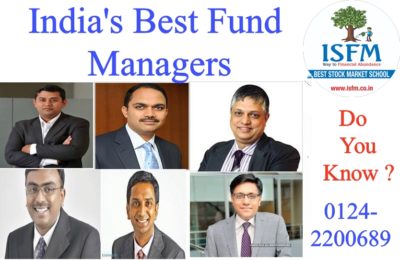
Top Mutual Fund Manager in India

Everyone know about SIP today and approx. 10 Cr. People in India investing on regular basis. Thanks to all Doctors, Engineers and other professional who is contributing 8000 Cr. On monthly basis. Average SIP is approx. 3500 Rs. But still India is having just only 12% of MF penetration of 2 trillion economy. Being a wise investor we must know whom we are giving money and what they will do with this money. Because Mutual fund success totally depend on the fund manager, if your fund manger is having good experience and traits to make money in stock market then you will get a handsome return otherwise you may get real fruits which you want. ISFM – Best Stock Market School have collected data from market and sharing with you, it will help to gain some knowledge about  mutual fund market. But your own research is also matter so it is endless efforts to digging about market in search of best. Top  10 Mutual Fund Manager in India. 1. PRASHANT JAIN HDFC Mutual Fund Prashant Jain is the Executive Director and CIO of HDFC MF. He has over 27 years of experience in fund management and research in the mutual fund industry . He has been associated with HDFC Asset Management COMPANY SINCE  June 2003. He is also the fund manager for the large cap and multi cap schemes of HDFC AMC-HDFC top 100 fund and HDFC equity Fund. 2. HARISH KRISHNAN AND HARSH UPADHYAYA KOTAK MF Harish Krishnan is a Fund Manager with Kotak AMC and Manages large cap,  thematic equity funds. The schemes include  Kotak 50, Kotak India Growth Fund, Kotak infrastructure &Economic Reform Fund. He has more than a decade of experience  spread over equity research and fund management. His Kotak Blue Chip Fund Regular Growth is one of the best performers in large cap segment of mutual fund schemes. Chartered Financial Advisor (CFA) Harsh Upadhyaya  is the CIO of Equity and Fund manager at Kotak Mahindra Asset Management Company. He joined the fund house in August 2012. 3. VINIT SAMBRE DSP MF Vinit Sambre is a Fund Manager and Head of Equitys at DSP MF.  He has been managing the DSP Micro Cap Fund since June 2010. He is also the fund Manager for the DSP Small and Midcap Fund. Sambre specializes in the small and mid cap space and has over 16 years of relevant work experience. DSP Midcap Fund has performed decently over the years. 4. MAHESH PATIL  Aditya Birla Sun Life Mutual Fund CFA Mahesh Patil served as a Co-CIO- Equity and fund Manager of Aditya Birla sun life AMC. He joined Birla sun life Asset Management in October 2005. Patil has an extensive experience in fund management,equity research and corporate finance. Aditya Birla Sunlife Frontline Equity Fund-Growth is one of the best funds managed by him with stellar returns and exceptional growth 5. JANAKKIRAMAN RENGARAJU AND ANAND RADHAKRISHNAN. FRANKLIN TEMPLETON INVESTMENTS Jankiraman  Rengaraju is a Vice President and a Templeton investments he manages Franklin India Prima Fund and Franklin India smaller companies fund. He has been investment management industry for 13 years. Franklin India Prima Fund managed by him is one of the performing funds in the mid cap segment. Anand   Radhakrishnan  is the CIO of Franklin India- Equity segment. He has over 25 years of investment industry experience. 6. NEELESH SURANA MIRAE ASSET MF Neelesh Surana is a fund manager and the CEO – Equity at Mirae Asset Global Investments (India). He joined Mirae  Assest in 2008 . in his capacity as CIO-Equity he heads the equity research and investment functions. He is responsible for managing equity funds of Mirae Asset (India) as well ass providing research support for the global mandate . Mirae Asset Emerging blue chip fund under him, is one of the best in the large and mid cap category. 7. SAMIR RACHH RELIANCE MF Samir Rachh is a Fund Manager with Reliance Nippon Life Asset Management. He was previously an assistant Fund Manager and Senior  Investment Analyst. He specializes in the mid cap stocks at the firm. Rachh joined Reliance Nippon life asset management in October 2007. Reliance small cap fund scheme that is managed by him is one of the leaders in the small cap category. 8. JIGNESH GOPANI Axis Mutual Fund Jignesh Gopani is a Fund Manager and head of Equity at Axis AMC. He has a total experience of 16 years, in which eight years are in equity fund management. Currently , the key funds under him are Axis focused 25 and Axis long – term Equity Linked Saving Scheme category –Axis long term Equity Fund is one of the favourites and has performed consistently for years. 9. SANSKARN NAREN ICICI Prudential MF Sankaran Naren is a Fund Manager and the CIO for Equity at ICICI Prodential Asset Management company since 2008. He is also the  Executive Director since 2016. Naren oversees the entire investment function across the mutual fund and the international advisory business. He is instrumental in the overall investment strategy  development and execution. He has several years of experience in the financial services industry ranging from investments  banking , fund management, equity research, and stock  broking operations. He manages one of the most innovate scheme-the ICICI Produce Balance Advantage Fund-the founder of this category. 10. SOUMENDRA NATH LAHIRI L&T Financial Holdings Soumendra  Nath Lahiri is a Fund manager and CIO at L&T finance holdings. He manages L&T Equity Fund , L&T Tax Advantage Fund , L&T india special situations fund , L&T emerging bussness fund and   ,L&T infrastructure fund . lahiri also manages the equity component of L&T India prudence fund and L&T dynamic equity fund ,and co-manages the L&T Midcap fund. He has been the Head of Equities at L&T Investment Management since September 2012. Disclaimer : – Ranking is personal view of author it is not showing any kind of reputation of Mutual fund / AMC. Source :  Contents and knowledge based on Outlook Money. 

Blog, Stock Market

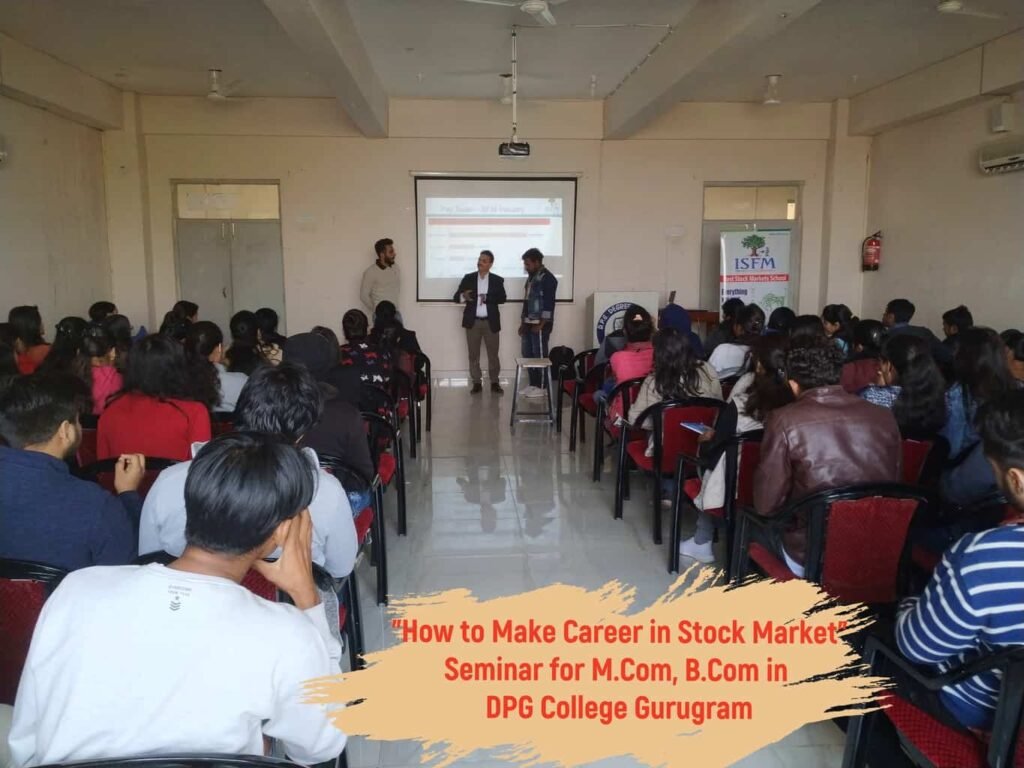
Career in Stock Market Seminar for DPG College Gurgaon

How to make career in Banking and Financial Services ?  It is a very crucial question for a graduate and postgraduate students in 21st century. People who are pursuing B.Com and M.Com / B.B.A / MBA are facing a big problem how to reduce gap what talent required in corporate world and what they have. Very hard to reduce this gap but some time its required more efforts from students side. Only academic degree is no more relevant until you don’t have sufficient experience or some crash courses in any areas. ISFM – Best Stock Market School in Gurugram conducted a session on ” How to Make Career in Stock Market” for DPG College students. Mr. Sushil Alewa and Mr. Dinesh Gupta discuss with students and guide about financial market. If you want to download full ppt use in this seminar, click below : –  Stock Market Mechanism & Career_DPG_Gurgaon ppt Photos of Seminar  : – 

ISFM
Blog, Stock Market

Stock Market Learning with Kabir’s Dohas

book  *Dohanomics* written by Mr. Vinayak Sapre. The writer has beautifully correlated the dohas of *Sant Kabir & Rahim* as to how investor should behave  while investing their hard earned money. 1. Make Your Portfolio Meaningful *साधु ऐसा चािहए, जैसा सूप सुभाय ।* *सार – सार को गिह रहै, थोथा देई उड़ाय ।।* When the market is on the upswing, i.e. when everybody on the street is over optimistic. After falling prey to greed, people realise that they have accumulated many stocks or instruments which are of no use and by that time the market also tanks. At this hour, they need an advisor who can clean up their portfolio and align it to their needs and help them to get rid of bad investments they made following the herd.It is very important to have a trustworthy, knowledgeable and competent advisor. 2. Patience is the key *धीरे –धीरे  रे  मना, धीरे  सब कु छ होय ।* *माली सीचे सौ घड़ा, ॠतु आए फल होय II* This is one of the most important aspects of successful investing. When one is investing in equity markets or equitymutual funds one needs to have a long-term horizon. By pouring a lot of water on a plant at one go, you can’t expect fruits immediately, it will come only in the season, till that time you will have to keep watering it regularly. Systematic Investment Plan (SIP) is a good way of investing for retail investors. Not only does it inculcate the habit of regular investing, it also makes an investor more disciplined. 3. Plan for the retirement *माँगन मरण समान है, िमत माँगो कोई भीख ।* *माँगन से तो मरना भला, यह सतगु की सीख II* The most ignored financial goal amongst Indians is retirement. People don’t realise the importance it should be given. Most old people they see around them today are pensioners and not too dependent on their children. This will not be the case, going forward as more and more people are forced to or choose to retire before the age of 50. This results in another 30 years of retirement. Secondly, the inflation in medical expenses is very high, therefore, it is advisable to plan for retirement to avoid dependency on others. As Kabir says, “Being dependent on others is equal to dying; if not physically then mentally. 4. On choosing the right advisor *साधु–ऐसा चािहए, जाका पूरा मंग ।* *िवपि पड़े छाड़ै नही, चढ़े चौगुना रं ग ।।* What kind of advisor does an investor need? One who can hand hold the investor during tough emotional and financial situations.  Further, a financial advisor needs to be more engaged with the investor during tough times. The advisor’s efforts during bad times should be four times more than on normal days. *Sant Kabir & Rahim* as to how investor should behave / act while investing their hard earned money 5. Advisor- Friend, philosopher, and guide *साधु आवत देखकर, हँसी हमारी देह ।* *माथा का ह उतरा, नैनन बढ़ा सनेह ।।* An advisor should be dependable. A successful financial advisor often becomes a sounding board for his clients. An advisor is a good coach, a guide, and a great empathiser. It is assumed that a good advisor is like a financial doctor. In fact, a good advisor plays a much bigger role than a mere financial doctor. 6. Attaining financial freedom enables you to pursue your passions and live a meaningful life. *चाह िमटी, िचंता िमटी मनवा बेपरवाह ।* *िजसको कु छ नही ं चािहए वह शहनशाह II* The investor should try to achieve a state of financial freedom. This is a state wherein one feels like a real king. When someone doesn’t have any more dreams to achieve, there is no peer pressure. One can live life the way one wants to. Such people feel like ‘The true King’. It’s always better to focus on the goals of life and enjoy every bit of it. People who plan their financial lives well generally start planning very early. 7. Do not procrastinate *काल करे  सो आज कर, आज करे  सो अब ।* *पल म लय होएगी, बर करे गा कब ।।* When it comes to taking action on health and wealth, people tend to procrastinate and postpone it for tomorrow, which very often never comes. Sant Kabir says finish tomorrows work today and today’s work at the current moment because one doesn’t know when one will fall on one’s deathbed. We are born with a purpose. Let us not waste any opportunity procrastinating. People say *दुघटना से देर भली, लेिकन यहाँ देर ही दुघटना है ।

ISFM
Blog, Stock Market

SEBI New Peak Margin Rules for Traders

SEBI’s New Peak Margin rules from 01-09-2021 SEBI margin rules explain in layman’s language-SEBI has changed some rules related to margin and trading.1) Buying and selling of shares will Require Upfront margin from now onwards.Eg: If you want to buy Adaniport shares worth 1lakh, you must have 20k Rs in your account as cash and the rest money to be paid within 2 days…Major Change If you want to sell 1 lac worth of Adaniport shares from your holdings for that scenario also you must have min 20k rs in your account. Failing which penalties will be levied.Read Carefully… Selling from holding will also require Upfront margin in cash (Var+ELM).You can keep extra cash or can pledge other holdings for the stipulated margin required.2) Shares bought today cannot be sold Tomorrow.Implications: BTST ClosedEg You bought Adaniport On Monday. You can only sell those shares after receiving the delivery of shares. T+2 you can sell on Wednesday.You can only sell the shares after you receive in Your DP/only after receiving the delivery of shares.3) Shares Sold Today from delivery….. the funds cannot be used for new trades today. You can use the funds for new trades the next day.Eg:  You sold 100,000 Rs worth of Adaniport’s shares today.You cannot use this money to buy fresh shares of other companies. No changes In options and Futures Rules for Now Till further Notice. Morale of the rules change : – Intraday trading practice which is reason for maximum loss of the trader is not going to end and brokers lobbywhich provide extra limit to the client just to shake of brokerage now get in problem.ISFM – Best Stock Market School recommended swing trading which is good for all segment of the market. Now learning is best for earning.

Blog, Stock Market

New Age Companies in India

Stock Market is most happening place in the world. So don’t blink your eyes while investment. Investing in others business also is a business. Giants company in market always having a research and development department which keep eyes on new startup and acquired them on time to time so that no one can replace them in market. Whatsapp was the excellent example acquired by Facebook and many more if you will search. ISFM Best Stock Market School has discover top 6 new age company which might be new multibagger in future. Everyone who is interested earn money from stock market must have to know about these companies. Affle India : – Affle is a leading digital-advertising services provider. It operates through two business segments. The first segment is he consumer platform wherein it provides services like acquiring new consumers through mobile advertising, targeting existing customers to complete e-commerce transactions and converting online engagement into in-store walk-ins through online-to-offline (O2O) services and earns the majority of  its revenues. On the other hand, its second business segment is the enterprise platform. Under this segment, it provides end-to-end solutions to enterprises so that they can enhance their engagement with mobile users. What sets the company apart from others is its presence across the digital-advertising value chain, spanning from the data management platform to the collection of  users’ data on their preferences, to the demand and supply sides of  advertising and fraud detection. In today’s world, mobile advertising has gained prominence, as it enables businesses to increase their sales. This has resulted in some marquee customers as its clients. Affle has run mobile advertising for some of  the largest e-commerce and mobile apps, such as Amazon, Flipkart, Zee, ALTBalaji, Johnson & Johnson, McDonald’s and Axis Bank, to name a few. Why Affle is important for investors: – Affle is the only listed company in India in mobile advertising. The company is a leading player in ad technology, which is one of the largest growing markets in India. 25% of in internet users in India are shopping online (source: the company’s RHP), which has increased digital ad spend, thus generating the demand for this new-age businesses. 2. CAMS : – Incorporated in 1988 in Madras, Tamil Nadu, Computer Age Management Services (CAMS) is the largest registrar and transfer agent (RTA) for mutual funds in India. It offers transaction management, bookkeeping and other value-added services to its clients and is deeply integrated into the mutual-fund ecosystem, which makes it difficult for its clients to change service providers. It serves four out of  the five largest mutual funds and has expanded its market share by around 10 percentage points over the last six years. Why Cams in important for investors : – The company effectively operates in a duopolistic market in which it is the leader by a large margin (it has a market share of 70 per cent). It is also the only player in this market to be listed on stock exchanges. It came out with an IPO in September 2020. The mutual fund industry is extremely underpenetrated and the company stands to benefit from the expected long-term increase in the proportion of financial assets as a part of  the overall savings. 3. CDSL: – Central Depository Services (India) Limited (CDSL), which started as a subsidiary of  the Bombay Stock Exchange, is a securities depository. It is the backbone through which many depository participants (DPs) offer dematerialized (demat) accounts to investors. It offers a variety of  services, including securities dematerialization, taking care of  KYC norms, processing of  corporate actions and other value-added services to both investors and corporates. Owing to SEBI’s regulations, the promoter’s stake (BSE) has come down to 20 per cent and the rest is held by other institutional and non-institutional public shareholders. Why CDSL is important for Investors : – The business model was established following the passage of the Depositories Act in 1996 and this specific model doesn’t exist in many places across the world, most notably in the U.S.A. The company is operating in a duopolistic industry and given the highly regulated nature of the industry, it is very likely to remain so. It is the only listed company in this space : – 4. India Energy Exchange : 4. India Energy Exchange : India’s first and largest power exchange, IEX provides a nationwide, automated trading platform for the physical delivery of  electricity, renewable energy certificates and energy-saving certificates. IEX brings together the buyers and sellers in power trading. It provides the platform for buyers and sellers of  power and earns transaction fees. Buyers of  power include distribution companies (DISCOMs), large retail consumers and industrial consumers. On the other hand, sellers of  power include power- generation companies, independent power plants, captive power plants and discoms. Its primary revenue sources include transaction fees (account for 84 per cent of  revenues) and annual subscription fees (5 per cent of  revenues). Since the commencement of  its business in 2008, the trading volume on its exchange has been increasing at a staggering rate of  over 32 per cent CAGR. The exchange platform enables efficient price discovery and increases accessibility and transparency of  the power market while enhancing the speed and efficiency of  the trade execution. At present, only two companies are engaged in the business of  power exchange – IEX and Power Exchange India Ltd. (PXIL). Why it is important for Investors : – IEX is the undisputed leader with a market share of 95 per cent in India and enjoys a near-monopoly in its business segment. It is the only listed power-exchange company. Power exchange is a relatively new business in India, with IEX being the first to commence operations. 5. Indiamart :- The company runs a business-to-business (B2B) e-commerce portal that connects buyers and sellers in the wholesale business segment. It uses a subscription model to derive its revenues from sellers who wish to list their products. Besides, it offers a host of  other value-added services such as advertisements, cloud telephony, CRM,

Blog, Stock Market

What is Coal Crisis and It’s Global Impacts

In the past few days, one of the modern-day crises has been flashing on the world media, i.e power crisis or the coal crisis. Coal happens to be the commonly available fossil fuel resource, which acts as a backbone in the electricity supply globally. In addition, Coal also pays a major contribution towards the production of steel, concrete, and paper. Mr. Sachin Gupta, Associated trainer with ISFM – Best Stock Market School have collected some important point that every have to know. The worldwide crisis was recognized in the past month, where some countries like the UK witnessed the cold season in summer, which pushed the demand for gases and as a result, UK switched on its old power plants. Consequently, the demand for coal soared very rapidly. The basic rule of economics played its trump card and the prices of coal skyrocketed at their 13-year higher level in Europe. Big Shot witnessed a larger Impact: The world’s major producers like China and India have recorded larger impact of the crisis. The fun fact is both countries are the leading consumer and importers globally. China has recently decided to ban its import of coal from Australia to reply to the Australian Governments demanded inquiry on the evolvement of COVID-19 from China as well as its shift from thermal energy to renewable energy in order to match their climate goal. When it comes to India, during 2019-20, approximately 73% of Coal used by the country was their own, and the remaining ~27% was imported. The crisis in the country was mainly due to the following: The lockdown in the past year led by the global pandemic, which resulted in a reduction of power demand. After the withdrawal of lockdown in 2021, the economy is reviving and witnessed a rise in power demand. There is a low supply of coal as compared to demand due to reduced import by India, owing to higher coal prices globally. Lower production of coal, caused by the extended monsoon season, resulted in flooding and waterlogging in many coal mines. The Central government also stated that some state governments has not maintained ample stock levels before the onset of the monsoon. Impact of Coal Shortage: As of result of the shortage of electricity to the industries, the economic reopening could be hampered. Some of the businesses may downscale their production. Future Steps: The coal companies are working consistently to raise output from mines and GOI (Government of India) is also trying to strengthen the supply by bringing more mines into operation. Citizens of the country are required to gradually shift them to renewable energy from thermal energy in order to battle against the limited resources. As per the latest interview by the management of Coal India Limited, the current scenario is likely to end in the later days of October 2021. Companies to be Benefited from the Circumstances: The Rising demand for electricity has charged up the power sector of India and as a result, Indian Energy Exchange, Tata Power, and Torrent Power have gained in the past week’s trading session on the Indian Securities market.

ISFM
Blog, Stock Market

Top 5 Shares to Buy in 2022

Good bye to 2021 and warm welcome to 2022. Being a investor we believe economy must grow at good path and we can earn handsome ROI on your investment. But last 2 years was very critical condition for portfolio but any how we survived. ISFM Best Stock Market School always try to finding the best stock for our students, We also disclose the methodology so that it can help you in future. We have identify 5 stocks for 2022 which can give u better return if you invest and stay with them. 1. Aarti Industry : – Involved in manufacturing speciality chemicals and pharmaceuticals, Aarti Industries has over 200 products and serves 400 customers worldwide. Of  its 20 manufacturing plants, 15 plants manufacture speciality chemicals and five plants manufacture pharmaceuticals. The company is one of  the top three global players for Nitro Chloro Benzene (NCB) and Di-chloro Benzenes (DCB). It has backward integration for most of  its APIs. Aarti Industries earned around 83 per cent of  its FY21 revenue from speciality chemicals and 17 per cent from pharmaceuticals. Thanks to its global presence, the company earned 44 per cent of  its FY21 revenue from exports. Over the last five years, its revenue and profits have grown by 8.4 per cent and 14.8 per cent, respectively, thereby helping its share price grow by a solid 41 per cent. Given the tailwinds in the speciality-chemical industry, it has planned to invest around `2,500–3,000 crore in its chemical operations and `350–500 crore in its pharma operations during FY22–FY24 to add over 40 products to its chemicals segment and over 50 products to the pharma segment, thereby increasing its overall operating margin. With China losing its dominance in manufacturing speciality chemicals, Aarti Industries’ leadership and scale will help it expand its business rapidly in the next few years. 2. Tech Mahindra : – This information technology (IT) services and consulting firm was founded as a joint venture between Mahindra & Mahindra and British Telecom in 1986. Later, British Telecom sold its stake to Mahindra & Mahindra. Its service offerings include network services, engineering services, platforms, security, digital marketing and customer experiences, business process services and IT. The company is a trusted transformation partner for several communication-service providers, telecom-equipment manufacturers and independent software vendors. Hence, the growing adoption of  5G is believed to augur well for the company. Tech Mahindra already boasts of  designing, building, testing and operating the world’s first 5G end- to-end cloud-native platform for a Japan- based Tier-1 carrier. While 5G for telecoms is likely to drive the company’s near-term growth, 5G for enterprises would take some time to be its growth driver. Unlike its competitors Infosys and Tata Consultancy Services that operate in the operating-expenditure- related business, Tech Mahindra is involved in the capital-expenditure-related business. This gives the company a competitive edge in the 5G world. As revealed by a Sharekhan report, this IT and consulting firm is poised to benefit from an open 5G network (a market opportunity of  $40–50 billion), network on the cloud ($8–10 billion), cognitive- managed operations ($10–15 billion), digital-operating support system ($5–8 billion) and enterprise-network modernization (greater than $50 billion). 3. Praj Industry : – The growing demand for ethanol has paved the way for sugar companies to capitalise on this opportunity. Besides, some other companies, for example Praj Industries, are likely to benefit from this trend. Established in 1984, the company is involved in providing technologies and solutions that are used for the production of  biofuels, such as ethanol, biodiesel, compressed biogas (CBG) and other biofuels. A leader in its industry, Praj Industries commands a market share of  60 per cent. Its product portfolio comprises bio-energy plants, high-purity water systems, zero-liquid discharge plants, breweries for alcohol, among others. It is one of  the few companies in the world that develops second-generation ethanol technology. This technology primarily uses rice and wheat residues, cotton stalks and cane trash for the production of  ethanol. Apart from domestic clients, the company has customers in more than 75 countries and its technologies are used to produce 8 per cent of  the global ethanol production. At present, India’s capacity to produce ethanol is pegged at 784 crore litre, which is expected to double in the next five years to cater to the growing ethanol demand. All these are likely to increase the demand for the company’s products and services. Besides, ethanol blending has also been mandated in many countries, including Brazil, the US, the European Union, China and Thailand, to name a few. So, there has been a consistent uptick in the inquiries and order intake for the company. In Q2 FY22, the company report 4. Jubli Food Works : – One of  the largest food-service companies in India, Jubilant FoodWorks holds the exclusive rights to develop and operate the Domino’s Pizza brand in India, Sri Lanka, Bangladesh and Nepal. It also holds exclusive rights for the Dunkin’ Donuts brand in India. Jubilant has a presence in the Chinese cuisine segment through its in-house brand ‘Hong’s Kitchen’ and has recently added biryani to its portfolio by launching the ‘Ekdum!’ brand. As of  September 2021, the company operated 1,435 Domino’s Pizza restaurants across 307 cities in India. Jubilant intends to be a food-tech powerhouse, as evident from the launch of  its analytics and insights division in FY21. The division works with product and engineering teams to strengthen the company’s digital capabilities. Besides, it is looking to invest in technologies to improve customer and employee experience and reduce inefficiencies in its supply chain and store operations. Given that the company already operates on a comparatively large scale, the ongoing digital transformation is likely to add to its moat. Further, being a cash-rich company, it has been able to diversify its business into adjacent verticals to keep up the growth momentum. Despite the rise of  aggregators, a majority of  Domino’s online sales are generated on its own platform, with its app being downloaded at a staggering rate. This enables the company to gain

Scroll to Top