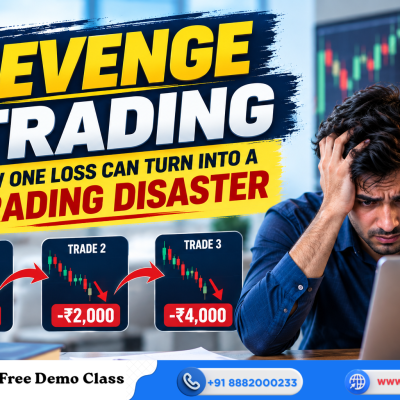
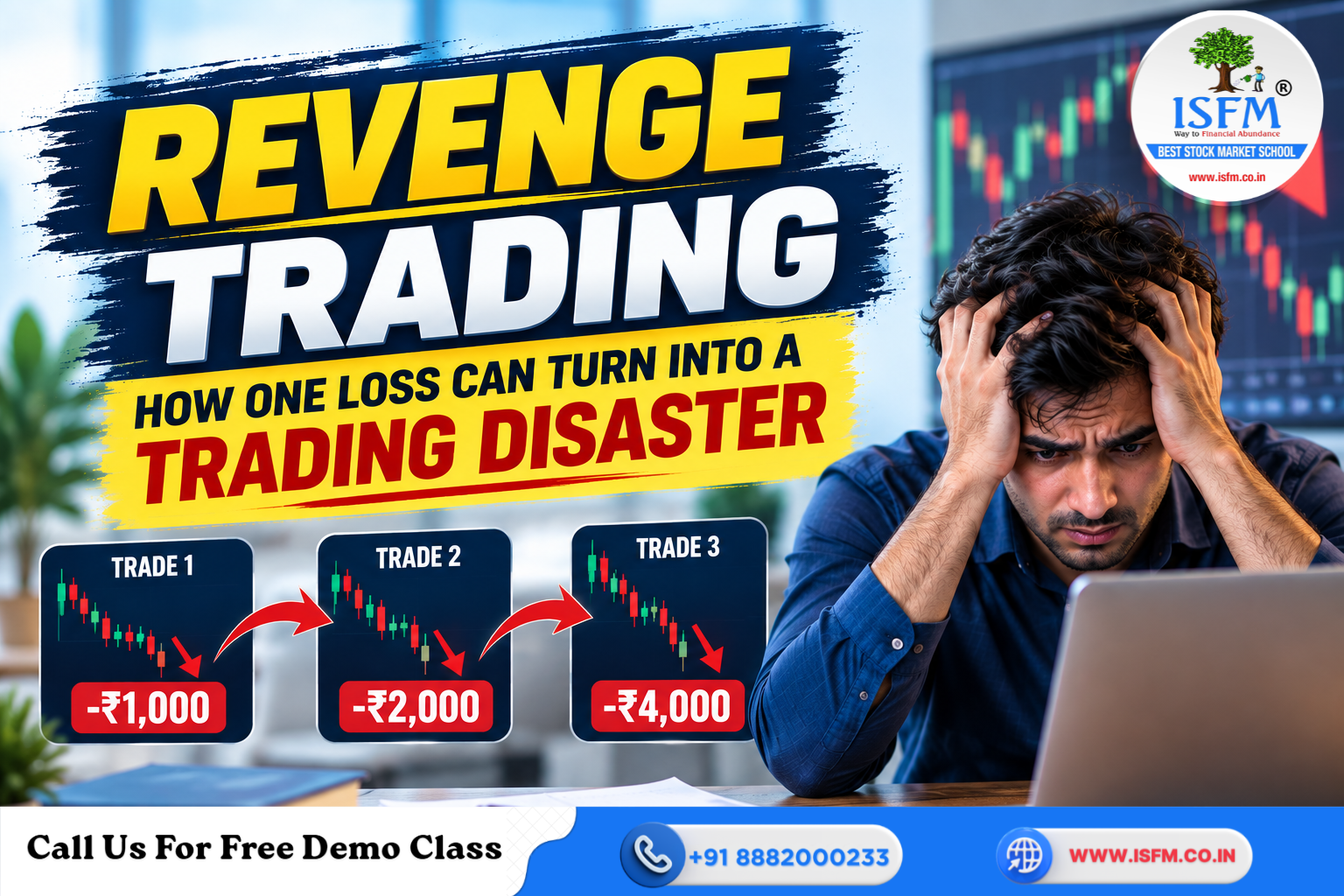
A trader takes a position with a clearly defined stop-loss. The trade goes against them, and ₹1,000 is lost. It is frustrating, but manageable.
According to Sushil Alewa, SEBI Registered Research Analyst (INH100009433), revenge trading often begins when a trader stops focusing on the next valid market opportunity and starts focusing on recovering the money lost in the previous trade. What appears to be a simple attempt to recover ₹1,000 can quickly lead to larger positions, impulsive decisions, and repeated losses.
The trader immediately enters another position, this time with a larger quantity. The setup is not perfect, but it looks good enough. That trade also loses. Now the trader increases the position size again, moves the stop-loss farther away, and starts taking trades simply because they want to recover the earlier loss.
What began as a ₹1,000 loss can quickly become a ₹5,000, ₹10,000, or even larger loss.
This is the danger of revenge trading.
A losing trade is a normal part of trading. The real problem begins when a trader tries to force the market to return the money immediately. Understanding this cycle can help traders recognise it before a manageable loss becomes a trading disaster.
What Is Revenge Trading?
Revenge trading occurs when a trader enters a new position primarily to recover a recent loss rather than because a valid trading setup exists.
There is an important difference between a planned trade and a revenge trade:
| Planned Trade | Revenge Trade |
| Based on a defined setup | Based on urgency or frustration |
| Follows risk limits | Often increases risk |
| Has predefined entry and exit | Rules may change during the trade |
| Accepts the possibility of a loss | Focuses on recovering money |
| Follows the trading plan | Abandons the trading plan |
Common signs include immediately re-entering after a stop-loss, increasing position size, ignoring confirmation, trading unfamiliar instruments, widening the stop-loss, or focusing more on the money lost than on the quality of the next setup.
For traders who want to improve their understanding of chart-based setups, entries, exits, and technical indicators, a structured Technical Analysis Course can provide a foundation for making decisions based on predefined market conditions rather than impulse.
How the Loss Spiral Develops
Revenge trading often follows a predictable sequence:
1. A legitimate trade hits the stop-loss: The loss may actually be completely consistent with the trading plan.
2. Emotional pressure increases: The trader feels frustration, anger, disappointment, or embarrassment.
3. The focus shifts from execution to recovery: Instead of asking, “Is there a valid setup?”, the trader starts thinking, “How can I make ₹1,000 back?”
4. Risk increases: The trader takes a larger position or accepts a lower-quality setup.
5. Another loss occurs: The original loss now feels even more important.
6. Rules start disappearing: The trader may widen the stop-loss, take multiple trades, or enter without confirmation.
At this point, the trader is no longer responding primarily to market conditions. The previous loss has become the centre of the decision-making process.
Why Do Traders Chase Losses?
Several psychological factors can contribute to revenge trading.
1. Loss Aversion
Losses often feel more painful than equivalent gains feel rewarding. After losing money, the desire to eliminate that loss can become extremely strong.
2. Ego
A losing trade can feel like being wrong. A trader may therefore take another position to prove that their original view was correct.
3. Overconfidence
After a loss, some traders assume the next trade will work because they feel they are “due” for a winning trade.
4. FOMO and Urgency
The trader may feel that waiting means missing the opportunity to recover the money.
5. Anchoring
The previous loss becomes a mental reference point. Every new trade is judged by whether it brings the account closer to its earlier level.
The Real Cost of Revenge Trading
Consider a simple example:
- Trade 1: Loss = ₹1,000
- Trade 2: Risk increased to ₹2,000
- Trade 3: Risk increased to ₹4,000
If all three trades lose, the total loss becomes ₹7,000.
The original ₹1,000 loss was not necessarily the disaster. The uncontrolled escalation that followed created the bigger problem.
This becomes particularly important in derivatives, where leverage can magnify the financial impact of incorrect decisions. Traders looking to understand option strategies, option-chain analysis, Greeks, and risk management can explore ISFM’s Options Trading Course.
Revenge trading can damage more than capital. It can affect decision quality, risk discipline, confidence, trading records, and long-term consistency.
Warning Signs You Are About to Revenge Trade
Before placing another trade, ask yourself:
- “I need to win it back today.”
- “I will double my size just once.”
- “The market owes me.”
- “I know this next trade will work.”
- “I cannot accept the last result.”
- “The setup is incomplete, but I do not want to miss the move.”
If several of these thoughts sound familiar, stepping away from the screen may be better than taking another trade.
A Practical Anti-Revenge Trading Plan
The strongest defence against revenge trading is not simply willpower. It is having rules that make emotional decisions harder to execute.
Take a mandatory break: After a meaningful loss, step away from the trading screen for a predefined period.
Set a daily maximum-loss limit: Decide before the session how much you are willing to lose. Once the limit is reached, stop trading.
Never increase size to recover money: Position size should be based on your trading plan, not your previous loss.
Limit the number of trades: A maximum-trades-per-session rule can reduce impulsive overtrading.
Predefine the stop-loss: Know where the trade is invalidated before entering. Do not widen the stop simply because the position is losing.
Write down the trade reason: Record the setup, entry, stop-loss, target, and reason before entering.
Reduce size after a losing streak: Increasing risk after losses increases emotional pressure. Smaller size can help restore discipline.
For traders seeking a broader understanding of equity, technical analysis, derivatives, and trading practices, ISFM’s Chartered Stock Trading Expert (CSTX) program provides structured learning across these areas.
Rule-based traders can also explore how systematic strategies can reduce emotional interference through an Algo Trading Course, particularly when strategies are tested and executed according to predefined rules.
How to Recover After a Bad Trading Day
If you have already entered a revenge-trading spiral, the first objective should not be recovering the money immediately.
Stop trading.
Then record what happened without self-judgment. Separate a normal strategy loss from a rule-breaking loss. Review whether the original setup was valid and identify the exact moment emotions changed your behaviour.
A trading journal can help reveal recurring patterns such as impulsive entries, increased position size, and rule-breaking after losses.
Traders who need more structured guidance around trading process, risk management, and disciplined execution can also explore one-to-one stock market mentorship.
Return to trading only after a calm review, and consider smaller position sizes while rebuilding consistency.
Conclusion
Losses are part of trading. Revenge trading can turn those losses into something much larger.
A trader does not need to win back every losing trade. The objective is to protect capital, follow a tested process, and remain consistent enough for a genuine trading edge to work over a series of trades.
The market does not know that you lost ₹1,000 five minutes ago. It only presents another set of conditions.
Your job is not to recover the previous loss immediately. Your job is to make the next decision correctly.
“You cannot control the trade that just ended, but you can control whether the next decision is planned—or emotional.”
Frequently Asked Questions
1. What is revenge trading?
Revenge trading is entering trades mainly to recover a recent loss rather than because a valid setup exists.
2. How can I stop revenge trading after a loss?
Take a break, use a daily loss limit, avoid increasing position size, and require a clearly defined setup before entering another trade.
3. Is re-entering after a stop-loss always revenge trading?
No. Re-entry can be valid when it follows a predefined strategy and specific conditions. It becomes revenge trading when the primary motivation is recovering the previous loss.
4. Can a trading journal help prevent revenge trading?
Yes. A journal can track position size, emotional state, setup quality, and rule adherence, helping traders identify patterns of impulsive behaviour after losses.
Educational Disclaimer
Trading involves substantial risk, and losses can occur. This article is intended for educational and informational purposes only and should not be considered financial or investment advice or a recommendation to buy or sell any security or derivative.