Some of the biggest investment failures in history were not caused by beginners. They involved Nobel Prize-winning economists, legendary investors, major financial institutions, and globally recognised companies. Despite their experience, knowledge, and resources, they made decisions that resulted in enormous losses.
These famous investment failures remind us that intelligence and experience do not eliminate investment risk. Understanding what went wrong can help investors make better decisions, protect capital, and develop a stronger investment process.
According to Sushil Alewa (SEBI Registered Research Analyst – INH100009433), successful investing is not simply about identifying opportunities or predicting market movements. It is equally about understanding risk, controlling emotions, and protecting capital. Investors must develop a disciplined approach, question their assumptions, and remain flexible when market conditions change. Learning from historical investment failures can help build more informed and sustainable investment habits.
Long-Term Capital Management: When Models Failed
Long-Term Capital Management (LTCM) was a hedge fund established in 1994 by highly qualified financial professionals, including Nobel Prize-winning economists. It used sophisticated mathematical models to identify small pricing differences between financial instruments.
The strategy initially delivered strong returns. However, LTCM relied heavily on leverage to increase profits. In 1998, following the Russian financial crisis, global markets experienced extreme volatility. Relationships between financial assets changed, liquidity disappeared, and LTCM suffered enormous losses. Major financial institutions eventually organised a rescue to prevent wider market disruption.
The lesson is that even sophisticated models cannot predict every market condition. Leverage magnifies losses just as quickly as profits. Investors must consider extreme scenarios, liquidity risks, and changing market correlations rather than relying entirely on historical data. Learning about these market dynamics is an important part of an Advanced Derivatives Training Course.
Warren Buffett and Dexter Shoe: Even Legends Make Mistakes
Warren Buffett is widely recognised for his long-term investment success, but his investment in Dexter Shoe became one of his most famous mistakes.
In 1993, Berkshire Hathaway acquired Dexter Shoe using company shares instead of cash. The business initially appeared attractive, but increasing competition from lower-cost overseas manufacturers damaged its competitive position.
The investment eventually lost much of its value. Buffett later acknowledged that using Berkshire shares for the acquisition made the mistake particularly expensive because those shares subsequently appreciated significantly.
The lesson is that a profitable business today may not remain competitive tomorrow. Investors must examine industry changes, competition, and long-term business sustainability. Understanding how to evaluate businesses and their financial strength is essential for anyone pursuing Fundamental Analysis and Investment Education.
Kodak and Nokia: When Market Leaders Failed to Adapt
Kodak once dominated the photography industry. However, the transition from traditional film photography to digital imaging fundamentally changed the market. Despite having developed early digital camera technology, Kodak struggled to adapt its business model quickly enough and eventually filed for bankruptcy protection in 2012.
Similarly, Nokia was once a dominant mobile phone manufacturer. However, the smartphone revolution, driven by touchscreen technology and new operating systems, changed consumer expectations. Nokia struggled to compete effectively and eventually lost its leadership position.
The lesson is that market leadership is never permanent. Investors should monitor technological developments, consumer behaviour, and competitive advantages. A company’s historical reputation cannot guarantee its future growth.
Enron: When Financial Reporting Became a Warning Sign
Enron was once considered an innovative energy company and one of America’s most admired corporations. However, complex accounting arrangements, off-balance-sheet structures, and serious governance failures concealed significant financial problems.
When its accounting practices came under scrutiny in 2001, confidence collapsed and the company filed for bankruptcy.
The lesson is that attractive business stories and impressive reported profits are not enough. Investors should examine cash flows, debt, accounting practices, auditor reports, and corporate governance. Financial complexity should encourage deeper investigation, not blind confidence.
Common Patterns Behind Famous Investment Failures
Although these failures occurred in different industries and market conditions, several behavioural and financial mistakes appeared repeatedly.
- Overconfidence: Assuming previous success guarantees future results.
- Excessive leverage: Taking financial risks beyond the capacity to absorb losses.
- Concentration: Depending too heavily on one company, sector, or investment idea.
- Model risk: Assuming historical patterns will continue under different market conditions.
- Poor governance: Ignoring transparency, accountability, and financial reporting.
- Failure to adapt: Holding onto outdated business assumptions.
- Emotional attachment: Refusing to reconsider a decision when new evidence appears.
Understanding these investment mistakes is an important part of behavioural finance and investment risk management.
Building a Stronger Investment Process
Respect leverage: A 10% decline in an unleveraged investment produces a 10% loss. With 10-times leverage, the same market movement can wipe out the capital supporting the position. Leverage increases exposure; it does not create investment skill.
Diversify your portfolio: Investing across companies, sectors, and asset classes reduces dependence on a single investment. Diversification cannot eliminate market risk, but it can reduce company-specific and concentration risk.
Review your investment thesis: A falling share price does not automatically mean an investment is wrong. However, deteriorating cash flows, increasing debt, governance concerns, or declining competitive advantages may indicate a deeper problem. Investors should update their assumptions when facts change. Learning price behaviour and market trends through a Technical Analysis Course can complement fundamental research.
Maintain a margin of safety: Avoid paying excessive prices based on optimistic forecasts. Conservative valuations provide some protection against unexpected developments and incorrect assumptions.
Accept mistakes early: Maintain an investment journal, record your original reasoning, review assumptions, and separate emotions from evidence. For traders, developing structured entry, exit, and risk-control rules is equally important. An Options Trading Course can help learners understand derivatives, option strategies, and associated risks.
Investors interested in systematic decision-making can also explore an Algo Trading Course to understand how predefined rules and automated strategies can support disciplined trading.
Conclusion: Protect Capital Before Chasing Returns
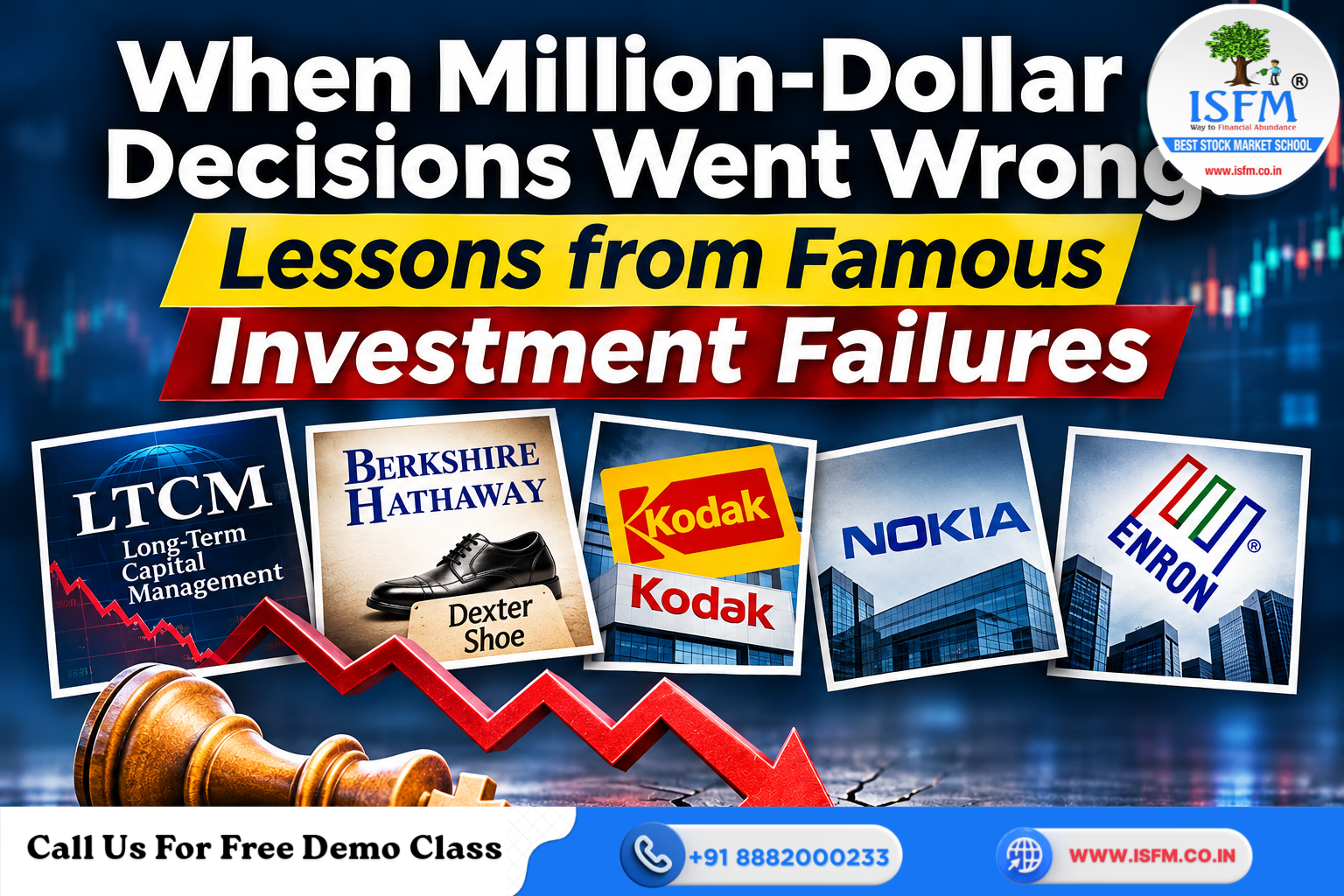
Famous investment failures demonstrate that no investor, regardless of experience, can eliminate uncertainty. LTCM highlighted the dangers of leverage, Buffett’s Dexter Shoe investment demonstrated the importance of competitive analysis, Kodak and Nokia revealed the cost of failing to adapt, and Enron exposed the consequences of weak governance.
The real purpose of studying these failures is not to become afraid of investing. It is to develop a resilient process that balances opportunity with risk.
The best investors are not those who never fail. They are those who survive their failures, learn from them, and refuse to let one mistake become a permanent loss of capital.
Financial Disclaimer: This article is for educational and informational purposes only. It does not constitute investment advice or a recommendation to buy or sell any financial instrument. Investments are subject to market risks. Readers should conduct independent research and consult a qualified financial professional before making investment decisions.