
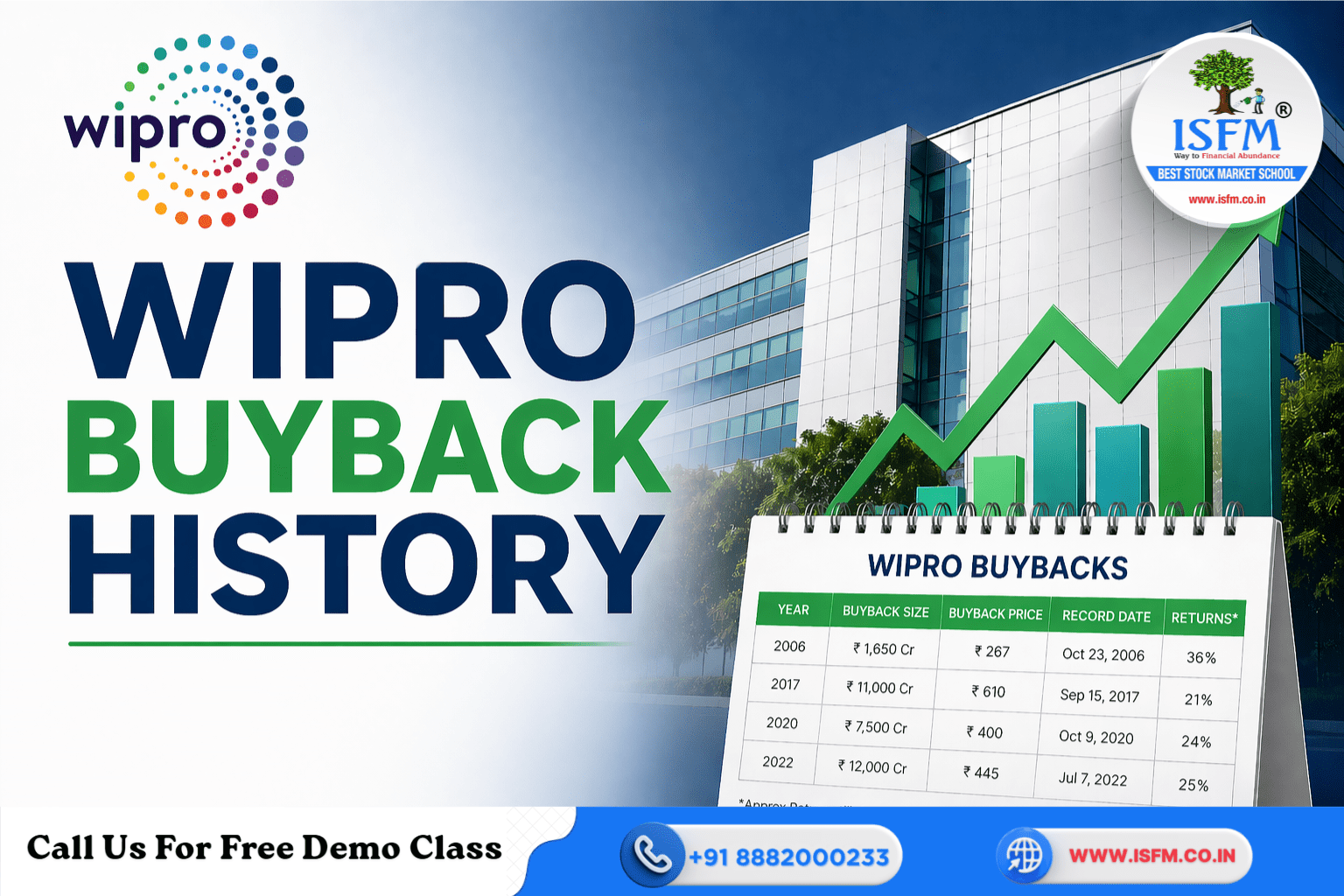
Wipro Ltd., one of India’s leading IT companies, has built a strong track record of rewarding shareholders through share buybacks. Over the past decade, the company has consistently used buybacks as a capital allocation strategy, reflecting both financial strength and management confidence.
This blog provides a structured overview of Wipro’s buyback history from 2016 to 2026, along with key insights that every investor and trader should understand.
Understanding Share Buybacks
A share buyback occurs when a company repurchases its own shares from the market, typically at a premium. This reduces the number of outstanding shares and can improve financial metrics.
Why Companies Do Buybacks:
- Return excess cash to shareholders
- Improve Earnings Per Share (EPS)
- Signal confidence in future growth
- Optimize capital structure
To truly understand how price reacts to such corporate actions, traders must learn technical analysis of stock market, which helps decode price behavior, volume, and trend shifts.
For active participants, buybacks create both short-term trading opportunities and long-term investment signals.
Wipro Buyback Timeline
1. Buyback 2016: The First Step
- Size: ₹2,500 Crore
- Price: ₹625 per share
- Mode: Tender Offer
- Retail Acceptance Ratio: 100%
Wipro’s first buyback was highly rewarding for retail investors.
2. Buyback 2017: Large-Scale Expansion
- Size: ₹11,000 Crore
- Price: ₹320 per share
- Record Date: 15 September 2017
- Acceptance Ratio: ~50%
This marked a sharp increase in participation.
3. Buyback 2019: Stability Phase
- Size: ₹10,500 Crore
- Price: ₹325 per share
- Record Date: 21 June 2019
- Acceptance Ratio: ~50%
Consistency remained the key theme.
4. Buyback 2020: Confidence During Crisis
- Size: ₹9,500 Crore
- Price: ₹400 per share
- Record Date: 11 December 2020
- Acceptance Ratio: ~33%
Even during COVID uncertainty, Wipro continued rewarding shareholders.
5. Buyback 2023: High Retail Participation
- Size: ₹12,000 Crore
- Price: ₹445 per share
- Record Date: 16 June 2023
- Acceptance Ratio: 77.40%
A standout event for retail investors.
6. Buyback 2026: The Upcoming Mega Event
- Size: ₹15,000 Crore
- Price: ₹250 per share
- Mode: Tender Offer
- Record Date: Expected June 2026
Key Considerations:
- New tax rules introduced in April 2026
- Promoter holding ~73% participation
- Retail acceptance ratio may decline
Understanding how such events impact derivatives and price movement becomes easier with advanced derivatives training, especially for traders dealing in F&O strategies.
Key Trends Across Buybacks
1. Increasing Buyback Size
From ₹2,500 crore (2016) to ₹15,000 crore (2026), Wipro reflects strong financial strength.
2. Changing Acceptance Ratios
- 100% (2016)
- ~50% (2017 & 2019)
- 33% (2020)
- 77.40% (2023)
This clearly shows that strategy matters more than opportunity.
3. Strategic Timing
Buybacks were executed across all market phases, proving long-term planning.
What Investors & Traders Should Learn
Focus on Acceptance Ratio
Profit depends more on acceptance ratio than just price.
Understand Promoter Participation
Higher promoter participation reduces retail allocation.
Evaluate Tax Implications
New tax rules (2026) may impact returns significantly.
Use Buybacks as a Strategy
Buybacks should be part of a broader trading framework.
For those aiming to become full-time traders, a structured program like Chartered Stock Trading Expert course can help develop consistent income strategies.
Conclusion
Wipro’s buyback journey from 2016 to 2026 reflects a disciplined capital allocation strategy and evolving market complexity. From 100% acceptance to competitive participation, the landscape has changed significantly.
For traders and investors, the 2026 buyback offers opportunity — but only for those who combine knowledge, strategy, and execution.
Disclaimer
This article is for educational purposes only and not investment advice. Always conduct your own research before investing.
If you found this blog helpful, you might also like this article: What separates a Profitable trader from a losing trader?