For many years, Sub-Brokers played an important role in India’s stock market ecosystem. They helped investors open trading accounts, introduced clients to stock brokers and assisted with buying and selling securities.
However, the regulatory structure changed significantly in 2018.
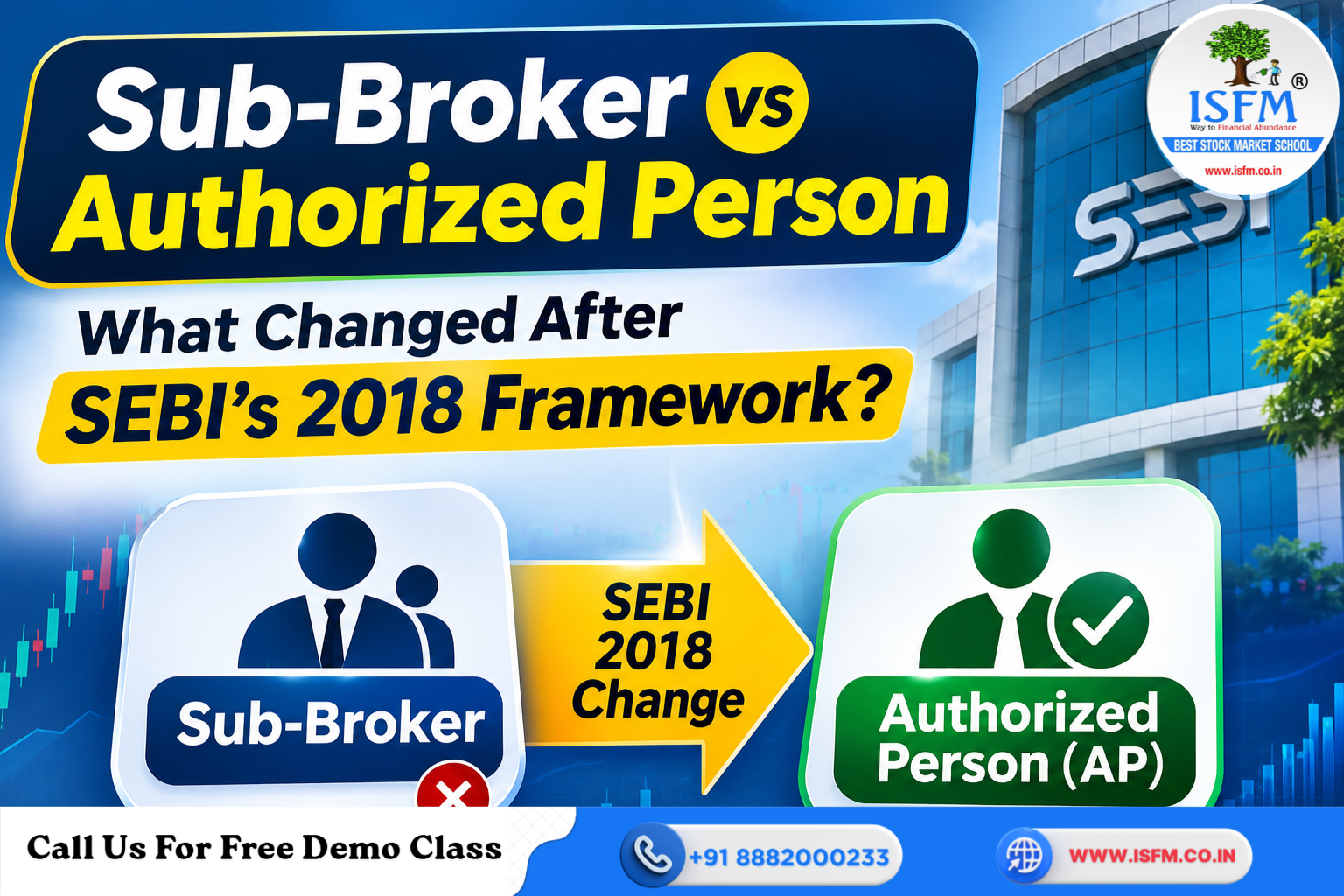
SEBI decided to discontinue the category of Sub-Brokers as registered market intermediaries and provide a migration route for existing Sub-Brokers to become Authorized Persons (APs) or, where eligible, Trading Members.
This was not simply a change of terminology. It changed who regulates the intermediary, how the relationship with the stock broker is structured, how clients interact with the broker and how new businesses can enter the distribution and broking ecosystem.
SEBI’s August 3, 2018 circular formally announced the discontinuation of Sub-Brokers and explained the role of Authorized Persons.
So, what exactly changed? Let’s understand the difference step by step.
What Was a Sub-Broker?
Before the 2018 framework, a Sub-Broker was a person or entity that was not itself a stock-exchange member but acted on behalf of a stock broker to assist investors in buying, selling or dealing in securities.
Importantly, Sub-Brokers were required to obtain SEBI registration under the SEBI Stock Brokers and Sub-Brokers Regulations.
The earlier framework therefore created a separate regulatory identity for Sub-Brokers.
A Sub-Broker generally operated as an extension of the principal stock broker and could assist clients with account opening, trading-related activities and investor servicing.
The old regulations also prescribed eligibility criteria, infrastructure requirements, agreements with the stock broker and a code of conduct for Sub-Brokers.
Simple example
Suppose ABC Securities was a registered stock broker.
A person operating in Gurgaon could become a registered Sub-Broker of ABC Securities and build a local client base.
The Sub-Broker would work with investors while trades were ultimately routed through the affiliated stock broker.
What Did SEBI Change in 2018?
In June 2018, SEBI’s Board approved the proposal to discontinue Sub-Brokers as a category of market intermediary.
The decision was subsequently implemented through SEBI’s August 3, 2018 circular.
SEBI stated that:
- No fresh Sub-Broker registrations would be granted.
- Existing registered Sub-Brokers could migrate to Authorized Persons or become Trading Members, subject to applicable requirements.
- Sub-Brokers who did not migrate would be deemed to have surrendered their registration.
- The transition was given a specified period to avoid disruption to existing businesses.
Existing Sub-Brokers were provided time until March 31, 2019, to migrate to the new structure or become Trading Members where eligible.
This was the major turning point.
What Is an Authorized Person?
An Authorized Person (AP) is a person or entity appointed by a stock broker/trading member to provide access to the trading platform of a stock exchange as an agent of that stock broker.
Unlike the old Sub-Broker model, an AP is not separately registered with SEBI as a market intermediary.
Instead, the AP is approved/registered through the relevant stock exchange framework following appointment by the stock broker.
The current NSE framework, for example, describes an Authorized Person as a person appointed by a Trading Member who provides access to the exchange’s trading platform as an agent of the stock broker.
Sub-Broker vs. Authorized Person Comparison
| Parameter | Sub-Broker – Old Framework | Authorized Person – Post-2018 Framework |
| Regulatory status | SEBI-registered intermediary | Not separately registered with SEBI |
| Appointment | Affiliated with Stock Broker | Appointed by Stock Broker |
| Exchange approval | Part of registration process | Exchange approval/registration applicable |
| Fresh registrations | Discontinued | AP model continues |
| SEBI registration certificate | Required | Not required as AP |
| Relationship with broker | Agency/affiliation | Agency/appointment |
| Client relationship | Through Sub-Broker structure | Direct relationship with Stock Broker |
| Contract notes | Old Sub-Broker framework had specific obligations | Issued by Stock Broker |
| Client funds/securities | Subject to old regulatory framework | AP cannot receive/pay funds or securities in its own name under the NSE framework |
| Revenue | Brokerage/commission arrangements | Commission/remuneration from Stock Broker |
| Migration | Existing Sub-Brokers could migrate | Current route for new entrants |
| Compliance | SEBI + Exchange framework | Stock Broker + Exchange framework |
The NSE framework specifically provides that the client has a direct relationship with the Trading Member and that the AP should not have a separate trading relationship with the client.
Why Did SEBI Discontinue the Sub-Broker Category?
The 2018 framework was aimed at simplifying and rationalizing the intermediary structure.
Instead of maintaining two overlapping concepts—Sub-Broker and Authorized Person—SEBI moved toward a more streamlined structure.
The new framework places greater emphasis on the direct relationship between the investor and the Stock Broker while allowing brokers to expand their distribution and client-servicing network through APs.
This can be viewed as a shift from:
Independent registered intermediary model
to
Broker-controlled agent/partner model
Does an Authorized Person Have the Same Role as a Sub-Broker?
Broadly, the business function can look similar, but the regulatory status is different.
This is where many people become confused.
An AP may still:
- Acquire clients
- Assist investors
- Promote the broker
- Help with account opening
- Provide local support
- Generate trading business
- Build a team
- Earn commissions/revenue according to the broker agreement
Therefore, from a business perspective, an AP may look like the old Sub-Broker.
But legally and regulatory, they are not the same category.
NSE’s FAQ also notes that the obligations and liabilities of an AP are similar to those of a Sub-Broker, while clarifying that the AP is approved by the Exchange rather than separately registered with SEBI.
Advantages of the Authorized Person Model
1. Lower Regulatory Complexity
An AP does not need to obtain a separate SEBI Sub-Broker registration.
This makes the entry structure comparatively simpler.
2. Lower Infrastructure Burden
The AP works within the infrastructure and systems of the Stock Broker rather than creating an independent brokerage infrastructure.
3. Established Brand Support
An AP can operate under the brand and technology ecosystem of an established broker.
4. Access to Trading Technology
The AP can leverage the broker’s:
- Trading platform
- Mobile application
- Research tools
- Back-office systems
- Customer support
- Technology infrastructure
5. Business Scalability
An entrepreneur can build a local or regional client acquisition and servicing business without becoming a full-fledged Trading Member.
Limitations of Becoming an Authorized Person
The AP model also has limitations.
1. Dependence on the Stock Broker
The AP depends heavily on the affiliated broker’s:
- Products
- Technology
- Pricing
- Brand
- Customer service
- Policies
2. No Independent Brokerage Identity
An AP cannot represent itself as an independent stock broker.
3. Restrictions on Client Money
Client funds and securities must be handled according to the broker and exchange framework.
4. Agreement-Based Revenue
The AP’s commercial income depends on the agreement with the Stock Broker.
5. Compliance Responsibility
Being an AP does not mean “no regulation.”
The AP remains subject to applicable exchange, broker and regulatory requirements.
How to Become an Authorized Person Today?
A simplified process looks like this:
Step 1: Select a Stock Broker
Compare brokers based on:
- Brokerage
- Technology
- Product range
- Customer support
- Brand reputation
- Revenue-sharing model
- Deposit/security requirements
- AP eligibility criteria
- Training and support
Step 2: Check Eligibility
Make sure you satisfy the applicable requirements of the broker and exchange.
Step 3: Submit Documents
Depending on the applicant structure, documents may include:
- PAN
- Identity proof
- Address proof
- Educational documents
- Business constitution documents
- Bank details
- Financial documents
- Other declarations/forms
Step 4: Sign Agreement with the Broker
The broker and AP enter into the prescribed agreement covering areas such as:
- Scope of activities
- Responsibilities
- Confidentiality
- Commission sharing
- Termination
- Compliance
NSE specifically provides for a written agreement between the Trading Member and AP.
Step 5: Exchange Approval
The Stock Broker submits the application to the relevant exchange.
The AP can begin operating under the applicable framework after receiving the required approval.
What Changed After 2018 in One Table?
| Before 2018 | After 2018 |
| Sub-Broker was a recognized intermediary | Sub-Broker category discontinued |
| SEBI registration required | AP does not require separate SEBI registration |
| Separate Sub-Broker certificate | Exchange approval/registration through broker |
| Sub-Broker acted for broker | AP acts as agent of broker |
| Separate intermediary identity | Greater emphasis on direct broker-client relationship |
| Fresh Sub-Broker applications possible | No fresh Sub-Broker registrations |
| Existing Sub-Brokers continued under old structure | Migration to AP/TM required |
| Sub-Broker model | AP model became the principal route |
SEBI’s own regulatory material confirms the discontinuation and the migration mechanism.
Sub Broker vs Authorized Person: Which Is Better?
For someone starting a business today, the practical comparison is straightforward.
There is no meaningful choice between becoming a new Sub-Broker and becoming an AP because the old Sub-Broker registration route was discontinued.
Therefore:
For a new entrepreneur
Authorized Person is the relevant model to explore.
For an old registered Sub-Broker
The appropriate historical route was migration to:
Authorized Person or Trading Member, subject to eligibility.
For a large financial business
Becoming a full Trading Member may be worth considering if the business meets the substantially higher eligibility, infrastructure, capital and compliance requirements.
Conclusion
The 2018 SEBI Sub-Broker framework marked a major structural change in India’s stock broking industry.
The old model was based on a SEBI-registered Sub-Broker operating as an intermediary affiliated with a Stock Broker.
The new model shifted toward the Authorized Person structure, where the AP is appointed by the Stock Broker and operates within the exchange framework.
The most important change can be remembered in one sentence:
SEBI moved away from separately registered Sub-Brokers and toward a Stock Broker–Authorized Person model.
For entrepreneurs planning to enter the stock market distribution and broking ecosystem today, understanding this distinction is essential.
If your objective is to build a business around client acquisition, investor servicing and stock-broker distribution, the Authorized Person model can be an important route to explore—but the commercial agreement, exchange requirements, compliance obligations and revenue-sharing terms should be carefully evaluated before making a decision.
For aspiring market professionals, strengthening practical knowledge of equity derivatives, options trading and algorithmic trading can complement an understanding of the stock-broking business.
Important: Regulatory and exchange requirements can change. Anyone planning to become an Authorized Person should verify the latest requirements with the concerned Stock Broker and Stock Exchange before starting the application process.