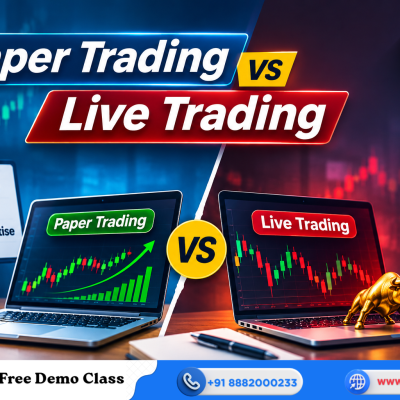
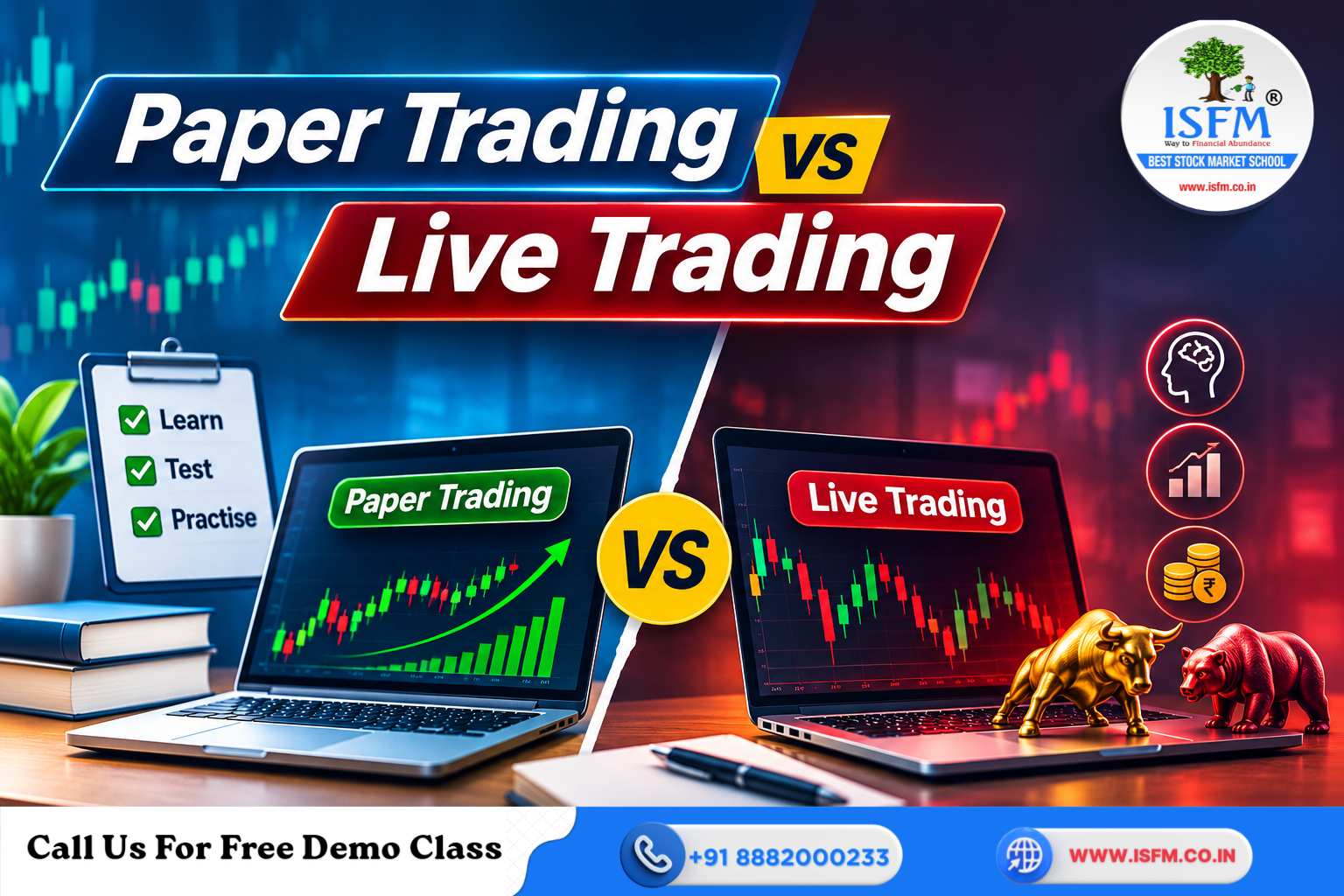
Imagine a trader testing a Nifty breakout strategy on a paper-trading account for three months. The results look impressive. Every entry follows the rules, stop-losses are respected, and profitable trades are allowed to run. Confident about the results, the trader finally starts live trading with real money. Suddenly, everything feels different. They hesitate before entering, exit profitable trades early, and struggle to accept losses.
Why does the same strategy feel completely different when real money is involved?
The answer lies in the difference between simulated performance and real-world trading behaviour. According to Sushil Alewa, SEBI Registered Research Analyst (INH100009433), successful trading requires more than understanding market movements; it also demands emotional discipline, risk management, and consistent execution.
What Paper Trading Can Teach You?
Paper trading is an important learning tool, particularly for beginners. It allows traders to practise without risking actual capital.
It helps develop familiarity with trading platforms, understand market and limit orders, identify chart patterns, test indicators, and practise risk-reward calculations. Traders can also maintain a journal and evaluate how their strategies perform under different market conditions.
For beginners learning technical analysis, paper trading provides an opportunity to practise chart reading, identify market trends, and understand entry and exit points.
However, it mainly tests trading knowledge and mechanics, not the ability to handle real financial pressure.
What Paper Trading Cannot Fully Replicate?
The biggest limitation of paper trading is the absence of genuine financial consequences.
When a simulated Nifty trade loses ₹2,000, the trader may simply move to the next opportunity. But when the same amount disappears from a live trading account, the emotional response can be completely different.
Real money introduces concerns about savings, financial responsibilities, and previous losses. Traders may become cautious, impatient, or aggressive.
Paper trading can simulate market conditions, but it cannot fully reproduce the emotional experience of risking personal capital.
The Psychology Gap: Understanding Loss Aversion
Loss aversion is the tendency to feel the pain of a loss more strongly than the satisfaction of an equivalent gain.
For example, a trader might feel extremely uncomfortable losing ₹1,000, even when the trading plan allows that loss.
This pressure often creates three problems:
- Moving stop-losses: Extending the stop-loss instead of accepting a planned loss.
- Holding losing positions: Waiting for prices to recover rather than following exit rules.
- Exiting winners early: Closing profitable positions because protecting a small gain feels safer.
These behaviours can damage an otherwise well-designed trading strategy. Learning proper risk management in derivatives trading can help traders understand position sizing, stop-loss planning, and the risks associated with leveraged positions.
Fear, Greed and FOMO in Live Trading
Live trading introduces emotional challenges that are often invisible in simulated accounts.
Fear can prevent traders from entering a valid setup after consecutive losses. Greed can encourage them to hold profitable positions beyond their targets. Hesitation can cause late entries, while FOMO (Fear of Missing Out) encourages traders to chase Nifty or Bank Nifty movements after prices have already extended.
Another common problem is revenge trading. After losing money in an options trade, a trader may immediately enter another position to recover the loss.
Similarly, a winning streak can create overconfidence, encouraging traders to increase position sizes without proper risk assessment.
The strategy may remain unchanged, but emotional decision-making changes its execution.
Execution Differences: Paper Trading vs Live Trading
Psychology is only one part of the difference. Actual market execution also matters.
Paper-trading platforms may assume that orders execute at displayed prices. Live markets involve bid-ask spreads, slippage, partial fills, liquidity constraints, and order rejections.
Consider a simple example. A paper platform fills a buy order at ₹500. In the live market, the available selling price may be ₹500.20. The trader therefore enters at a higher price.
For frequent intraday traders, even small execution differences can affect overall profitability. Brokerage, Securities Transaction Tax (STT), GST, exchange charges, and other applicable costs must also be considered.
Understanding futures and options trading and its execution requirements becomes particularly important when dealing with leveraged market positions.
Why Paper-Trading Results Can Be Misleading?
A profitable paper-trading record does not automatically prove that a strategy has a sustainable trading edge.
Common reasons include:
- Testing a strategy on too few trades.
- Ignoring transaction costs and slippage.
- Testing only favourable market conditions.
- Taking excessive risks because the money is virtual.
- Assuming perfect order execution.
- Failing to account for emotional mistakes.
Paper trading should therefore be treated as preparation, not proof of future profitability.
How to Transition From Paper Trading to Live Trading?
Moving from simulated to real trading should be gradual. Traders should focus on consistency rather than immediately targeting large profits.
A practical approach includes:
- Start with one market and one clearly defined setup.
- Use the smallest viable position size.
- Risk only money that will not affect essential expenses.
- Define entry, stop-loss, and exit rules before entering.
- Set a maximum daily loss limit.
- Avoid unnecessary trades and overtrading.
- Maintain a detailed trading journal.
- Compare live execution with paper-trading expectations.
- Increase position size only after demonstrating consistent discipline.
Traders interested in systematic execution can also explore algo trading and automated trading systems to understand how predefined rules can reduce discretionary decision-making, although automation does not eliminate market or execution risks.
Conclusion: The Real Test Begins With Live Trading
Paper trading is a useful classroom where traders can understand markets, practise strategies, and develop basic skills without risking capital. However, live trading introduces financial pressure, emotional challenges, and execution realities that simulated accounts cannot fully reproduce.
The goal is not to eliminate every emotion but to develop a process that prevents emotions from controlling trading decisions.
Paper trading teaches you what to do. Live trading teaches you whether you can do it when money, fear, and uncertainty are real.
Financial Risk Disclaimer: Stock market trading, including equities, futures, options, forex, and cryptocurrencies, involves financial risk. Past paper-trading or simulated results do not guarantee future live-market performance. Always understand the risks, practise appropriate position sizing, and avoid risking money you cannot afford to lose.