Imagine Nifty moves just 20 points during a trading session, but you notice that both Call and Put premiums have increased sharply. You check the index again, and there is hardly any significant movement. So, what made options more expensive?
The answer may lie in implied volatility and its connection with India VIX.
According to Sushil Alewa, SEBI Registered Research Analyst (INH100009433), understanding volatility is essential for options traders because option premiums can change even when the underlying index remains relatively stable.
For traders dealing in Nifty 50 options, Bank Nifty options, weekly expiry and monthly contracts, understanding India VIX can provide valuable insight into changing market conditions. Traders interested in understanding option pricing and practical strategies can also explore the Options Trading Course.
What Is India VIX?
India VIX is the volatility index introduced by the National Stock Exchange (NSE). It measures the market’s expectation of Nifty 50 volatility over the next 30 calendar days.
It is calculated using Nifty option prices and represents expected volatility as an annualised percentage.
In simple terms:
- Higher India VIX generally indicates expectations of larger market movements.
- Lower India VIX generally indicates expectations of relatively smaller movements.
- Rising India VIX reflects increasing uncertainty.
- Falling India VIX reflects decreasing expected volatility.
However, India VIX does not predict whether Nifty will move upward or downward. It measures the expected magnitude of movement, not its direction.
How Is India VIX Calculated?
India VIX is derived from Nifty option prices rather than simply analysing historical market movements.
NSE uses the best bid and ask prices of eligible near-month and next-month Nifty options. It combines information across relevant strikes and expiries to estimate the market’s implied volatility over the coming 30 calendar days.
The resulting calculation produces a single volatility index.
This is important because India VIX reflects expectations already embedded in option prices.
What Is an Option Premium?
An option premium is the price paid by an option buyer to acquire the right, but not the obligation, to buy or sell the underlying asset.
It has two major components:
- Intrinsic Value: The value an option would have if exercised immediately.
- Time Value: The additional amount traders pay for the possibility of favourable price movement before expiry.
Time value is influenced by remaining time, implied volatility and market uncertainty.
This is where India VIX becomes relevant to options trading. Traders looking to develop deeper knowledge of option pricing, Greeks and derivatives strategies can explore the Advanced Derivatives Course.
India VIX vs Option Premium: Understanding the Connection
India VIX and option premiums are connected through implied volatility (IV).
India VIX measures broad expected volatility in the Nifty market, whereas every individual option contract has its own implied volatility.
When India VIX increases, implied volatility across many Nifty options may also increase. This can push option premiums higher.
Similarly, when India VIX declines, option implied volatility may decrease, reducing premiums.
However, the relationship is not perfectly uniform. Different strikes, expiry dates, liquidity conditions and market events can produce different changes in individual option premiums.
| Factor | Rising Volatility | Falling Volatility |
| India VIX | Generally increases | Generally decreases |
| Implied Volatility | Often increases | Often decreases |
| Call Premium | May increase | May decrease |
| Put Premium | May increase | May decrease |
| Time Value | Generally increases | Generally decreases |
Why Do Both Call and Put Premiums Increase?
Many beginners assume that Call premiums increase when Nifty rises and Put premiums increase when Nifty falls.
Although directional movement influences option prices, volatility also plays an important role.
When uncertainty increases, traders expect potentially larger price movements in either direction. Consequently, both Call and Put options can become more expensive.
At-the-money options may experience noticeable increases in time value. Out-of-the-money options can also become more valuable because the possibility of reaching their strike prices increases.
Remember: India VIX does not indicate whether Nifty will rise or fall. It indicates how much movement the market expects.
What Is Vega and How Does It Affect Option Premiums?
Vega is an important option Greek that measures how much an option’s premium may change when implied volatility changes by one percentage point.
For example:
Suppose a Nifty option is trading at ₹150 and has a Vega of ₹10.
If implied volatility increases by 3 percentage points, its premium may increase approximately ₹30 due to Vega alone, assuming other factors remain unchanged.
The estimated premium becomes ₹180.
Similarly, a decrease in implied volatility can reduce the premium.
This explains why understanding Vega is important for traders buying or selling options, particularly around major economic announcements and market events. Traders can also develop a stronger understanding of price trends and market behaviour through a Technical Analysis Course.
Why Can Option Premiums Fall When Nifty Remains Flat?
This situation is commonly experienced by option buyers.
Suppose you purchase a Nifty Call option expecting the index to move upward. However, Nifty remains almost unchanged.
During this period, India VIX declines, reducing implied volatility and the option’s time value.
Additionally, time decay continues as expiry approaches.
As a result, your option premium may decline even though Nifty has not moved significantly against your position.
This is one reason traders can be directionally correct but still lose money in options trading.
India VIX Is Not a Market Direction Signal
There are several misconceptions surrounding India VIX:
- Rising India VIX does not automatically mean Nifty will fall.
- Falling India VIX does not guarantee a market rally.
- High India VIX does not guarantee a market crash.
- Low India VIX does not guarantee that markets will remain calm.
India VIX represents changing market expectations. These expectations can change quickly during earnings announcements, elections, geopolitical developments and major economic events.
How Should Options Traders Use India VIX?
Traders can use India VIX as an additional reference while evaluating option premiums.
Consider these practices:
- Compare current India VIX with its recent trading range.
- Monitor individual option implied volatility rather than relying only on India VIX.
- Understand Vega before entering long or short option positions.
- Check liquidity and bid-ask spreads.
- Consider the possibility of volatility falling after major events.
- Maintain predefined stop-loss and position-sizing rules.
Option sellers may benefit from declining volatility, but short options carry substantial risk if the underlying index makes a sharp move.
Traders interested in automating trading strategies and studying systematic approaches can also explore an Algo Trading Course.
A Practical Nifty Example
Suppose Nifty is trading at 22,000.
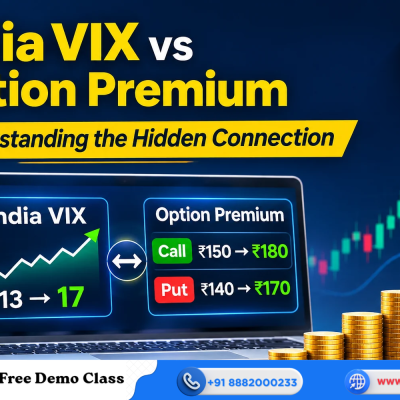
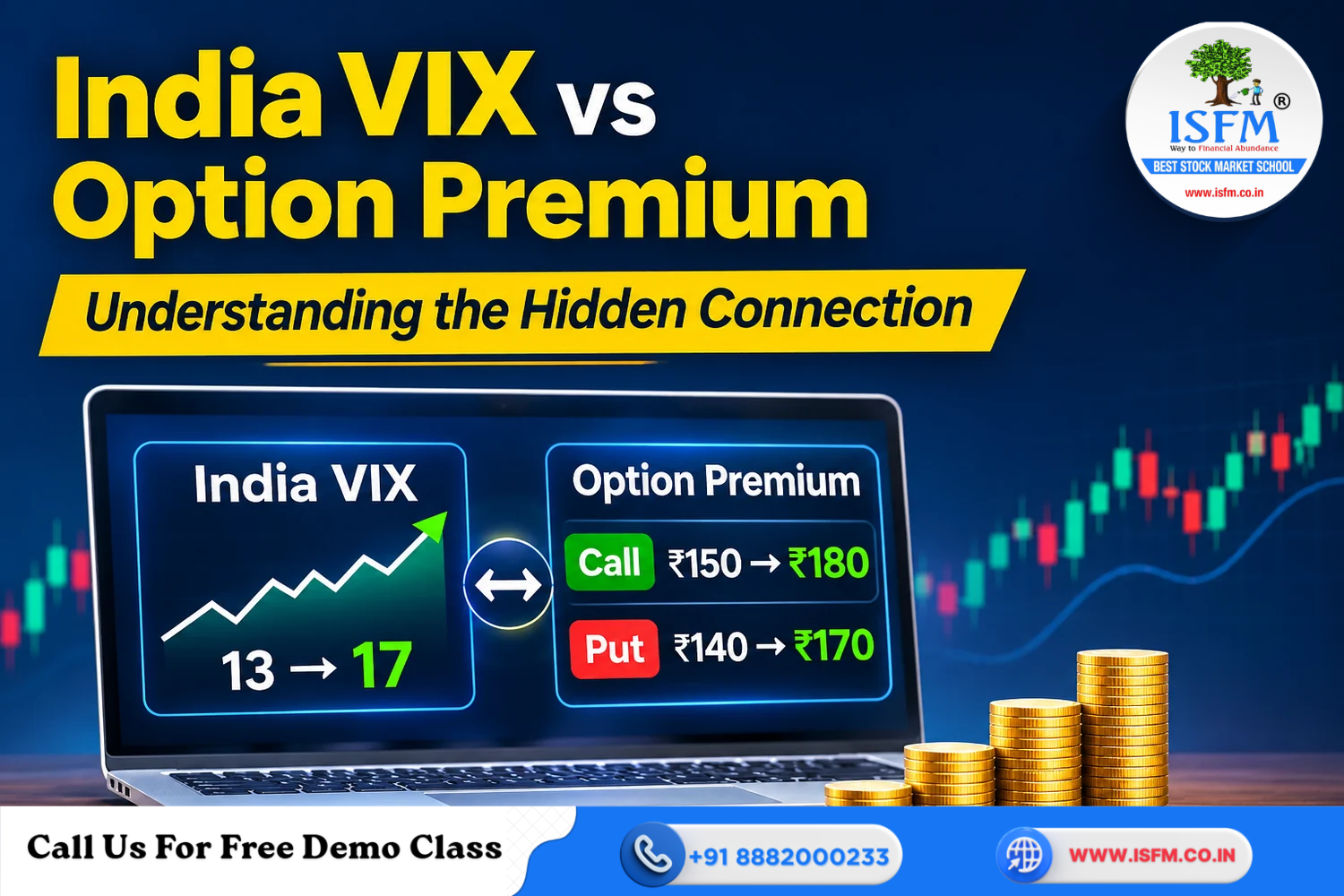
India VIX increases from 13 to 17 due to rising market uncertainty. During the same period, Nifty moves only 15 points.
A trader notices that both the 22,000 Call and 22,000 Put premiums have increased.
Why?
Because higher implied volatility has increased the time value of both options. The premium movement is not necessarily driven by Nifty’s direction.
This is why professional options traders monitor both price movement and volatility.
Conclusion
India VIX and option premiums are closely connected through implied volatility, but they are not identical.
For beginners, understanding this relationship can help explain unexpected premium movements, particularly in weekly and monthly Nifty options.
Remember one important principle:
India VIX tells you how much movement the market expects. Option premiums tell you how much traders are paying for that expectation.
Understanding volatility, Vega and time decay can help traders make more informed decisions rather than relying only on market direction.
Those looking to build comprehensive knowledge of equity markets, derivatives and trading strategies can explore ISFM’s Diploma in Stock Trading.
Financial Disclaimer: This article is for educational purposes only and should not be considered investment advice or a recommendation to buy or sell any financial instrument. Options trading involves substantial risk and may result in significant financial losses.