

Blog

FOMO in Trading
Blog

FOMO in Trading: How Fear of Missing Out Destroys Traders (and How to Stop It)

Have you ever watched a stock, crypto coin, or option skyrocket while your social media feed filled with screenshots of huge profits? Suddenly, you feel like you’re the only one not making money. Your heart starts racing, and you think, “If I don’t buy now, I’ll miss the opportunity forever.” That feeling is called FOMO (Fear of Missing Out), and it’s one of the biggest reasons traders lose money. FOMO in trading is the emotional urge to enter a trade simply because others appear to be profiting. Instead of following a strategy, traders let emotions take control. Learning proper market analysis through a Share Market Course can help traders make informed decisions rather than emotional ones. In this article, you’ll learn what FOMO really is, why it’s dangerous, and how to overcome it with disciplined trading habits. What Does FOMO in Trading Really Look Like? FOMO doesn’t always feel obvious. It often disguises itself as confidence or urgency. Here are some common examples: The truth is, FOMO isn’t caused by the market. It’s driven by comparison, impatience, and the fear of being left behind. To avoid emotional entries, traders should first understand chart patterns, trends, and price action through a Technical Analysis Course, which teaches traders to rely on data instead of emotions. Why FOMO Is So Dangerous for Traders FOMO can quietly destroy both your trading account and your confidence. 1. You Buy Near the Top Most traders who experience FOMO enter after a large price move has already happened. By then, professional traders may already be taking profits. 2. You Take Bigger Risks Instead of following proper position sizing, traders often risk more money hoping to “catch up.” This increases losses when the trade goes wrong. 3. You Lose Confidence A FOMO trade often ends in disappointment. Instead of learning from the mistake, many traders immediately chase another opportunity, creating a dangerous cycle: See profits → Chase trade → Lose money → Feel frustrated → Chase another trade Developing a disciplined trading mindset through structured education is often far more valuable than chasing the next hot stock tip. Signs You’re Trading with FOMO Ask yourself these questions: If you answered “yes” to several of these, FOMO may be influencing your decisions. Remember, recognizing the problem is the first step toward fixing it. Why Our Brain Falls for FOMO FOMO isn’t a weakness—it’s part of human psychology. Herd Behaviour People naturally feel safer doing what everyone else is doing. In financial markets, this often leads to buying after prices have already surged. Loss Aversion Psychologically, missing a profit feels almost like taking a loss. That emotional discomfort pushes traders into poor decisions. Social Proof When traders post winning trades online, it creates the illusion that everyone is making money except you. What you don’t see are the losses they never share. Ironically, markets often attract the largest number of emotional buyers near the end of a strong rally. Practical Ways to Beat FOMO in Trading 1. Create a Written Trading Plan Your trading plan should clearly define: Only take trades that match your plan—nothing else. If you actively trade derivatives, having predefined rules is essential. A professional Options Trading Course can help you develop a disciplined, strategy-driven approach. 2. Limit Market Noise Social media can be helpful, but it can also create unnecessary pressure. Instead of constantly checking Telegram groups or viral posts: Less noise means better decisions. 3. Decide Risk Before Entering Professional traders decide their risk before entering a trade. Never increase your position simply because others are making money. A good rule is to risk only a small percentage of your trading capital on any single trade. 4. Delay Emotional Decisions Whenever you feel an urgent need to buy immediately, pause. Wait: Many emotional trades disappear once the excitement fades. 5. Maintain a FOMO Journal Keep a separate journal for emotional trades. Record: After a month, you’ll notice repeating patterns that can dramatically improve your discipline. Many successful traders also use algorithmic trading strategies to remove emotional decision-making from their trading process. Learning the basics through an Algo Trading Course can help traders understand how rule-based systems eliminate emotional bias. Turning FOMO into a Trading Edge Experienced traders don’t just manage their own emotions—they observe the emotions of others. When everyone suddenly becomes excited about one stock, it often signals that the move is already mature. This doesn’t mean you should automatically trade against the crowd. Instead, use market sentiment as one additional piece of information alongside technical analysis, volume, and risk management. If you’re aiming to build long-term trading discipline and professional skills, consider enrolling in the Chartered Stock Trading Expert (CSTX) program, where trading psychology, technical analysis, and risk management form the foundation of every trading decision. Before entering any trade, ask yourself: “If I hadn’t seen anyone else’s profits, would I still take this trade?” If the answer is no, you’re probably reacting emotionally rather than strategically. Conclusion: Choose Discipline Over Hype FOMO is completely normal. Every trader experiences it at some point. The difference between successful and unsuccessful traders isn’t the absence of emotion—it’s the ability to manage it. The market will always provide another opportunity. There will always be another breakout, another rally, and another trending stock. Your goal isn’t to catch every move. Your goal is to protect your capital, continuously improve your knowledge, and consistently follow your trading plan. “In trading, missing one move is normal; missing your rules is what truly costs you.”
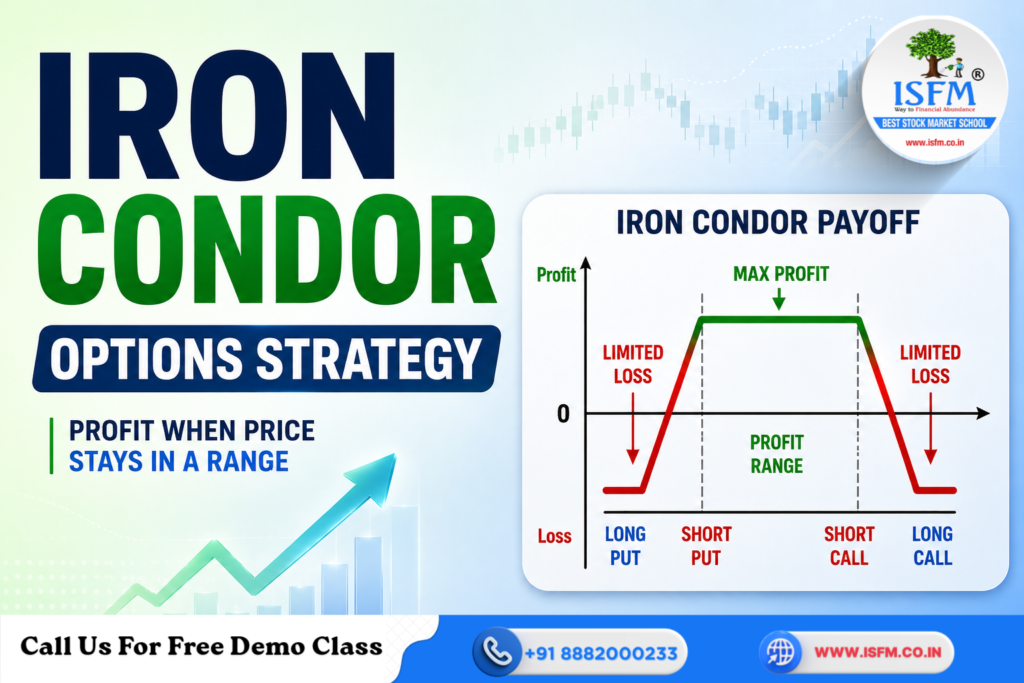
Iron Condor Strategy
Blog

Iron Condor Strategy: Defined-Risk Range Strategy for Indian Options Traders

In the Indian stock market, there are many phases when indices like Nifty or Bank Nifty move sideways instead of trending strongly. During such periods, directional trades often fail, but option premium-selling strategies can perform exceptionally well. One such powerful approach is the Iron Condor strategy—a neutral, defined-risk options strategy designed for traders who expect the market to stay within a range. If you are new to options strategies, it’s recommended to first understand the basics through a structured options trading course. What is Iron Condor Strategy? The Iron Condor is a combination of two spreads: This creates a four-leg strategy where you: The goal is simple: Earn premium while the market stays between the two sold (inner) strikes. How Iron Condor Works (Short Call Spread + Short Put Spread) The strategy profits from time decay (theta) and low volatility. This makes Iron Condor a defined risk NSE strategy, unlike naked short straddles or strangles. For deeper understanding of such combinations, traders often explore advanced derivatives training. Why Use This Defined-Risk Neutral Strategy? Iron Condor is widely used because it offers: For traders focusing on consistency, structured learning like a stock trading course helps in mastering such setups. Setup: Strike Selection, Spread Width & Expiry A successful Nifty Iron Condor setup depends on proper planning: 1. Strike Selection (OTM Wings) 2. Spread Width 3. Expiry Choice Step-by-Step Numerical Example Let’s assume: Nifty spot = 24,000 Trade Setup: Premium Received: Key Levels: Payoff at Expiry: Nifty Price Outcome 23,600 Max Loss 23,800 Breakeven 24,000 Max Profit 24,200 Breakeven 24,400 Max Loss This clearly shows how the neutral premium strategy earns when price stays within the inner range. Real-World Indian Market Scenario Imagine Nifty trading between 23,900–24,200 for several sessions due to: In such a case, directional trades struggle, but an Iron Condor India setup works efficiently by capturing time decay. Unlike a short strangle: This makes it ideal for disciplined traders. When to Use Iron Condor in Indian Markets Best conditions: Avoid using it during: Key Risks and Management Techniques Risks: Management Techniques: To master risk management professionally, traders often choose mentorship-based programs like the Chartered Stock Trading Expert Course. When to Exit the Position Smart traders don’t wait till expiry every time. Exit when: Quick Recap and Takeaway If used with discipline, Iron Condor can become a consistent income strategy for Indian traders.

How to Learn Technical Analysis from Scratch in 2026
Blog

How to Learn Technical Analysis from Scratch in 2026 (Step-by-Step Roadmap)

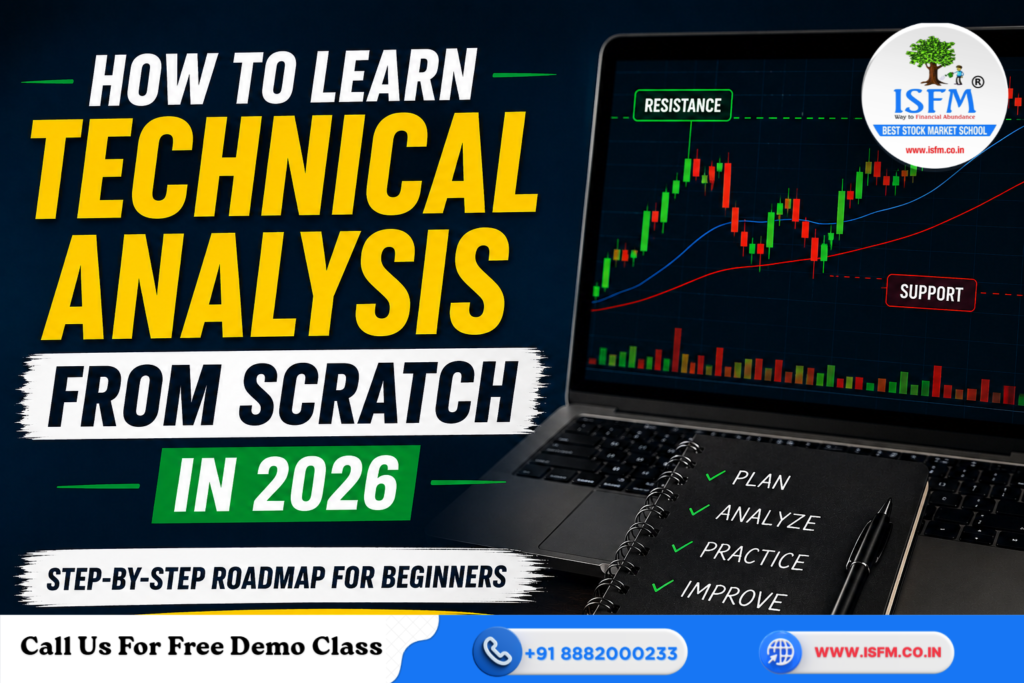
Technical analysis has never been more accessible—or more confusing. In 2026, thousands of YouTube videos, AI-generated strategies, and social media “experts” promise quick profits using countless indicators and secret formulas. For beginners, it’s easy to feel overwhelmed. The truth is that technical analysis isn’t about finding a magic indicator. It’s about understanding how price behaves and making disciplined decisions based on probability. This guide provides a simple, step-by-step roadmap to help you learn technical analysis from scratch without wasting time on unnecessary complexity. If you’re looking for structured learning, enrolling in a professional Technical Analysis Course can help you build strong chart-reading skills from the ground up. Step 1: Understand What Technical Analysis Really Is Technical analysis is the study of price, volume, and time to identify potential trading opportunities. Instead of focusing on company financials, technical analysts examine charts to understand market psychology and trends. However, technical analysis is not: Successful traders focus on probability and risk management, knowing that even the best setups can fail. Step 2: Learn the Basics of Charts and Timeframes Before using any indicator, learn how to read charts. The three common chart types are: Understanding timeframes is equally important: Beginners should primarily practice on the Daily and 4-Hour charts, where market noise is lower and trends are easier to identify. To strengthen your foundation, you can also explore Share Market Courses, which cover technical analysis along with market basics. Step 3: Build Strong Price Action Fundamentals Price action is the foundation of technical analysis. Start by learning: Support and Resistance These are price levels where buying or selling pressure repeatedly appears. Market Trends Daily Practice Choose one stock or index and spend 15 minutes every day: Repeat this exercise for 2–3 weeks before moving to advanced concepts. Step 4: Learn Candlestick Psychology—Not 50 Patterns Many beginners waste time memorizing dozens of candlestick names. Instead, understand what candles represent. Always focus on context. A bullish rejection candle at a major support level is far more meaningful than the same candle appearing randomly in the middle of a chart. Master these three concepts first: If you want to dive deeper into chart-reading techniques, our Candlestick Bible Course is a great next step. Step 5: Use Only a Few Core Indicators One of the biggest mistakes beginners make is filling their charts with too many indicators. Start with just three: Moving Averages (MA) Help identify the overall trend and dynamic support/resistance. Relative Strength Index (RSI) Measures momentum and highlights overbought or oversold conditions—but should always be used with price action. MACD Shows momentum shifts and trend strength. Remember: Indicators should confirm what price is already telling you—not replace it. Step 6: Learn High-Probability Chart Patterns Focus only on patterns that appear frequently and are easy to recognize: For every pattern, identify: The highest-probability setups occur when these patterns align with an existing trend and key support or resistance levels. Step 7: Build One Simple Trading Strategy Avoid switching between multiple trading styles. Choose one: Your strategy should include: If your goal is to specialize in options, consider learning through a dedicated Options Trading Course, where technical analysis is combined with practical options strategies. Follow basic risk management: Consistency matters more than finding the “perfect” setup. Step 8: Practice Before Trading with Real Money Knowledge alone isn’t enough. Use: Reviewing your journal regularly helps identify mistakes and improve decision-making. Step 9: A Practical 2026 Learning Roadmap Timeline Focus Area Months 1–2 Charts, timeframes, trends, support & resistance Months 3–4 Candlestick psychology and core indicators Months 5–6 Chart patterns and building a written strategy Months 7–12 Demo trading, backtesting, journaling, and small live trades Even 20–30 minutes of focused practice every day can produce better results than studying for hours once a month. For traders looking for a complete learning path, the Chartered Stock Trading Expert (CSTX) Program combines technical analysis, derivatives, fundamentals, and live market practice. Conclusion Technical analysis is a skill developed through practice, discipline, and consistency—not shortcuts or secret indicators. Instead of jumping from one strategy to another, commit to one learning roadmap and give yourself several months to improve. Remember, successful traders don’t try to predict every market move. They follow a repeatable process, manage risk carefully, and continuously refine their edge. If you’re starting your trading journey in 2026, don’t aim to learn everything at once. Master one simple strategy, practice it consistently, and let disciplined execution become your biggest advantage.

How AI Is Used in Stock Trading
Blog

AI in Stock Trading: How AI Is Used in Stock Trading?

Artificial Intelligence (AI) is no longer a futuristic concept—it has become an integral part of modern stock trading. From analysing millions of data points in seconds to executing trades automatically, AI is transforming how financial markets operate. While large institutions have relied on AI-powered trading systems for years, affordable trading platforms and advanced software have made these technologies increasingly accessible to retail traders in 2026. Before using AI tools, it’s important to understand how financial markets work. Building a strong foundation through a Technical Analysis Course can help traders interpret AI-generated signals more effectively. But despite the excitement, AI isn’t a shortcut to guaranteed profits. It’s a powerful tool that enhances decision-making when combined with sound trading knowledge and risk management. What Does AI in Stock Trading Really Mean? In stock trading, AI refers to computer systems that use machine learning, data analysis, and predictive algorithms to identify trading opportunities and support investment decisions. Unlike traditional software that follows fixed instructions, AI systems can learn from historical market data and improve their predictions over time. AI is commonly used for: However, it’s important to remember that AI works with probabilities, not certainties. Markets are influenced by unexpected events that no algorithm can predict perfectly. How AI Is Used in Stock Trading? 1. Smart Stock Screening Instead of manually checking hundreds of stocks, AI-powered screeners analyse: Within seconds, AI can identify stocks that match specific trading strategies, helping traders save valuable time. 2. Predictive Market Analysis Machine learning models study years of historical price data to recognize recurring market patterns. These systems attempt to forecast: Although predictions are never perfect, AI provides traders with additional insights that support better decision-making. Traders interested in learning how these models are built can explore ISFM’s Algo Trading Course, which covers algorithmic and automated trading concepts. 3. Algorithmic Trading Algorithmic trading combines predefined trading rules with AI models to execute trades automatically. For example, an AI trading system can: Institutional investors use these systems extensively, and many retail brokers now offer AI-assisted algorithmic trading platforms. 4. Risk Management and Portfolio Optimization One of AI’s biggest strengths is managing risk. Modern AI tools help traders by: Understanding derivatives and hedging techniques can further strengthen risk management. ISFM’s Advanced Derivatives Course explains practical strategies used by professional traders. Benefits of AI in Stock Trading Faster Analysis AI processes enormous volumes of market data in seconds—something impossible for humans to do manually. Emotion-Free Decisions Fear and greed often cause trading mistakes. AI follows predefined rules consistently without emotional bias. Better Pattern Recognition Machine learning can discover relationships between different market variables that may not be obvious to human traders. Greater Accessibility In 2026, AI-powered charting platforms, APIs, and trading assistants are available even to individual traders, making advanced analysis more affordable than ever. Many professional traders combine AI with structured trading education, such as ISFM’s Chartered Stock Trading Expert (CSTX) program, which covers technical analysis, derivatives, and practical market applications. Risks, Limitations, and Common Myths Despite its advantages, AI has important limitations. Models Depend on Historical Data AI learns from past market behaviour. When completely new events occur, predictions may become unreliable. Overfitting Some AI systems perform exceptionally well during backtesting but fail in live markets because they have memorized historical data instead of learning general patterns. Black-Box Decisions Many AI models provide recommendations without clearly explaining why. Blindly following such systems can be risky. Technical Risks Poor-quality data, software bugs, internet failures, or execution delays can negatively affect automated trading strategies. Common Myths The reality is that AI improves decision-making—it doesn’t eliminate uncertainty. How Retail Traders Can Start Using AI Responsibly? If you’re new to AI, there’s no need to build complex trading algorithms immediately. Instead: Before relying on AI, traders should also understand market regulations and industry standards. Pursuing NISM Certification Training can strengthen your financial market knowledge and improve your credibility. The Future of AI in Stock Trading The future looks promising. Over the next few years, traders can expect: Rather than replacing traders, AI is likely to become a trusted partner that helps analyse information faster while humans continue making strategic decisions. Conclusion Artificial Intelligence is reshaping stock trading by improving market analysis, trade execution, and risk management. It enables traders to process information more efficiently and identify opportunities that might otherwise go unnoticed. However, AI is not a magic formula for success. Markets remain unpredictable, and no algorithm can guarantee consistent profits. The traders who succeed in 2026 and beyond will be those who combine technology, market knowledge, disciplined execution, and effective risk management. Treat AI as a powerful assistant—not a replacement for your own judgment.

Highest Paying Jobs in the Indian Stock Market
Blog

6 Highest Paying Jobs in the Indian Stock Market: 2026 Career Guide

The Indian stock market in 2026 offers far more career opportunities than simply buying and selling shares. As India’s financial markets continue to grow, demand for skilled professionals in research, trading, portfolio management, risk analysis, and wealth management is increasing. If you’re a student or a working professional looking to build a rewarding finance career, this guide highlights some of the highest-paying stock market jobs and the skills needed to succeed. What Does a Stock Market Career Really Mean? A professional stock market career involves working with brokerages, mutual funds, investment firms, banks, portfolio management companies, and wealth management organizations. These roles require specialized knowledge, analytical skills, and regulatory understanding. Popular career options include portfolio managers, quantitative analysts, equity research analysts, derivatives traders, wealth managers, and market risk professionals. If you’re just starting, learning the fundamentals through a structured Technical Analysis Course can provide a strong foundation before moving into advanced finance roles. Highest Paying Stock Market Jobs 1.) Portfolio Manager / Fund Manager Portfolio managers oversee investment portfolios and make decisions to maximize long-term returns while managing risk. They analyze markets, companies, and economic trends. Strong experience, investment knowledge, and certifications like CFA are highly valued, making this one of the highest-paying careers in finance. 2.) Quantitative Analyst (Quant) / Algo Developer Quants develop mathematical models and algorithmic trading strategies using statistics, programming, and machine learning. Engineering, mathematics, computer science, or quantitative finance backgrounds are common. As algorithmic trading grows, demand for skilled quants continues to rise. Interested in automation? Explore an Algo Trading Course to understand how technology is transforming financial markets. 3.) Equity Research Analyst Equity research analysts study companies, industries, and financial statements to recommend investment opportunities. Strong analytical ability, accounting knowledge, and report-writing skills are essential. Experienced analysts often progress to senior research or portfolio management positions. 4.) Derivatives / Proprietary Trader Professional traders execute trades in futures, options, and other derivatives using disciplined risk management. Success depends on market knowledge, strategy development, and emotional control rather than speculation. Experienced traders with consistent performance can earn attractive compensation. Develop your derivatives expertise with an Options Trading Course designed for practical market application. 5.) Investment Advisor / Wealth Manager Wealth managers help individuals and families build long-term investment portfolios based on their financial goals. Excellent communication skills, relationship management, and financial planning knowledge are essential. As India’s wealth grows, this profession offers strong long-term career prospects. 6.) Risk Manager (Market Risk) Risk managers identify, measure, and control financial risks faced by institutions. They monitor portfolios, stress-test investment strategies, and ensure regulatory compliance. Professionals with FRM, statistics, or financial engineering backgrounds are highly sought after. Senior leadership positions such as Chief Investment Officer (CIO), Head of Research, and Chief Risk Officer generally offer even higher compensation after years of experience. Skills and Qualifications That Matter in 2026 Employers increasingly look for professionals with expertise in financial analysis, valuation, accounting, statistics, derivatives, and risk management. Programming languages such as Python and SQL are becoming valuable, especially for quantitative roles. Relevant qualifications include CA, CFA, FRM, MBA (Finance), engineering degrees, and NISM Certifications. However, internships, live market projects, case studies, and hands-on trading experience often make candidates stand out more than academic qualifications alone. Students can also explore career-focused programs like the Chartered Financial Market Expert (FMX) course to build practical industry skills. Pay vs Work-Life Balance High-paying finance careers often come with greater responsibility and pressure. Trading and investment-focused roles may involve fast decision-making and longer working hours during volatile markets. On the other hand, certain risk management and wealth advisory positions generally provide a more balanced work-life environment. Choose a career that matches both your financial goals and personal lifestyle. How to Choose the Right Path Begin with internships, market simulations, certification courses, and practical projects to discover where your strengths lie. Conclusion The Indian stock market in 2026 offers exciting and well-paying career opportunities for professionals who invest in the right skills. Whether your interest lies in research, trading, technology, or wealth management, long-term success comes from continuous learning, practical experience, discipline, and ethical decision-making—not from chasing quick profits.

Top 10 Stock Market Analysts in India in 2026
Blog

Top 10 Stock Market Analysts in India in 2026

The Indian stock market attracts millions of investors and traders every day. Making informed investment decisions can be challenging, especially for beginners. This is where stock market analysts play an important role. They study companies, industries, market trends, economic data, and price movements to help investors make better decisions. Some analysts specialize in technical analysis, while others focus on fundamental investing, macroeconomic trends, or equity research. If you’re new to the markets, enrolling in a Technical Analysis Course can help you understand how professional analysts interpret charts and trends. What Makes a Good Stock Market Analyst? A good stock market analyst is more than someone who predicts price movements. The best analysts are credible, consistent, research-driven, and transparent in explaining their views. Rather than making sensational predictions, experienced analysts rely on facts, data, and disciplined research. Some are experts in chart analysis and trading strategies, while others focus on long-term investing, company fundamentals, or economic trends. Investors should value an analyst’s experience, research quality, and logical reasoning over popularity alone. Top 10 Stock Market Analysts in India 1. Sudarshan Sukhani Sudarshan Sukhani is one of India’s most respected technical analysts. Known for his expertise in chart patterns and market trends, he has educated thousands of traders through market commentary and training programs. His practical approach makes technical analysis easier to understand. 2. Deepak Shenoy Founder of Capitalmind, Deepak Shenoy is known for his data-driven market analysis and thoughtful commentary on macroeconomic trends. His balanced views help investors understand the broader picture instead of focusing only on short-term market movements. 3. Basant Maheshwari Basant Maheshwari is popular among retail investors for his insights into long-term wealth creation. He emphasizes patience, market psychology, and investing in quality businesses rather than chasing short-term profits. 4. Vijay Kedia Vijay Kedia is one of India’s best-known investors, recognized for identifying multibagger stocks. His investment philosophy combines simplicity, conviction, and long-term thinking, making his ideas valuable for aspiring investors. 5. Vishal Khandelwal Founder of Safal Niveshak, Vishal Khandelwal is widely respected for promoting value investing. His educational content focuses on disciplined investing, financial wisdom, and independent decision-making rather than market speculation. 6. Samir Arora Samir Arora, founder of Helios Capital, is known for his sharp market observations and macroeconomic insights. His analysis is often followed by serious investors looking to understand long-term market trends and global influences. 7. Damodaran Muthukrishnan Damodaran Muthukrishnan advocates principle-based value investing. He encourages investors to remain disciplined, avoid emotional decisions, and stay focused on long-term financial goals. 8. Porinju Veliyath Porinju Veliyath is known for his contrarian investment style, particularly in small-cap and mid-cap companies. He often looks for undervalued businesses with long-term growth potential. 9. Nooresh Merani Nooresh Merani is a well-known technical analyst who regularly shares chart-based market updates and trading insights. His work is especially useful for traders who follow momentum and price action. Traders looking to develop similar chart-reading skills can explore an Options Trading Course that covers technical setups and derivatives trading. 10. Sanjeev Prasad Sanjeev Prasad is recognized for his expertise in equity strategy and institutional research. His analysis covers broader market trends, sectors, and corporate developments, making it valuable for investors seeking professional market perspectives. How Each Analyst Can Help You? Every analyst has a different area of expertise. Beginners may benefit from educational investors like Vishal Khandelwal or Damodaran Muthukrishnan, who focus on investing principles. Long-term investors often follow Vijay Kedia, Basant Maheshwari, or Porinju Veliyath for wealth-building ideas. Traders interested in chart analysis may find Sudarshan Sukhani and Nooresh Merani particularly useful. Investors who prefer macroeconomic and institutional research may appreciate the insights of Deepak Shenoy, Samir Arora, and Sanjeev Prasad. If you’re starting your investment journey, learning the basics through a Stock Market Investment Course can help you understand the concepts discussed by these analysts and apply them effectively. Remember that no analyst is always right. Markets are influenced by countless factors, and different experts may hold different opinions about the same stock or sector. It’s always wise to compare viewpoints before making investment decisions. How to Use Analyst Opinions Wisely? Stock market analysts provide valuable research and ideas, but their opinions should never be treated as guaranteed investment advice. Every investment carries risk, and future market performance cannot be predicted with certainty. Use analyst reports as one source of information alongside company financials, industry trends, valuation, and your own investment goals. Combining technical knowledge with fundamental analysis can significantly improve decision-making. Investors who wish to build these skills can consider Fundamental Analysis Training . Diversification, proper risk management, and disciplined investing remain essential regardless of whose opinion you follow. Conclusion India has many respected stock market analysts with expertise in technical analysis, value investing, macro research, and equity strategy. The best analyst for you depends on your investment goals and trading style.

How New Traders Do Risk Management in Trading
Blog

How New Traders Do Risk Management in Trading?

Many new traders enter the stock market thinking about profits first. While earning returns is the goal, protecting your money should always come before making profits. A single bad trade should never be able to damage your entire trading account. Successful traders understand that survival comes first, and profits follow over time. In this article, you’ll learn simple risk management for new traders that can help you trade with confidence, reduce unnecessary losses, and build good habits from the beginning. What is Risk Management in Trading? Risk management is the process of controlling potential losses before entering a trade. Instead of only asking, “How much can I make?”, smart traders first ask, “How much can I lose?” Every trade carries some risk, but planning for the worst-case scenario helps traders stay disciplined. Good stock market risk management allows traders to remain consistent, avoid major drawdowns, and continue learning without wiping out their capital. Learning the basics through a structured Stock Market Investment Course can help beginners understand these essential concepts before risking real money. 1. Risk Only a Small Amount Per Trade One of the most important rules is to never risk too much on a single trade. Many professional traders follow the 1–2% rule, meaning they risk only 1% to 2% of their total trading capital on any one position. For example, if your trading account is ₹1,00,000, risking only ₹1,000–₹2,000 on a trade helps protect your account from large losses. Small losses are much easier to recover from than large ones. Losing 10% of your capital is manageable, but losing 50% requires a 100% return just to break even. 2. Always Use a Stop-Loss A stop-loss is a predefined price where you exit a losing trade to limit damage. Before entering any trade, decide exactly where your stop-loss will be. New traders often make the mistake of moving or removing their stop-loss because they hope the price will recover. Professional traders accept small losses as a normal part of trading instead of holding losing positions indefinitely. Understanding chart patterns and support-resistance levels through a Technical Analysis Course can help traders place more effective stop-loss orders. 3. Size Positions Properly Position sizing means deciding how much money to invest in each trade. Even if a trading setup looks perfect, taking an oversized position can expose your account to unnecessary risk. Your position size should always match your account size, stop-loss distance, and personal risk tolerance. Proper position sizing in trading ensures that no single trade has the power to significantly damage your portfolio. 4. Avoid Emotional Trading Fear and greed are two of the biggest enemies of traders. Beginners often enter trades because of excitement, panic during market drops, or try to recover losses through revenge trading. Instead of reacting emotionally, follow a written trading plan. Enter trades only when your setup meets predefined conditions. Following the Golden Rules for Trading in the Stock Market can help new traders develop discipline and avoid emotional mistakes. 5. Diversify Your Exposure Avoid putting all your trading capital into one stock, one sector, or one market idea. Even if different stocks appear unrelated, they may move together during market volatility. Holding several highly correlated positions increases overall risk. Diversifying your exposure helps reduce the impact of one bad trade or unexpected market event. Spreading risk across different opportunities provides better protection for your trading account. 6. Respect Leverage Leverage allows traders to control larger positions using borrowed money or margin. While leverage can increase profits, it also magnifies losses. For beginners, excessive leverage can quickly wipe out trading capital if the market moves in the wrong direction. If you’re new to trading, use leverage cautiously and only after fully understanding the risks involved. Those interested in derivatives should first understand the concepts taught in an Options Trading Course before using leverage. 7. Trade with a Plan Every trade should have a clear plan before you click the buy or sell button. Your trading plan should include: Avoid entering trades based on social media tips, rumors, or gut feelings. A structured trading plan builds discipline, consistency, and confidence over time. 8. Keep a Trading Journal One of the simplest ways to improve is by maintaining a trading journal. Record important details for every trade, including: Reviewing your journal regularly helps identify repeated mistakes and improve future decisions. Over time, your journal becomes one of your most valuable learning tools. Conclusion Risk management is the foundation of long-term trading success. Markets will always offer new opportunities, but protecting your capital ensures you’ll be ready to take them. New traders should focus on survival first and profits second. By risking only a small portion of capital, using stop-loss orders, managing position size, avoiding emotional decisions, respecting leverage, diversifying exposure, following a trading plan, and maintaining a trading journal, you create a strong framework for consistent growth. Trading is a journey, not a race. Protect your capital, control your emotions, and let your experience grow steadily over time. With the right education and disciplined habits, you can build a strong foundation for long-term success in the stock market.

SBI Funds Management IPO Review
Blog

SBI Funds Management IPO Review 2026

The SBI Funds Management IPO is one of the most anticipated public issues of 2026. Backed by State Bank of India (SBI) and global asset manager Amundi, SBI Funds Management is India’s largest asset management company (AMC) by Assets Under Management (AUM). With the mutual fund industry witnessing strong growth, investors are keen to know whether this IPO deserves a place in their portfolio. If you’re planning to invest in this IPO, here’s a complete analysis covering IPO details, company fundamentals, financial performance, strengths, risks, competitors, and our recommendation on whether you should apply. New to IPO investing? Learn how to evaluate IPOs, understand valuations, and build a strong investment portfolio with ISFM’s Stock Market Investment Course SBI Funds Management IPO Details Particular Details IPO Opening Date 14 July 2026 IPO Closing Date 16 July 2026 IPO Allotment Date 17 July 2026 (Expected) IPO Listing Date 21 July 2026 (Expected) Issue Type Book Built Issue (100% Offer for Sale) IPO Price Band ₹545 – ₹574 per share Lot Size 26 Shares Minimum Investment (Retail) ₹14,924 Maximum Retail Investment ₹1,94,012 (13 Lots / 338 Shares) Total Fund Raise ₹11,692.91 Crore Listing Exchange NSE & BSE About SBI Funds Management SBI Funds Management Ltd. is the investment manager of SBI Mutual Fund, India’s largest mutual fund house by AUM. The company is a joint venture between State Bank of India (SBI) and Amundi Asset Management, one of the world’s leading investment management companies. The company serves millions of investors across India through a wide range of investment products and benefits from SBI’s vast banking network, trusted brand name, and strong distribution reach. Investors who want to understand how to analyze companies before investing should learn Fundamental Analysis, which helps in evaluating business quality, financial statements, and long-term growth potential. Key Management The company is led by an experienced management team with deep expertise in investment management and financial services. Major Products & Services SBI Funds Management offers a diversified range of investment solutions, including: Financial Performance The company has delivered strong and consistent financial growth over the past few years. Financial Year Revenue Profit After Tax FY24 ₹3,426 Cr ₹2,072 Cr FY25 ₹4,236 Cr ₹2,531 Cr FY26 ₹4,976 Cr ₹3,069 Cr Financial Highlights Understanding financial statements and company performance becomes easier with practical market education. ISFM’s Chartered Stock Trading Expert (CSTX) program teaches stock analysis, company evaluation, and investment strategies using real market examples. Strengths of SBI Funds Management 1. India’s Largest Asset Management Company The company manages over ₹12.5 lakh crore of Assets Under Management (AUM), making it the market leader in India’s mutual fund industry. 2. Strong Parentage The backing of State Bank of India and Amundi provides strong credibility, financial stability, and a robust distribution network. 3. Asset-Light Business Model The company generates recurring income through management fees without requiring heavy capital investments. 4. Large Distribution Network SBI’s nationwide branch network enables the company to reach millions of retail investors. 5. Growing Mutual Fund Industry Increasing SIP investments and rising financial awareness continue to support long-term industry growth. Risks Before investing in any IPO, it is essential to understand market trends and price behaviour. Learning Technical Analysis can help investors make better entry and exit decisions. Competitors Major listed competitors include: Compared to its peers, SBI Funds Management enjoys several competitive advantages: Why Investors are Interested in this IPO Several factors make this IPO attractive: Conclusion SBI Funds Management is one of India’s highest-quality financial services businesses. Its leadership in the asset management industry, consistent financial growth, trusted brand, and recurring revenue model make it a fundamentally strong company. Although the IPO is entirely an Offer for Sale, the company’s long-term business prospects remain attractive due to the continued expansion of India’s mutual fund industry. Recommendation: Should You Apply? Long-Term Investors – APPLY SBI Funds Management offers: Listing Gain Investors – Apply with Moderate Expectations Since this is a large-sized IPO and a 100% Offer for Sale, listing gains may be moderate. Investors should focus more on the company’s long-term growth rather than short-term listing performance. Final Recommendation: APPLY For investors with a 3–5 year investment horizon, SBI Funds Management appears to be one of the strongest IPO opportunities of 2026. The company combines market leadership, strong financial performance, and long-term growth potential, making it suitable for investors seeking quality businesses with sustainable earnings.

Golden Rules for Trading in the Stock Market
Blog

9 Golden Rules for Trading in the Stock Market

Trading in the stock market can be a rewarding way to grow wealth, but success does not come from luck or guessing market movements. It comes from following a disciplined approach and managing risk effectively. Many beginners believe that earning profits is all about finding the “perfect” stock, but experienced traders know that following the right trading rules is even more important. If you’re new to trading, learning from experienced mentors through a structured Stock Market Investment Course can help you understand these essential principles before risking real money. In reality, many traders lose money not because the market is unfair, but because they ignore basic principles like risk management, planning, and emotional control. The good news is that these mistakes can be avoided. In this article, we will discuss the golden rules for trading that every beginner, student, and retail trader should follow to build long-term success. 1. Protect Your Capital The first and most important rule of trading is to protect your capital. Without capital, you cannot continue trading or take advantage of future opportunities. Never invest money that you cannot afford to lose. The stock market always carries risk, and even the best traders experience losses. Instead of trying to make huge profits from one trade, focus on preserving your trading account. Remember, surviving in the market for the long term is more important than making one big winning trade. 2. Always Use a Stop-Loss A stop-loss is a predefined price level where you automatically exit a trade if it moves against you. It helps limit losses before they become too large. Many beginners hold losing trades hoping the price will recover. Unfortunately, this often leads to even bigger losses. By using a stop-loss, you remove emotions from your decision-making process. Before entering any trade, always decide: Having a clear exit plan protects both your capital and your confidence. 3. Trade with a Plan Successful traders never enter trades randomly. Every trade should be based on a well-defined trading plan. Your trading plan should include: Writing down your trading plan improves discipline and prevents impulsive decisions. When you follow a structured process, your results become more consistent over time. For traders looking to build a complete trading framework, the Chartered Stock Trading Expert (CSTX) Course covers practical trading strategies, planning, and risk management. 4. Risk Only a Small Portion of Your Capital One bad trade should never destroy your entire trading account. A common risk management rule is to risk only a small percentage of your total capital on any single trade. This practice, known as position sizing, helps traders survive losing streaks. For example, if your trading capital is ₹1,00,000, risking only 1% or 2% on a trade keeps losses manageable. Small losses are much easier to recover from than large ones. Good traders think about protecting their downside before thinking about profits. 5. Follow the Trend One of the oldest trading principles is “The trend is your friend.” Trading in the direction of the prevailing market trend generally offers a higher probability of success than trading against it. Before taking a trade, identify whether the market is: For example, buying quality stocks during an uptrend is usually safer than trying to buy during a strong downtrend. Similarly, traders who use short selling may find better opportunities during bearish markets. You can learn trend identification, support & resistance, and chart analysis in ISFM’s Technical Analysis Course. 6. Control Your Emotions Trading is as much about psychology as it is about market analysis. The biggest enemies of traders are: Fear may cause you to exit winning trades too early, while greed may tempt you to take unnecessary risks. Revenge trading often happens when traders try to recover losses quickly by taking impulsive trades. Successful traders remain patient and stick to their trading plan. They understand that missing one opportunity is far better than making an emotional mistake. 7. Avoid Overtrading Many beginners believe that placing more trades will automatically increase profits. In reality, overtrading usually leads to more mistakes, higher brokerage costs, and greater emotional stress. Professional traders wait patiently for high-quality trading setups instead of trading every market movement. Sometimes, the best trading decision is to do nothing until the right opportunity appears. Quality trades are always better than quantity. 8. Keep Learning The stock market is constantly changing. New market conditions, economic events, and trading strategies emerge regularly. To improve your skills, continue learning about: Maintain a trading journal to record every trade. Reviewing both winning and losing trades helps identify mistakes and improve future performance. Continuous learning is one of the most valuable habits of successful traders. 9. Use Leverage Carefully Leverage allows traders to control larger positions using a smaller amount of capital. While it can increase profits, it also increases losses. A small adverse market movement can result in significant losses when high leverage is used. In some cases, traders may lose a substantial portion of their capital within a short period. Beginners should be especially cautious with margin trading and avoid using excessive leverage. It is always better to trade smaller positions and gain experience before increasing exposure. If you want to learn options and futures trading with proper risk management, check out the Options Trading Course. Conclusion The golden rules for trading are simple, but they are the foundation of long-term success in the stock market. Protecting your capital, using stop-losses, following a trading plan, managing risk, controlling emotions, avoiding overtrading, continuing to learn, and using leverage responsibly can significantly improve your trading performance. No strategy can guarantee profits in every trade, but disciplined traders are better prepared to handle both winning and losing periods. In the stock market, success is not about making quick money—it is about staying consistent, managing risk wisely, and surviving long enough to benefit from future opportunities. Remember: In trading, survival comes first, profits come second. Those who protect their capital and maintain discipline give themselves the best chance of achieving long-term success.

Benefits of Commodity Trading for Traders
Blog

Benefits of Commodity Trading for Traders

Commodity trading has become an important part of the financial markets. It involves buying and selling raw materials such as gold, silver, crude oil, natural gas, wheat, cotton, copper, and other agricultural products. These commodities are traded on regulated exchanges, allowing traders to benefit from price movements. Many people believe commodity trading is only for large institutions, but that’s no longer true. Today, retail traders can also participate in commodity markets through futures contracts. If you’re new to the markets, starting with a Stock Market Investment Course can help build a strong foundation before exploring commodities. 1. Portfolio Diversification One of the biggest benefits of commodity trading is portfolio diversification. Commodity prices often move differently from stocks and bonds. For example, when equity markets are under pressure, gold prices may rise as investors look for safer assets. Adding commodities to a portfolio helps reduce dependence on a single asset class and spreads overall risk. Learning chart patterns and price trends through a Technical Analysis Course can help traders identify opportunities in commodity markets. 2. Inflation Protection Inflation reduces the purchasing power of money. During periods of rising inflation, commodity prices often increase because production and transportation costs also rise. Commodities such as gold, crude oil, and agricultural products are commonly viewed as a hedge against inflation. This makes commodity trading useful during uncertain economic conditions and periods of rising prices. 3. Hedging Against Risk Commodity markets are widely used for hedging, which means protecting against future price fluctuations. For example: 4. Opportunity in Multiple Markets Commodity traders can participate in several sectors, including: Each market responds to different economic factors, creating opportunities throughout different market cycles. Even when stock markets remain sideways, commodities may offer profitable trading setups. If you’re interested in specializing, the Commodity Trading Course covers commodity exchanges, futures contracts, risk management, and practical trading strategies. 5. Liquidity and Accessibility Major commodity markets have high trading volumes and active participation, allowing traders to enter and exit positions efficiently. Many commodity contracts also trade for longer hours than the stock market, enabling traders to react quickly to global news, economic data, and geopolitical developments. 6. Learning Leverage and Market Discipline Commodity trading is generally done through futures contracts, which involve leverage. While leverage can increase profits, it can also magnify losses. This teaches traders important skills such as: Many successful traders also combine commodity analysis with options strategies. The Options Trading Course helps traders understand hedging, leverage, and advanced trading techniques. 7. Connection with the Real Economy Commodity prices reflect real-world demand and supply. For example: Following commodity markets helps traders better understand inflation, global trade, industrial growth, and economic cycles. This broader knowledge improves decision-making across stocks, commodities, and derivatives. Important Caution Although there are many commodity market advantages, commodity trading carries significant risk due to volatility and leverage. Beginners should always: The best way to reduce trading mistakes is through proper education, disciplined practice, and continuous learning before risking large amounts of capital. Conclusion Commodity trading offers several benefits, including portfolio diversification, inflation protection, hedging, high liquidity, and opportunities across multiple sectors. It also helps traders develop discipline and gain a deeper understanding of the global economy.

Scroll to Top
Get Free Demo Class in Live Market Trading
Be an Expert
Stock Trader

Just in One Month

16+

Years of Experience

30,000

Students Trained


Call Now