
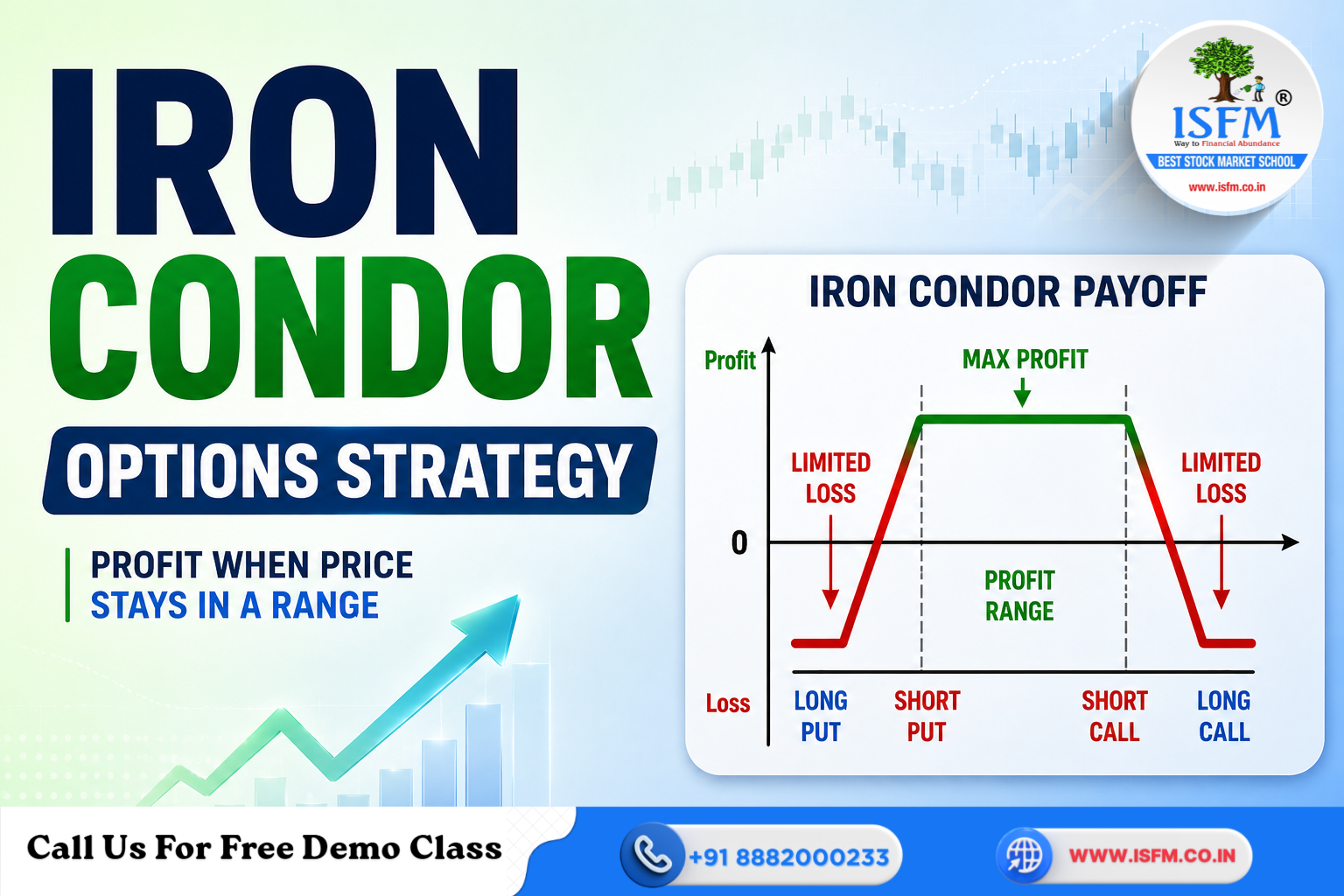
In the Indian stock market, there are many phases when indices like Nifty or Bank Nifty move sideways instead of trending strongly. During such periods, directional trades often fail, but option premium-selling strategies can perform exceptionally well.
One such powerful approach is the Iron Condor strategy—a neutral, defined-risk options strategy designed for traders who expect the market to stay within a range.
If you are new to options strategies, it’s recommended to first understand the basics through a structured options trading course.
What is Iron Condor Strategy?
The Iron Condor is a combination of two spreads:
- Bear Call Spread (sell call + buy higher call)
- Bull Put Spread (sell put + buy lower put)
This creates a four-leg strategy where you:
- Sell an out-of-the-money (OTM) call
- Buy a further OTM call
- Sell an OTM put
- Buy a further OTM put
The goal is simple:
Earn premium while the market stays between the two sold (inner) strikes.
How Iron Condor Works (Short Call Spread + Short Put Spread)
The strategy profits from time decay (theta) and low volatility.
- You collect premium upfront (net credit)
- Profit is maximized when price stays within the range
- Loss is limited due to protective wings (bought options)
This makes Iron Condor a defined risk NSE strategy, unlike naked short straddles or strangles.
For deeper understanding of such combinations, traders often explore advanced derivatives training.
Why Use This Defined-Risk Neutral Strategy?
Iron Condor is widely used because it offers:
- Defined maximum loss
- High probability of profit (~70–80%)
- Lower margin requirement vs naked selling
- Consistent income in range-bound markets
- Strong theta decay benefit
For traders focusing on consistency, structured learning like a stock trading course helps in mastering such setups.
Setup: Strike Selection, Spread Width & Expiry
A successful Nifty Iron Condor setup depends on proper planning:
1. Strike Selection (OTM Wings)
- Sell strikes outside expected range
- Buy further OTM options for protection
2. Spread Width
- Wider spreads = higher risk, higher reward
- Narrow spreads = lower risk, lower return
3. Expiry Choice
- Weekly expiry: faster decay, higher risk
- Monthly expiry: smoother movement, safer approach
Step-by-Step Numerical Example
Let’s assume:
Nifty spot = 24,000
Trade Setup:
- Sell 24,200 CE
- Buy 24,400 CE
- Sell 23,800 PE
- Buy 23,600 PE
Premium Received:
- Total net credit = ₹120 (example)
Key Levels:
- Profit zone: 23,800 to 24,200
- Max profit = ₹120
- Max loss = Spread width (200) – 120 = ₹80
Payoff at Expiry:
| Nifty Price | Outcome |
| 23,600 | Max Loss |
| 23,800 | Breakeven |
| 24,000 | Max Profit |
| 24,200 | Breakeven |
| 24,400 | Max Loss |
This clearly shows how the neutral premium strategy earns when price stays within the inner range.
Real-World Indian Market Scenario
Imagine Nifty trading between 23,900–24,200 for several sessions due to:
- No major economic events
- Low volatility environment
- Consolidation after earnings
In such a case, directional trades struggle, but an Iron Condor India setup works efficiently by capturing time decay.
Unlike a short strangle:
- Risk is limited
- Margin requirement is lower
- Stress is significantly reduced
This makes it ideal for disciplined traders.
When to Use Iron Condor in Indian Markets
Best conditions:
- Sideways or consolidating market
- Low implied volatility
- No major news/events expected
- Stable index movement
Avoid using it during:
- Budget announcements
- RBI policy days
- Breakout or trending markets
Key Risks and Management Techniques
Risks:
- Breakout beyond outer strikes → loss
- Limited but still significant loss potential
- Early assignment risk
- Volatility spike affecting option pricing
Management Techniques:
- Adjust position if price nears outer strikes
- Exit early at 50–70% profit
- Avoid holding till expiry during high volatility
- Use proper position sizing
To master risk management professionally, traders often choose mentorship-based programs like the Chartered Stock Trading Expert Course.
When to Exit the Position
Smart traders don’t wait till expiry every time.
Exit when:
- 50–70% of max profit is achieved
- Market shows breakout signs
- Volatility increases sharply
- One side becomes threatened
Quick Recap and Takeaway
- Iron Condor is a neutral, defined-risk premium strategy
- Combines bull put spread + bear call spread
- Works best in range-bound markets
- Profit comes from time decay (theta)
- Loss is limited but must be managed
If used with discipline, Iron Condor can become a consistent income strategy for Indian traders.