
Author name: Mr. Sushil Alewa

Sushil Alewa is the Founder & Director of ISFM – International School of Financial Market, established in July 2014 with the aim of bridging the gap between academic finance and real, practical market participation. A Certified Financial Planner - CFP from US (Reg. No. IN 51734) and SEBI Registered Research Analyst (Reg. No. INH100009433) with an MBA in finance, Sushil has spent more than 16 years in the Indian capital markets. His career spans equity advisory and research at Sharekhan, India Infoline, Indiabulls and Religare, followed by HNI portfolio advisory at Anand Rathi Wealth Management — experience that shaped the practitioner-first approach ISFM is known for today. He is an active trader and researcher, and his teaching draws directly from live market work rather than theory alone. His areas of focus include technical analysis, derivatives and options strategies, equity research and fundamental analysis, and investor awareness. Sushil is currently a PhD scholar researching options trading strategies, and regularly conducts investor awareness and financial literacy programs for students, professionals and corporate audiences.

Top Adani Group Stocks
Blog

Top Adani Group Stocks to Watch in 2025: Features, Pros, Cons & Growth Potential

When it comes to India’s infrastructure and energy giants, Adani Group stands as a formidable force shaping the nation’s economic landscape. Led by billionaire industrialist Gautam Adani, the conglomerate has diversified into sectors like renewable energy, ports, logistics, data centers, FMCG, airports, and more. With multiple companies listed on Indian stock exchanges, Adani Group stocks have captured investor interest—some with stunning rallies, others with long-term potential. Here’s a deep dive into the top listed Adani stocks, their features, advantages, drawbacks, and the ones poised for future growth. Top Listed Adani Group Stocks in India (2025) 1. Adani Enterprises Ltd (AEL) Ticker: NSE: ADANIENTSector: Incubator/Infrastructure/Green EnergyMarket Cap: ₹4.5+ Lakh CrorePE Ratio: 120+ (as of mid-2025) 🧩 Key Features: ✅ Pros: ❌ Cons: 2. Adani Green Energy Ltd (AGEL) Ticker: NSE: ADANIGREENSector: Renewable EnergyMarket Cap: ₹3.5+ Lakh Crore 🧩 Key Features: ✅ Pros: ❌ Cons: 3. Adani Ports and Special Economic Zone Ltd (APSEZ) Ticker: NSE: ADANIPORTSSector: Logistics/Port InfrastructureMarket Cap: ₹2.2+ Lakh Crore 🧩 Key Features: ✅ Pros: ❌ Cons: 4. Adani Power Ltd Ticker: NSE: ADANIPOWERSector: Thermal PowerMarket Cap: ₹1.7+ Lakh Crore 🧩 Key Features: ✅ Pros: ❌ Cons: 5. Adani Total Gas Ltd (ATGL) Ticker: NSE: ATGLSector: City Gas DistributionMarket Cap: ₹1.5+ Lakh Crore 🧩 Key Features: ✅ Pros: ❌ Cons: Brightest Adani Stocks for Future Growth While each Adani stock plays a critical role in India’s infrastructure push, the following stocks stand out for their long-term growth potential: 🔹 Adani Green Energy Ltd (AGEL) 🔹 Adani Enterprises Ltd (AEL) 🔹 Adani Ports (APSEZ)  Pros & Cons of Investing in Adani Group Stocks ✅ Pros: ❌ Cons: Investor Insight: Should You Invest in Adani Stocks in 2025? Adani Group’s listed entities are at the forefront of India’s transformation—from energy self-reliance to trade expansion and urban infrastructure. While short-term corrections may occur due to market fluctuations or valuation adjustments, the long-term story remains compelling. If you’re looking for:  Conclusion: Are Adani Stocks Worth Adding to Your Portfolio? Yes—but with caution and strategy. Adani Group stocks are not for conservative investors, but those who can handle volatility and seek long-term gains may find serious value here. Do your due diligence, diversify wisely, and align your investments with your risk tolerance.


Indigenous AI-Native Telecom Technologies
Blog

 India Accelerates Indigenous AI-Native Telecom Technologies; Bids to Host ITU PP-30 Summit

India is taking a major leap toward global telecom leadership by spearheading the development of AI-native telecom technologies, aiming to shape future global standards. The Department of Telecommunications (DoT) has confirmed that premier Indian institutions like C-DoT, IITs, and various top R&D centers are actively designing next-generation AI-driven telecom networks, while influencing global protocols through bodies like ITU-T, ITU-R, and 3GPP.  India Leads the Charge in AI-Powered Telecom Evolution At the ITU-T Focus Group meeting on AI-Native for Telecommunication Networks (FG-AINN), Sanjeev K. Bidwai, Member (Technology), DoT, emphasized India’s strategic vision for AI-integrated telecom. Citing the ITU-R M.2160 vision document, he noted that AI will be the cornerstone of future telecom networks, enabling: “AI-native networks aren’t just technological innovations — they are strategic assets,” Bidwai added. 🎓 Want to stay ahead in the tech-finance race? ISFM’s Chartered Financial Market Expert Course covers technical analysis, derivatives, and digital-era market applications — ideal for future-ready professionals.  India’s Competitive Edge in AI-Telecom Innovation With its vast telecom user base and a thriving startup ecosystem, India offers an unparalleled testing ground for AI-native solutions. Bidwai credited India’s advantage to its: He also highlighted a key collaboration between IIT Jodhpur and C-DoT, where teams are building AI frameworks for automated network diagnostics and real-time management, compliant with Open RAN (ORAN) standards. India is also exploring AI-powered digital twin technology for smarter telecom infrastructure planning. 🧠 Interested in learning how AI meets data analysis? Explore ISFM’s Algo Trading Course — combining finance, coding, and automation, it’s your gateway to tech-enabled markets. 🤝 India Eyes Global Leadership in Telecom Policy and Standards India has formally proposed to host the ITU Plenipotentiary Conference 2030 (PP-30) and seeks continued membership in the ITU Council (2027–2031). Additionally, India is backing M. Revathi — a trailblazing nominee to become the first woman and first Asia-Pacific candidate to lead the ITU Radiocommunication Bureau (2027–2030). 🧠 Why AI-Native Networks Matter The FG-AINN, created in July 2024 by ITU-T Study Group 13, is focused on redefining the architecture of telecom systems by embedding AI at the core. The goal is to create networks that are: Use cases under development include smart cities, connected mobility, remote healthcare, and real-time disaster response systems. 💡 Bridge the knowledge gap between finance and tech. ISFM’s Technical Analysis Course offers real-time data reading and predictive analytics — critical in telecom’s AI age.  Global Voices Back AI in Telecom In a special video message, Seizo Onoe, Director of ITU’s Telecommunication Standardisation Bureau, emphasized the transformative impact of AI-native automation on telecom performance, self-management, and real-time decision-making.Atsuo Okuda, ITU Regional Director for Asia-Pacific, echoed similar views, calling for stronger collaboration frameworks to promote inclusive, secure, and high-performing telecom infrastructures across Asia and beyond.  Conclusion: India’s AI-Telecom Strategy is Global in Ambition With its focus on AI-native telecom research, policy innovation, and global standardization, India is not only reshaping its digital landscape but also helping define the future of global telecommunications. From 5G and ORAN testbeds to ITU leadership, India’s AI telecom strategy is well-positioned to create a global ripple effect in the years to come. 🎯 ISFM is grooming the next wave of digital-age financial leaders. Join a course that complements India’s AI and telecom growth story — whether in market tech, trading algorithms, or economic analytics.

Why Retail Investors Are Losing Confidence in Equity Mutual Funds
Blog

Why Retail Investors Are Losing Confidence in Equity Mutual Funds

Equity mutual funds—long hailed as the go-to investment for long-term wealth creation—are now facing growing skepticism among retail investors. As market conditions evolve and new investment options emerge, investor behavior is shifting. Here’s why many are rethinking their equity mutual fund strategy in 2025. Market Volatility Is Shaking Investor Confidence Recent stock market turbulence has triggered a noticeable dip in investor enthusiasm. After the strong post-pandemic rally in 2021–2022, global and domestic equities have entered a volatile phase. Uncertainty stemming from geopolitical tensions, rising inflation, and tighter monetary policies by central banks has made equity markets unpredictable. Retail investors, many of whom entered during the bull market expecting double-digit returns, are now facing a reality check. The gap between expectation and actual performance is pushing some to exit prematurely—eroding the very benefits of long-term compounding that equity mutual funds offer. 📚 Learn how to analyze market trends with ISFM’s Technical Analysis Course Active Funds Struggle to Outperform Indexes One of the major pain points for investors has been the underperformance of actively managed mutual funds. Particularly in the large-cap category, many funds have failed to consistently beat benchmark indices such as the Nifty 50 and Sensex. At the same time, index funds and ETFs—offering lower expense ratios—are delivering comparable or even better returns. This has sparked a growing debate: Why pay higher fees for underwhelming active management when passive strategies can do the job at a fraction of the cost? 💡 ISFM’s Chartered Financial Market Expert Program covers equity, mutual funds, and passive investment strategies to help investors make informed decisions. Short-Term Thinking Is Undermining Long-Term Gains A major contributing factor to the current disillusionment is investor behavior itself. Many retail investors fall into the trap of chasing returns or reacting emotionally to market corrections. This short-term mindset—fueled in part by social media noise—leads to frequent redemptions and profit booking, often at the worst possible times. This cycle of buy-high, sell-low undermines the core principle of long-term investing and prevents investors from harnessing the power of compounding returns. 🧠 Master disciplined investment techniques with ISFM’s Stock Market Investment Course Rise of Fixed Income and Alternative Investment Options With interest rates climbing, fixed deposits (FDs)—especially from small finance and public sector banks—are now offering attractive returns, often around 7–8%. For conservative investors and retirees, these options provide capital safety and predictable returns—making them an appealing alternative to equities. Gold ETFs, debt funds, and hybrid funds are also seeing increased inflows. These products offer a balance between risk and return, attracting those seeking more stability in uncertain times. 📈 Explore ISFM’s Fundamental Analysis Course to evaluate diversified investment avenues and build robust long-term portfolios. Transparency Concerns and Fund Charges Add to the Worry Although SEBI and AMFI have made strides in improving transparency, many investors remain unsure about the fees they’re paying and whether fund managers are truly delivering value. High portfolio churn and lackluster returns raise questions about fund strategy and execution. As investors become more financially literate, they’re asking tougher questions. They want clear justification for fund performance and more transparency around cost structures. 🛠️ ISFM’s Certified Financial Planning Course empowers learners to evaluate mutual funds, understand cost structures, and optimize financial planning. Is It the End of the Road for Equity Mutual Funds? Not at all. Despite growing skepticism, equity mutual funds remain a powerful tool for long-term wealth creation—but only when used correctly. Investors need to: 🧭 Need career direction? Explore all ISFM Stock Market Courses or schedule a free demo or counseling session Final Thoughts The disillusionment with equity mutual funds is not just about returns—it’s about evolving investor expectations in a rapidly changing financial ecosystem. While equity funds have their challenges, they still offer unmatched potential for long-term wealth accumulation. ✅ The key? Stay informed, stay invested, and stay disciplined. 🎓 Train with Professional Traders at ISFM – Join a new batch starting soon📍 Visit us at: ISFM, Sector 38, Gurgaon (Near Medanta Hospital)📞 Call: +91 8882000233 | Visit Website

Top 10 Best-Performing PMS Strategies in 2025
Blog

Top 10 Best-Performing PMS Strategies in 2025

May 2025 proved to be a robust month for Portfolio Management Services (PMS) in India, with several strategies delivering double-digit returns. The top 10 PMS strategies posted returns ranging from 16.49% to 13.80%, highlighting strong market momentum and increasing investor optimism.  Performance Highlights: 2025 These returns reflect a bullish trend across Small & Midcap, Multicap, and Flexi Cap segments.  Sectoral Trends and Holdings Analysis Leading PMS performers leaned into high-growth sectors:  Strategy Deep-Dive: Top PMS Fund Managers 1. Money Grow – Small Midcap Fund 2. NAFA Clean Tech Portfolio 3. Negen Capital Multicap Fund 4. Aurum Small Cap Opportunities 5. Samvitti Capital – Multicap 6. Ambit Emerging Giants 7. Bin73 Sunrise Alpha 8. Decennium Opportunity Fund 9. Bonanza Multicap Fund 10. Accelt Long Term Equity Fund  Key Takeaways for Investors  Why Track PMS Performance? For HNIs and serious investors, PMS offers curated, actively managed portfolios designed to generate alpha. Monitoring performance and understanding fund strategies is essential for aligning with your risk and return goals. 📚 Want to Learn How to Evaluate & Invest in PMS or Stock Markets? Explore expert-level stock market training at ISFM – India’s Best Stock Market School. Learn from SEBI-registered advisors and industry professionals through practical, job-oriented programs: ✅ New Batches Every Month📍 Visit us: ISFM Location – Gurgaon📞 Call: +91 8882000233 | Website

Blog

Singularity AMC Eyes $100 Billion Market Cap Potential Across High-Growth Sectors

Energy transition, electronics manufacturing, and medical devices are among the top investment themes of the oversubscribed SGOF II fund by Singularity AMC. The growth equity platform, led by founder and CIO Yash Kela, projects a combined market capitalization of $100 billion across these transformative sectors. Key Sectors with Explosive Growth Potential The SGOF II fund aligns closely with India’s broader ambition for strategic autonomy. The sectors currently in focus include: 📈 According to ISFM – India’s Best Stock Market School, these high-growth sectors are now also integral to career-oriented training programs, offering new-age opportunities for retail investors, traders, and future professionals. For example: SGOF II: Sector-Driven Strategy Backed by Strong Returns The ₹1,800 crore SGOF II fund has already invested in eight dynamic companies, such as: These are sectors that ISFM’s Algo & Derivatives Courses prepare students to analyze using real-time data, chart patterns, and strategic investment logic. ️Building Future-Ready Companies from Scratch A standout feature of Singularity AMC’s model is greenfield incubation—launching companies from the ground up in fields like solar inverters and commercial EVs. The ISFM Chartered Financial Market Expert Program trains candidates in spotting such long-term, scalable value across sectors. 💡 “These companies can reach profitability in 3–4 years,” says Kela. “Our goal is to deliver 6x to 10x ROI—something we emphasize at ISFM while teaching real-world portfolio strategy.” Innovative Fund Structure for Faster Returns SGOF II optimizes DPI (Distributions to Paid-In capital) by distributing capital: This structured investment mix supports both early returns and long-term capital appreciation, concepts extensively covered in ISFM’s Stock Market Investment Course. High-Quality Deal Flow at Reasonable Valuations Despite surging interest in sectors like electronics, cleantech, and mobility, Singularity AMC maintains access to proprietary deals at fair valuations, avoiding the price run-ups common in SaaS or consumer tech. 🎯 Students at ISFM learn to analyze such valuation trends through Technical Analysis Courses and Advanced Derivatives Training, gaining skills to assess risk-adjusted entry points. Conclusion With a focus on next-gen industrial sectors, deep incubation strategies, and consistent IRRs above 30%, Singularity AMC is helping shape India’s future as a global innovation and manufacturing hub. 🚀 Ready to explore career and income opportunities in these high-growth sectors?Get trained by professional traders and financial experts at ISFM – The Best Stock Market School in India, offering both online and offline courses in equity, derivatives, fundamental analysis, and algo trading.

Sub-Broker-Norms-Under-Review-SEBI-and-Exchanges-to-Roll-Out-Stricter-Guidelines-Soon_www.isfm_.co_.in_-scaled.png
Blog

Sub-Broker Norms Under Review: SEBI and Exchanges to Roll Out Stricter Guidelines Soon

In a move aimed at strengthening investor protection and enhancing compliance, stock exchanges—under the guidance of the Securities and Exchange Board of India (SEBI)—are expected to release a consultation paper reviewing the regulatory framework for sub-brokers, also known as Authorized Persons (APs). What’s Changing in the Sub-Broker Regulations? According to industry insiders, a working group has already submitted a detailed report, and the exchanges are preparing to finalize proposed changes. These updates may include: Two-Tier Classification of Authorized Persons Likely The upcoming consultation paper is expected to introduce a dual-tier system for APs: 1. Referral-Based Authorized Persons 2. Full-Service Authorized Persons Educational & Experience Criteria Under Consideration Regulators may propose stricter eligibility requirements: Existing APs not meeting the new norms might be given a window to clear the NISM Series VII certification, which covers: Explore NISM-focused training at ISFM – India’s Best Stock Market School, where you can get certified with expert guidance. Enhanced Monitoring & Compliance Measures To tackle misuse and protect investors, the proposed framework may include: No Cap on Referral Fees or AP Limits SEBI has clarified there will be no limit on referral fees or the number of APs a broker can appoint—supporting wider financial inclusion and partner-driven growth models. Interested in becoming a certified professional in financial markets?Check out ISFM’s flagship Chartered Financial Market Expert Course—which includes NISM modules and real-world trading exposure. Push for Uniform Regulations Across Exchanges The paper is likely to push for harmonization of sub-broker norms across NSE, BSE, and other platforms, as there are currently minor variations in implementation. Conclusion The upcoming SEBI-backed consultation paper is set to reshape sub-broker regulations in India, focusing on transparency, compliance, and investor protection. Stakeholders—including aspiring and current sub-brokers—are encouraged to upskill with market-relevant training from institutions like ISFM Gurgaon, which offers:

SEBI Launches ‘Valid’ – A New UPI-Based Fraud-Prevention Mechanism for Safer Market Transactions_www.isfm.co.in.png
Blog

SEBI Launches ‘Valid’ – A New UPI-Based Fraud-Prevention Mechanism for Safer Market Transactions

SEBI (Securities and Exchange Board of India) has introduced a game-changing digital payment safeguard named ‘Valid’, aimed at protecting investors from financial fraud in capital market transactions. This innovative UPI-based payment mechanism is designed to ensure that investors only send money to verified SEBI-registered intermediaries, adding a vital layer of transparency and trust in the securities ecosystem.  What is SEBI’s Valid UPI Mechanism? ‘Valid’ is a Unified Payments Interface (UPI)-based structured payment ID that will be issued exclusively to SEBI-registered market participants—such as stock brokers, mutual fund houses, investment advisers, research analysts, and portfolio managers. This verified payment tool allows these entities to collect funds from clients through a secure and traceable route, thereby reducing the risk of fraudulent activities and unregistered money collection schemes.  Why SEBI Introduced the Valid UPI System SEBI has observed a growing threat from unregistered players soliciting investments under false pretenses. This fraudulent behavior often results in severe financial losses for investors. To counter this, SEBI collaborated with NPCI (National Payments Corporation of India), banks, and market participants to develop a secure, verified UPI ecosystem.  How Does ‘Valid’ Work?  Launch Date and Transaction Limit 🧭 SEBI Check: Real-Time UPI ID Verification Tool In a move to further strengthen investor protection, SEBI is also developing a new tool called “SEBI Check”. This feature will allow users to:  SEBI’s CeFCoM: A Secure Fee Payment System for Investment Advisers and Analysts Earlier, SEBI introduced the Centralized Fee Collection Mechanism (CeFCoM) for Investment Advisers (IA) and Research Analysts (RA). This system is a secure, closed-loop payment gateway enabling investors to pay advisory fees only to verified professionals through methods like: This enhances both compliance and investor trust by restricting fee payments to only SEBI-recognized experts.  Final Thoughts SEBI’s introduction of the ‘Valid’ UPI handle and tools like SEBI Check and CeFCoM mark a significant milestone in digital transparency, investor protection, and fraud mitigation in Indian financial markets. These steps reflect SEBI’s proactive stance in using fintech innovation to make Indian capital markets safer, faster, and more reliable for millions of retail and institutional investors.

gold loan rules
Blog

RBI Tightens Gold Loan Rules: What Investors Need to Know

On June 6, 2025, the Reserve Bank of India (RBI) released updated guidelines regulating loans against gold and silver assets. The move aims to strengthen risk management in the gold loan sector by placing restrictions on what can be accepted as collateral. The key takeaway: banks and NBFCs can no longer extend loans against gold bars, digital gold, or gold/silver-backed mutual funds and ETFs. Why Did RBI Tighten Gold Loan Rules? The central bank’s primary goal is to curb credit risk and market volatility linked to highly speculative gold-based financial instruments. Assets such as gold bullion, gold and silver ETFs, and mutual fund units are susceptible to sudden price fluctuations, which pose significant risk to lenders. “Gold bullion or ETFs are fundamentally different from gold jewellery. Their value can swing sharply, exposing lenders to losses,” says Shaji Varghese, CEO of Muthoot FinCorp. These changes are part of RBI’s broader strategy to enhance the stability and transparency of asset-backed lending across all regulated financial institutions. Key Highlights of the New RBI Guidelines 🚫 Prohibited Collateral: ✅ Permitted Collateral: No Major Impact on Gold/Silver ETF Investments While investors may worry about the implications, experts clarify that this move is more about loan eligibility than investment returns. “Most investors purchase gold or silver ETFs for diversification, not as collateral,” notes Puja Singh, CEO of Manipal Fintech. The restrictions won’t affect portfolio allocation or capital gains from these financial instruments, and ongoing investments in ETFs or digital gold remain unaffected. What Happens to Existing Loans? According to Lt. Col. Rochak Bakshi, Founder of True North Finance, loans sanctioned before April 1, 2026, are grandfathered under the old rules. This means they can continue as is until maturity—no need for prepayment or changing the collateral structure. Concerns Over Financial Inclusion While the move improves regulatory oversight, some believe it could have unintended consequences. “Excluding ETFs and digital gold could reduce financing options, especially for tech-savvy retail investors who prefer holding digital assets,” says Bakshi. The lack of a centralized registry for ETFs also raises concerns about double pledging, which may have influenced RBI’s cautious stance. A Balancing Act: Risk Management vs Investor Flexibility The new rules reflect RBI’s attempt to strike a balance between risk mitigation and financial accessibility. While gold jewellery continues to be a reliable source of collateral, investors relying on digital gold or ETFs for liquidity may need to explore alternative financing options. For investors seeking to build wealth with better financial planning and training on Sovereign Gold Bonds (SGBs) or gold-related market strategies, institutions like the ISFM – Best Stock Market School offer specialized Fundamental Analysis Training and Certified Financial Planning Course to help navigate new regulations effectively. You can also explore how asset-backed instruments like SGBs can be part of your investment portfolio with ISFM’s expert-led Chartered Financial Market Expert Course — which includes both fundamental and technical analysis for smarter financial decisions. Final Thoughts The RBI’s gold loan policy revamp is a clear step toward improving credit discipline and systemic resilience. For investors, understanding these changes is key to making informed decisions around asset allocation and liquidity planning. If you’re looking to deepen your understanding of market regulations, gold-backed investments, or credit risk management, join ISFM and turn your financial knowledge into lasting success.

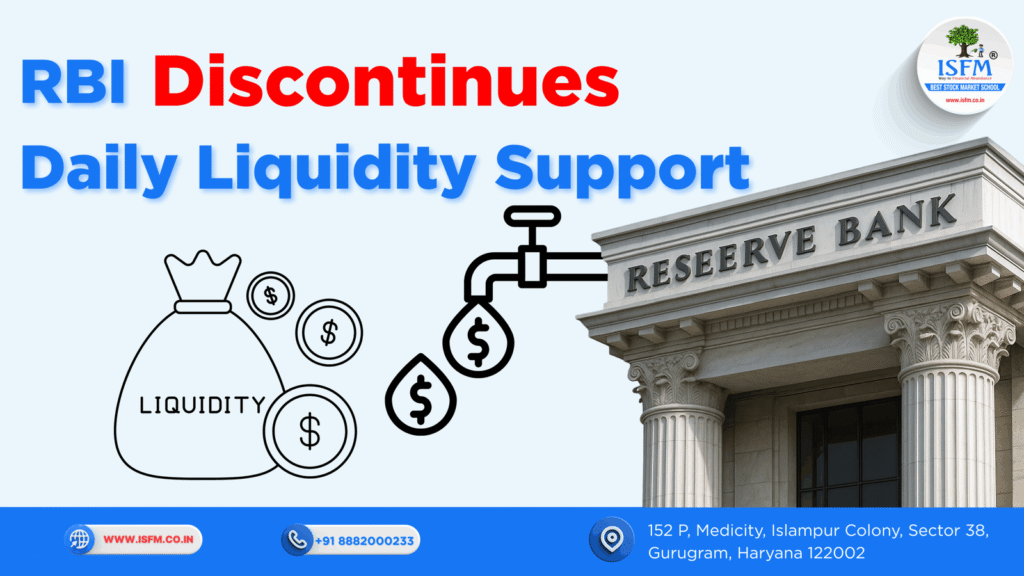
The Reserve Bank of India (RBI) has decided to discontinue its daily liquidity support through Variable Rate Repo (VRR) auctions starting June 11, 2025. This move follows a sustained improvement in banking system liquidity, which has turned into a massive surplus since April.
Uncategorized

RBI Discontinues Daily Liquidity Support: Here’s Why the Central Bank Ended Daily VRR Auctions

The Reserve Bank of India (RBI) has decided to discontinue its daily liquidity support through Variable Rate Repo (VRR) auctions starting June 11, 2025. This move follows a sustained improvement in banking system liquidity, which has turned into a massive surplus since April. Want to understand how RBI policies affect markets? Learn how macroeconomic indicators shape trading with ISFM’s Fundamental Analysis Course.  What Is Daily VRR and Why Was It Introduced? Variable Rate Repo (VRR) is a short-term monetary tool that allows the RBI to inject liquidity into the banking system when there’s a cash crunch. Banks and primary dealers bid at rates generally higher than the repo rate to borrow funds for one day. Amid tightening liquidity in late 2024—caused by tax outflows, weak government spending, and foreign portfolio investor (FPI) sell-offs—the RBI began conducting daily VRR auctions from January 16, 2025 to support banks and stabilize short-term interest rates. Want to decode how central banking tools influence interest rates? Explore ISFM’s Stock Market Investment Course for deeper insights.  How Much Liquidity Did the RBI Inject Through Daily VRR? According to RBI data, from January to June 2025, the central bank pumped a staggering ₹43.61 lakh crore via daily VRRs. These funds were overnight infusions, reversed the next day. Here’s a month-wise breakdown:• January: ₹13.48 lakh crore• February: ₹17.75 lakh crore• March: ₹8.91 lakh crore• April: ₹2.13 lakh crore• May: ₹1.07 lakh crore• June (till 9th): ₹25,899 crore  Why Is RBI Halting Daily VRR Now? RBI’s decision is rooted in significant improvements in liquidity conditions. Since April 1, 2025, a series of durable liquidity measures has resulted in a surplus of over ₹3 lakh crore. These include:• Open Market Operations (OMOs): RBI injected ₹4.84 lakh crore via 15 bond purchase auctions.• USD/INR Buy-Sell Swaps: Infused liquidity worth $25.2 billion.• Bond redemptions and interest payments, along with month-end government payouts like salaries and pensions. With these drivers, the banking system is awash with funds, rendering daily VRR unnecessary. Learn how liquidity and monetary policy affect asset prices in ISFM’s Chartered Financial Market Expert Course.  Did Daily VRR Help Banks? Yes. Daily VRR auctions were highly effective in easing short-term liquidity stress. Market participants note that these injections helped maintain overnight call rates near or below the repo rate, ensuring smoother interbank transactions during the liquidity crunch. ️ What Caused the Liquidity Shortage Before January? Between November and December 2024, liquidity in the banking sector turned negative due to:• Large tax outflows• Heavy FPI equity sell-offs• Forex market interventions by RBI to stabilize the rupee• Sluggish government spending In response, the RBI initiated daily VRR operations to offset the strain. If you want to analyze these real-world triggers using trading tools like OI, PCR, and Greeks, join ISFM’s Advanced Derivatives Training.  What’s the Outlook for Liquidity in 2025? Experts predict a continued liquidity surplus throughout the remainder of the year, driven by:• RBI Surplus Transfer: ₹2.69 lakh crore transferred to the government for FY25.• CRR Cut: A 100 basis points (bps) reduction in the Cash Reserve Ratio in June will inject ₹2.5 lakh crore between September and November. These moves are expected to further strengthen liquidity, giving the RBI room to shift away from daily support tools.  Key Takeaways for Investors and Markets • RBI’s exit from daily VRR signals robust banking system liquidity.• Markets may expect more stable interest rates in the short term.• Policy focus is likely to shift from short-term fixes to long-term liquidity management. Equip yourself with professional-grade knowledge through ISFM’s Chartered Stock Trading Expert Course, designed to empower traders and investors to interpret such macroeconomic shifts and profit from them.

Orkla India IPO
Blog

Orkla India IPO: MTR and Eastern Brand Owner Plans Complete Offer for Sale

Orkla India, the powerhouse behind popular spice and packaged food brands MTR and Eastern, has officially filed its Draft Red Herring Prospectus (DRHP) with the Securities and Exchange Board of India (SEBI), marking the first step towards launching its Initial Public Offering (IPO). According to the DRHP filed on Tuesday, the IPO will be a complete Offer for Sale (OFS) involving 2.28 crore equity shares, which will be offloaded by the company’s promoters and existing shareholders. This means that the company will not raise any fresh capital, and all proceeds will go directly to the selling shareholders.  Key Highlights of Orkla India’s IPO Filing: Orkla India, formerly known as MTR Foods, is a leading Indian packaged food company operating in multiple categories including spices, ready-to-eat meals, masalas, breakfast mixes, and sweets. It retails under the household names MTR, Eastern, and Rasoi Magic.  Market Landscape & Industry Outlook: As per a report by Technopak, the Indian packaged food industry was valued at ₹10.18 lakh crore in FY24, growing at a CAGR of 10.8% since FY19. Orkla India stands as a major player in this rapidly growing segment, riding on strong brand equity and a loyal consumer base. ️ IPO Lead Managers: Strategic Moves Before the IPO: In March 2025, as part of a corporate governance revamp, Orkla India appointed four independent directors to its board, signaling strong intent to align with best practices and strengthen investor confidence ahead of the IPO.  What This Means for Investors: With a legacy of trusted food brands and a strong position in India’s fast-growing FMCG sector, Orkla India’s IPO is expected to attract significant investor attention. However, as it is an OFS, prospective investors should note that no fresh capital is being infused into the business, and the offering is solely a shareholder exit event.  Learn Stock Market Investing with ISFMAs IPOs like Orkla India’s attract investor interest, it’s essential to understand how to evaluate such offers. The Institute of Stock Market (ISFM) offers expert-led Stock Market Investment Courses, Fundamental Analysis Training, and specialized classes on IPOs and equity research.

Scroll to Top