
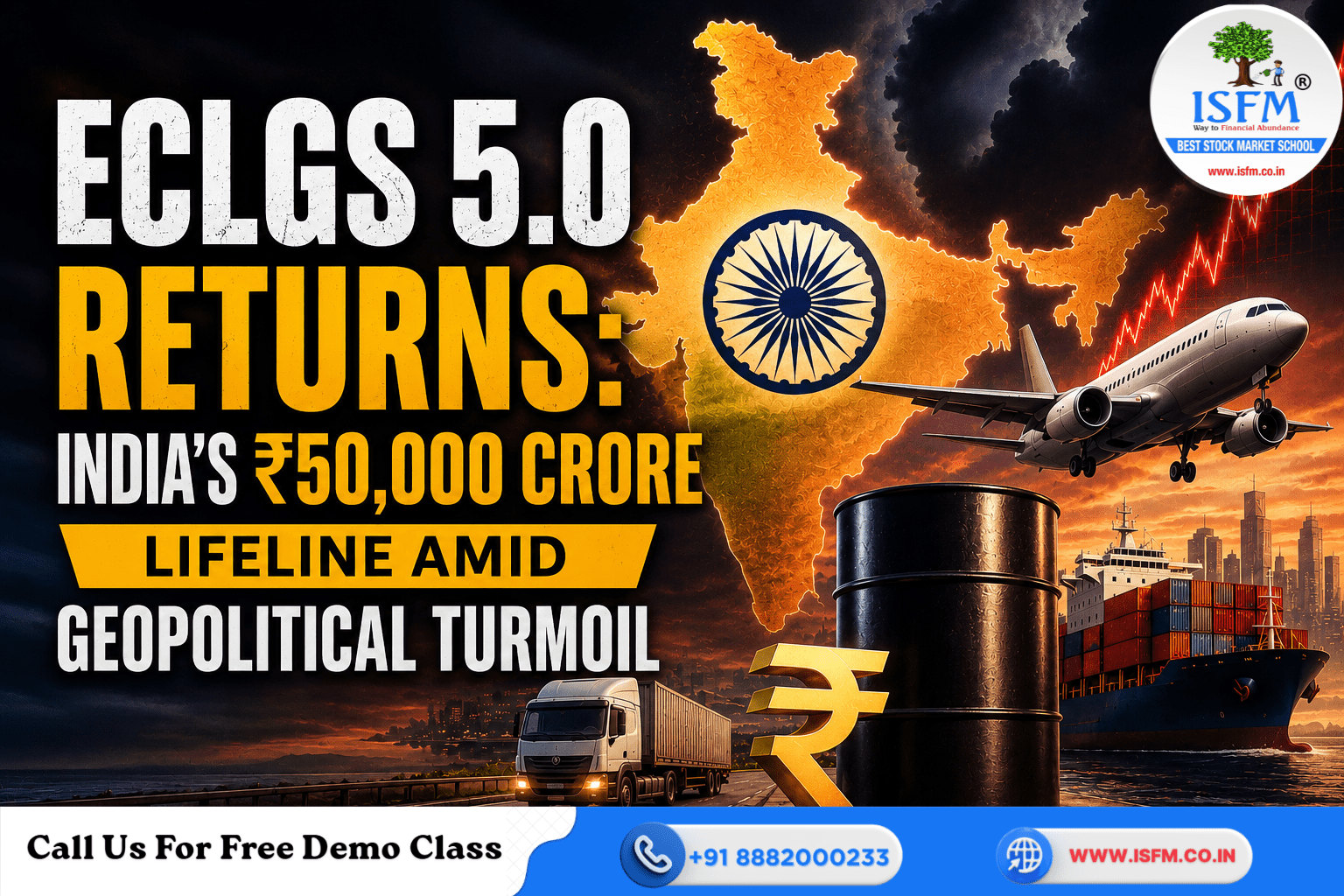
ECLGS 5.0 Returns: India’s ₹50,000 Crore Shield Against a Global Economic Shock
India Is Preparing Before the Crisis Deepens
The West Asia conflict is no longer just a geopolitical issue. Rising crude oil prices, disrupted shipping routes, and supply-chain uncertainty are beginning to create pressure on businesses globally. For India, the biggest risk is not only inflation — it is a sudden slowdown in business cash flow and bank lending.
To prevent that from happening, the government has revived ECLGS 5.0 (Emergency Credit Line Guarantee Scheme), a crisis-era support mechanism first introduced during Covid-19.
This time, the Centre has approved a broader ₹50,000 crore economic package, with the main focus on restoring credit flow to businesses facing temporary liquidity stress. The move is especially important for MSMEs and airlines, two sectors highly sensitive to rising costs and global disruptions.
For traders and investors, this policy could influence aviation stocks, MSME-focused midcaps, and even banking sentiment over the coming months. Investors already tracking banking sector trends, crude oil impact on Indian markets, or aviation stock opportunities should closely monitor how this liquidity support changes market sentiment. Traders looking to strengthen their understanding of market trends and macroeconomic analysis can also explore ISFM Stock Trading Courses.
What Exactly Has the Government Announced?
Under ECLGS 5.0, the government has allocated ₹18,100 crore, which is expected to unlock nearly ₹2.55 trillion in additional loans across the economy.
The structure of the scheme is designed to encourage banks to continue lending during uncertain conditions. MSMEs will receive a 100% government guarantee on additional loans, while airlines and large firms will receive 90% guarantee coverage.
Businesses can borrow up to 20% of their peak FY26 working capital usage, while airlines can access loans of up to ₹1,500 crore each. MSME loans will come with a five-year tenure and a one-year moratorium, giving businesses breathing room before repayments begin.
The concept behind the scheme is simple: if geopolitical disruptions are creating temporary stress, the government will absorb part of the lending risk so banks do not suddenly tighten credit.
That matters because when lending slows, even fundamentally strong businesses can face operational pressure. This is particularly relevant for companies in sectors like capital goods, manufacturing, logistics, and export-driven industries where working capital cycles are critical.
Why the Aviation Sector Became a Priority
Among all industries, aviation has emerged as one of the most vulnerable sectors in the current environment.
Airlines are facing rising aviation turbine fuel costs due to higher crude oil prices. At the same time, the weakening rupee has increased dollar-denominated expenses such as aircraft leasing and maintenance payments. Route disruptions in West Asia are also increasing operational uncertainty and flight costs.
To address this, the government enabled around ₹5,000 crore in additional support specifically for airlines.
The aviation business depends heavily on uninterrupted cash flow. Even short-term liquidity issues can quickly affect fuel payments, salaries, maintenance schedules, and daily operations. By stepping in early, policymakers are trying to prevent temporary stress from turning into a larger operational crisis.
For stock market participants, aviation stocks could remain highly volatile, but liquidity support may improve short-term sentiment in the sector. Traders already studying technical setups and momentum-based trading strategies may also benefit from learning advanced chart-reading techniques through Technical Analysis Course.
Relief Today, Growth Strategy for Tomorrow
Interestingly, the government did not limit its focus to emergency support alone.
Alongside ECLGS 5.0, the Cabinet approved several long-term investment initiatives aimed at strengthening India’s manufacturing and infrastructure ecosystem. These include a ₹5,659 crore Mission for Cotton Productivity, higher sugarcane FRP at ₹365 per quintal, semiconductor projects in Gujarat, and ₹23,437 crore railway multitracking projects.
A new ship repair facility in Gujarat was also approved.
This reflects a broader economic strategy: stabilize businesses in the short term while continuing long-term expansion in manufacturing, logistics, and infrastructure.
That balance is important because economic confidence depends not only on crisis management, but also on future growth visibility.
What This Means for Traders and Businesses
ECLGS 5.0 effectively acts as a financial shock absorber for the Indian economy.
The government understands that global disruptions can spread into the domestic banking system through weaker cash flows and cautious lending behavior. By offering sovereign-backed guarantees early, policymakers are trying to prevent a temporary global crisis from triggering a broader domestic slowdown.
For traders, several themes could emerge from this policy move. MSME-focused companies may benefit from improved liquidity conditions, while aviation stocks could see recovery rallies if operational stress eases. Banking stocks may also gain if credit growth remains stable despite global uncertainty.
At the same time, traders should continue tracking key macro indicators such as crude oil prices, rupee movement, inflation data, and RBI policy expectations. Those interested in derivatives-based opportunities during volatile market conditions can also explore Advance Derivatives Training.
Bottom Line
ECLGS 5.0 shows that India is choosing to act early rather than wait for economic stress to spread across the system.
By supporting business liquidity and encouraging continued lending, the government is trying to protect growth momentum during a period of rising global uncertainty.
For investors and traders, this could become an important theme shaping the India economy in 2026.
If you found this blog helpful, You might also like: Wipro 15,000 Cr Buyback