Author name: Mr. Sushil Alewa

Sushil Alewa is the Founder & Director of ISFM – International School of Financial Market, established in July 2014 with the aim of bridging the gap between academic finance and real, practical market participation. A Certified Financial Planner - CFP from US (Reg. No. IN 51734) and SEBI Registered Research Analyst (Reg. No. INH100009433) with an MBA in finance, Sushil has spent more than 16 years in the Indian capital markets. His career spans equity advisory and research at Sharekhan, India Infoline, Indiabulls and Religare, followed by HNI portfolio advisory at Anand Rathi Wealth Management — experience that shaped the practitioner-first approach ISFM is known for today. He is an active trader and researcher, and his teaching draws directly from live market work rather than theory alone. His areas of focus include technical analysis, derivatives and options strategies, equity research and fundamental analysis, and investor awareness. Sushil is currently a PhD scholar researching options trading strategies, and regularly conducts investor awareness and financial literacy programs for students, professionals and corporate audiences.

5Top 10 Stock Market Educators in India
Blog

Top 10 Stock Market Educators in India (2025): Learn from the Best to Build Wealth

India’s financial landscape is evolving rapidly. With more people turning to stock market investing for wealth creation, the demand for credible education is at an all-time high. To guide new and experienced traders alike, we’ve compiled a list of the Top 10 Stock Market Educators in India for 2025—leaders who are revolutionizing financial learning through innovative courses, mentorship, and real-world strategies. 1. Rachana Ranade – India’s Finance Queen 2. Vivek Bajaj – Options Trading Pioneer 3. CA Rachana Phadke – Finance for the Masses 4. Prakash Gaba – The Chart Whisperer 5. Sandip Jain – From Trader to Teacher 6. Dr. Vijay Malik – India’s Value Investing Advocate 7. Anil Singhvi – The Voice of Retail Investors 8. Varun Agarwal – Tech Meets Trading 9. Ashwani Gujral – The Charting Legend 10. Sharique Samsudheen – Personal Finance Guru Conclusion: Choose the Right Mentor for Your Financial Journey The road to financial freedom starts with the right guidance. Whether you’re a beginner looking to invest smartly or a trader seeking advanced strategies, these top stock market educators in India (2025) are worth following. Stay connected with their content, enroll in their courses, and take confident steps toward wealth creation.

Rachana-Ranade-vs-Vivek-Bajaj
Blog

Rachana Ranade vs Vivek Bajaj: Who Is the Best Stock Market Teacher in 2025?

As stock market participation rises among retail investors in India, choosing the best stock market educator becomes crucial. Two names often top the list—Rachana Ranade and Vivek Bajaj. With millions of followers, both are redefining financial education through their courses, content, and platforms. But who truly adds more value in 2025? In this comparison, we explore their backgrounds, teaching styles, platforms, and achievements to help you pick the right mentor for your trading journey. Rachana Ranade: Simplifying Trading with Technical Analysis Quick Profile Background & Journey Born in Mumbai and a Chartered Accountant by qualification, Rachana discovered a calling in teaching retail traders. Her passion for technical analysis led to the creation of her now-viral YouTube channel, launched in 2019. Her visual style and relatable analogies helped bridge the gap for new investors. Courses & Offerings Rachana Ranade’s courses include: These Rachana Ranade courses are offered through her website and mobile app, combining video tutorials with quizzes and assignments. Publications & Insights Investing Philosophy She promotes long-term investments in blue-chip stocks, mutual funds, and index strategies, with occasional guidance on intraday and swing trading using indicators like RSI and MACD. Highlights Vivek Bajaj: Building Financial Literacy through EdTech Quick Profile Career & Mission Vivek Bajaj, an MBA in Finance from IIM Indore, started as a professional trader before venturing into education. In 2015, he co-founded Elearnmarkets, followed by the StockEdge app—an analytics tool used by over 2 million investors and traders. Vivek Bajaj Courses These courses are ideal for those seeking in-depth, structured learning on stock markets, especially on derivatives and long-term investing. Thought Leadership Investing Approach Vivek emphasizes value investing with a mix of active derivatives trading. He often cites companies like ITC, HDFC, and Asian Paints in his case studies. Awards & Impact Rachana Ranade vs Vivek Bajaj: Face-to-Face Comparison Criteria Rachana Ranade Vivek Bajaj Teaching Style Visual, story-driven technical analysis Structured, data-backed fundamental analysis Course Format YouTube, mobile app, eBooks Elearnmarkets LMS, StockEdge app Audience Reach 4M+ YouTube followers 1.5M+ course learners and 2M+ app users Specialization Intraday, swing trading, chart patterns Options, long-term investing, portfolio building Tools & Platforms Personal academy & YouTube StockEdge App, Elearnmarkets Platform SEO-Relevant Strengths Best for beginners, retail traders Best for fundamental investors, F&O learners Who Should You Choose in 2025? 👉 New Traders:Start with Rachana Ranade’s stock market courses to grasp basics like candlestick patterns and chart reading. 👉 Serious Investors:Choose Vivek Bajaj’s Elearnmarkets courses to master portfolio building, options trading, and stock screening. 👉 Looking for Apps?Try StockEdge by Vivek Bajaj for advanced research, or explore Rachana’s mobile platform for course access. FAQs – Rachana Ranade vs Vivek Bajaj Q1: Who is more popular on YouTube?Rachana leads with 4M+ subscribers; Vivek’s Elearnmarkets has around 500K+. Q2: Are their courses beginner-friendly?Yes. Rachana is ideal for newcomers. Vivek offers both beginner and advanced-level finance courses. Q3: Which platform is better for options trading?Vivek Bajaj’s Options Trading courses are more in-depth and professional. Q4: Do they offer free content?Absolutely. Both have free webinars, YouTube videos, and educational tools. Final Verdict: Best Stock Market Educator in India? Choosing between Rachana Ranade and Vivek Bajaj depends entirely on your learning style and financial goals. Explore both before making your decision—many learners even follow both for a 360-degree view of trading and investing!

Raamdeo-Agrawals
Blog

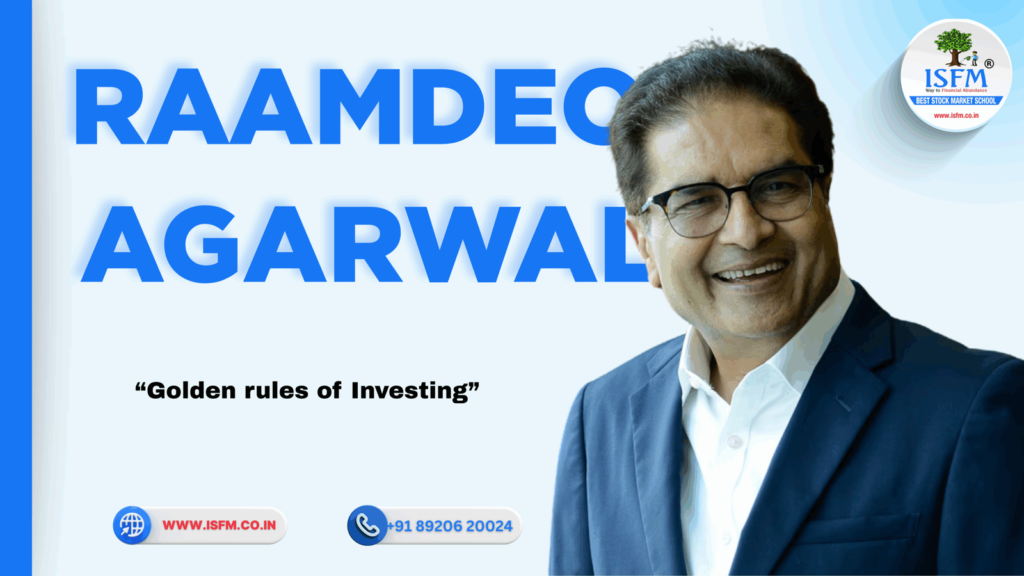
Raamdeo Agrawal’s Golden Rules of Investing – A Timeless Investment Blueprint

When talking about value investing in India, one name that consistently stands out is Raamdeo Agrawal — the strategic mind behind Motilal Oswal Financial Services Ltd. With over 30 years of market experience, Agrawal has championed the art of disciplined stock picking and long-term wealth creation. This comprehensive guide unpacks his iconic investment principles, his professional journey, and the philosophy that continues to influence millions of investors. Who is Raamdeo Agrawal? A Quick Overview Early Life & Education Born in 1956 in a humble village in Rajasthan, Raamdeo’s journey from modest beginnings to becoming a billionaire investor is both inspiring and instructive. After earning his B.Com degree from Mumbai University, he became a Chartered Accountant (CA) and later completed the CFA program. His early curiosity in finance laid the foundation for his value-driven investment approach. The Rise of Motilal Oswal Financial Services In 1987, Raamdeo joined hands with Motilal Oswal to establish a small brokerage firm — which later evolved into one of India’s top financial institutions. Motilal Oswal’s reputation was built on transparent research, ethical investing, and long-term wealth strategies. Today, the firm manages ₹150,000+ crores in assets and is synonymous with quality equity advisory in India.👉 Learn about their evolution Golden Rules of Investing by Raamdeo Agrawal These five core principles have guided Agrawal through bull and bear markets alike: 1. Quality First Invest in businesses with robust financials, high Return on Equity (ROE), and sustainable competitive advantages. 2. Margin of Safety Only buy when the stock is undervalued compared to its intrinsic worth — this reduces downside risk. 3. Think Long-Term Ignore short-term market volatility. Hold fundamentally strong companies for years, even decades. 4. Bet on Ethical Management Only invest in companies led by transparent and honest leadership. 5. Avoid Excessive Debt Stay away from highly leveraged companies. Agrawal believes low debt = high survivability. 🧠 Case in Point: His early bet on Page Industries (Jockey India) yielded massive long-term gains, validating all five rules in one investment. Recommended Reading: Books & Publications Raamdeo Agrawal frequently shares his market wisdom through publications and talks: Notable Portfolio Holdings Agrawal’s personal and firm-level portfolios have included long-term winners such as: Personal Life and Philosophy Married to Usha Agrawal, Raamdeo remains grounded despite his billionaire status. A strong believer in simple living and continual learning, he often credits his family for supporting him through financial and professional ups and downs. Awards, Recognition & Social Contributions Why You Should Follow Raamdeo Agrawal’s Investment Wisdom Whether you’re just starting out or managing a sizable portfolio, Agrawal’s investing rules offer timeless guidance. His stress on research-backed investing, patience, and moral integrity makes him one of the most reliable figures in the Indian stock market ecosystem. Conclusion: A Life Built on Value and Vision Raamdeo Agrawal’s journey from rural Rajasthan to the top echelons of India’s financial elite exemplifies the power of conviction, ethics, and value investing. His golden rules go beyond stock tips—they’re a roadmap for building financial freedom.

ITR-Filing-2025
Blog

ITR Filing 2025: Essential Documents Checklist for a Smooth Income Tax Return Process

Planning to file your Income Tax Return (ITR) for AY 2025–26? Before you get started, make sure you’re well-prepared. While you can begin filing after receiving Form 16 and accessing your updated Annual Information Statement (AIS), it’s crucial to start collecting the right documents early to avoid last-minute hassles. ✅ Visit the Income Tax Portal to stay updated on form releases and filing utilities. ITR Filing Season 2025 Begins The Income Tax Department has officially released the updated ITR forms for Financial Year 2024–25 (Assessment Year 2025–26). These forms include key updates from the Union Budget 2024, especially around capital gains tax rules. However, online filing utilities are still awaited, and most salaried individuals are yet to receive their Form 16 from employers. That said, the due date—July 31, 2025—is approaching fast. Begin your return preparation by collecting the necessary financial and personal documents. List of Important Documents for ITR Filing 2025 Choosing the Right ITR Form Even though ITR-1 (Sahaj) has been simplified, it now accommodates certain capital gains—such as those from equity shares and mutual funds (up to ₹1.25 lakh annually)—subject to conditions. However, using the wrong form can lead to your return being marked as defective. 👉 Check which ITR form applies to you Tax-Saving Documents You Must Keep Handy For Section 80C and 80CCD(1B) For Section 80D For Section 80E For Section 24(b) For Section 80G Income from Other Sources New vs. Old Tax Regime: Preserve These Documents With Budget 2025 proposing enhanced tax rebate limits (up to ₹12 lakh) and relaxed slabs under the new tax regime, many taxpayers are expected to switch. However, for FY 2024–25, if you initially opted for the new regime with your employer but now plan to revert to the old one, you’ll need proof of eligible deductions. 📝 Note: You are not required to attach these documents with your ITR. But keep them ready for verification if discrepancies arise in Form 16, AIS, or Form 26AS.

AI-Literacy
Blog

AI Literacy: Preparing the Next Generation to Lead Responsibly in an AI-Driven World

We are living in the midst of a technological revolution where Artificial Intelligence (AI) is not just a buzzword—it’s reshaping how we live, learn, and work. The question is no longer if AI will impact our lives, but how prepared are we—especially the younger generation—to navigate this transformation. The answer lies in teaching AI literacy from an early age. By equipping young minds with the ability to think critically, question technology, and understand its ethical implications, we’re shaping responsible leaders for tomorrow. Why Early AI Education Matters AI is already integrated into daily life—from voice assistants and recommendation engines to personalized learning tools. But understanding how to use AI isn’t enough. Children must learn how AI works, how it’s built, and where it can go wrong. This foundational understanding empowers them to make informed decisions. AI literacy isn’t about turning kids into coders—it’s about creating informed digital citizens who are ready to question and contribute meaningfully. Building Critical Thinking Around AI AI can now generate content, analyze patterns, and even mimic human conversation. While this is powerful, it also makes it easy to spread misinformation or reinforce existing biases. That’s why critical thinking is the first line of defense. Encourage students to ask: By developing these habits early, we prepare children to evaluate AI-generated content just as they would traditional media. “Distrust by Design”: A New Standard for AI Literacy One of the most essential principles in AI education is “Distrust by Design.” This concept doesn’t promote negativity—it encourages healthy skepticism. AI systems are created by humans and trained on real-world data, which means they can inherit biases, limitations, and ethical concerns. Young learners must be taught to dig deeper: These questions help them understand that transparency and accountability are not optional—they are essential. Scepticism: The Foundation of Ethical AI Use AI outputs are not always right, fair, or complete. That’s why instilling curiosity and scepticism is vital. For example: Teaching children to challenge AI results leads to more thoughtful, inclusive, and fair decision-making in their future careers and lives. A Community Approach to AI Education Creating a future-ready generation requires a collaborative ecosystem. Schools cannot do it alone. Everyone—from parents to tech companies—must play a role: Together, these stakeholders can foster an environment where AI literacy becomes a core life skill, not just a technical subject. Shaping Ethical Leaders for a Digital Age The leaders of tomorrow must understand more than how AI works. They must know when and how to use it responsibly. True AI literacy blends technical awareness with ethical leadership, critical thinking, and social responsibility. Those who grow up questioning AI will be the ones ensuring it serves the public good—not just corporate interests. They’ll hold systems accountable and demand progress that respects human dignity and fairness. A Call to Action: Let’s Educate to Empower AI is here to stay, and so is its impact. But with the right foundation, today’s students can grow into tomorrow’s ethical innovators. By embedding AI awareness, scepticism, and “distrust by design” into early education, we’re not just preparing kids to adapt to the future—we’re empowering them to shape it. Let’s not wait. Let’s start now—by promoting AI education for all and ensuring the next generation leads with intelligence, empathy, and integrity.

Retirement isn’t the finish line—it’s the start of a new financial journey. After years of disciplined saving, the real challenge begins: how to invest your retirement money wisely to ensure long-term stability, income, and peace of mind. A well-crafted strategy can help grow your savings, manage risks, and sustain your lifestyle for decades to come.
Blog

How to Invest Your Retirement Corpus Wisely: A Long-Term Strategy for Financial Security

Retirement isn’t the finish line—it’s the start of a new financial journey. After years of disciplined saving, the real challenge begins: how to invest your retirement money wisely to ensure long-term stability, income, and peace of mind. A well-crafted strategy can help grow your savings, manage risks, and sustain your lifestyle for decades to come. Shift Focus: From Wealth Accumulation to Wealth Preservation During your working years, your investment strategy likely focused on aggressive growth through equities and high-yield instruments. But in retirement, the goal changes. Now it’s about capital preservation and generating consistent income—without taking unnecessary risks. An effective retirement investment plan balances growth with safety. This typically includes a mix of: 👉 Explore our Stock Market Investment Course to build confidence in market-based strategies. Use the Bucket Strategy to Manage Withdrawals A smart approach to retirement planning is the bucket strategy, where you divide your investments into three time-based “buckets”: This strategy minimizes the risk of selling long-term assets during market downturns and keeps your monthly expenses covered safely. Rebalance Regularly to Stay on Track Even after retirement, your portfolio isn’t “set and forget.” As the market fluctuates, your asset allocation may drift from your original plan. Portfolio rebalancing helps: Rebalancing is crucial for aligning your investments with your evolving income needs and risk tolerance. 💡 Learn more with our Technical Analysis Course to understand market patterns and rebalance smartly. Generate Income Without Tapping into Principal Creating a steady retirement income without eroding your savings is a common concern. Here are some tools to consider: A blended approach ensures liquidity while letting your core investments continue to grow. Don’t Ignore Inflation and Taxes Retirement can span 20–30 years. Over this time, inflation can significantly reduce your purchasing power. That’s why entirely shifting to low-return investments can backfire. Keeping some equity exposure is critical to outpace inflation. Additionally, be proactive about tax planning: Our Certified Financial Planning Course dives deeper into tax strategies and portfolio structuring. Final Thoughts: Make Your Money Work for You Your retirement savings are more than just a nest egg—they’re your financial engine. By blending growth with stability, regularly reviewing your strategy, and being mindful of market conditions, you can create a sustainable income that supports your dreams.

harsh jain
Blog

Harsh Jain: Co-founder and CEO of Groww

A decade ago, stock market participation in India was limited to just 2% of the population. Enter Harsh Jain, a tech-savvy entrepreneur determined to change that. As the Co-founder and CEO of Groww, Jain has built one of India’s most trusted investment platforms, known for its ease of use, transparency, and investor-first philosophy. This article uncovers the story behind Groww’s meteoric rise and how Jain’s mission is reshaping India’s investment culture. Who is Harsh Jain? Early Life and Academic Background Born in 1990 in Jaipur, Rajasthan, Harsh Jain was raised in a modest household that valued education and curiosity. A bright student with a passion for computers and finance, he graduated from IIT Bombay in 2012 with a degree in Computer Science. His early professional experience at Flipkart laid the foundation for his product-driven mindset, which became instrumental in creating a user-first investment platform. The Birth of Groww: From Idea to Unicorn In 2017, Harsh Jain, along with co-founders Lalit Keshre, Neeraj Singh, and Ishan Bansal, launched Groww with a vision: make investing simple and accessible for every Indian. Starting as a mutual fund platform, Groww soon diversified into stock trading, ETFs, and international equities. Growth Drivers and Disruptive Strategies As of 2024, Groww has surpassed 15 million users and commands a valuation of over $3 billion, establishing itself as a major force in India’s fintech space. Funding Rounds & Key Milestones Media Features & Thought Leadership Though Harsh Jain hasn’t authored a book, he is a recognized thought leader in the fintech space: Personal Life & Social Impact Awards and Achievements Looking Ahead: The Future of Investing with Groww Harsh Jain continues to push boundaries in fintech with innovations like fractional shares, direct indexing, and AI-based portfolio advisory. His vision is clear: investing should be a right, not a privilege. By empowering everyday Indians with the tools and knowledge to build wealth, Jain is laying the foundation for a financially inclusive India.

Bulk & Block Deals in Stock Market
Blog

Bulk & Block Deals in Stock Market: Features, Importance, Pros, Cons & Benefits

Stock markets are more than just numbers—they reflect investor psychology, institutional movement, and powerful market trends. Among the various high-value transactions, Bulk Deals and Block Deals offer crucial insights into institutional trading patterns, which are especially useful for informed trading strategies. If you’re interested in learning how to decode institutional behavior, consider the Technical Analysis Course in Gurgaon by ISFM. What is a Bulk Deal? A Bulk Deal involves buying or selling more than 0.5% of a company’s total equity shares in a single day via normal market hours on a stock exchange. Example: For a company with 10 crore shares, a deal involving 5 lakh or more qualifies as a bulk deal. If you’re a beginner or intermediate trader, explore our Stock Market Investment Course to understand market basics, including deal types and market structure. What is a Block Deal? A Block Deal is a negotiated transaction between two parties for at least 5 lakh shares or ₹10 crore in value, carried out in a special trading window from 9:15 AM to 9:50 AM. 🧾 These trades are typically executed by institutional investors and do not disturb normal price discovery. To understand how institutions use these deals for entry or exit, consider our advanced Fundamental Analysis Training. Key Features of Bulk & Block Deals Feature Bulk Deal Block Deal Minimum Quantity 0.5% of total equity 5 lakh shares or ₹10 Cr worth Execution Time Normal market hours 9:15–9:50 AM (Special Window) Disclosure Mandatory for stock exchanges Must be disclosed the same day Parties Involved Large/Institutional Investors Mostly Institutional Investors Price Impact Can affect stock price Limited due to separate timing Want to learn how to analyze price movement after deals? Check out our Chartered Stock Trading Expert Course, which covers live market trading and price behavior after major transactions. Importance of Bulk & Block Deals Decode these moves with clarity using our Advance Derivatives Training — perfect for professionals tracking institutional behavior and OI data. Pros of Bulk & Block Deals Cons of Bulk & Block Deals Avoid falling into such traps by mastering chart patterns, RSI, MACD, and EMA with our Technical Analysis Course. How Market Participants Can Benefit 1. Follow Institutional Behavior Learn how to identify trends early with our Fundamental + Technical Analysis bundle. 2. Perfect Entry/Exit Timing Refine your timing strategies in our Options Trading Course, which includes strategies based on volume shifts and institutional entry points. 3. Spot Turnaround Opportunities Early movers often act through block deals. Learn valuation and turnaround signals in our Certified Financial Planning Course. 4. Avoid Retail Traps Study with SEBI-registered advisors in our live sessions: Chartered Stock Trading Expert Program. 5. Real-Time Alerts & Tools Get professional-grade training on using platforms like StockEdge, Moneycontrol, and Screener in our Algo Trading Course. Real-Life Example In 2023, a mutual fund picked up ₹50 crore worth of mid-cap FMCG stock via block deal. The stock rallied 45% in three months. Such success stories are shared in our Live Trading Classes offered in ISFM’s Gurgaon campus and through recorded sessions on our app. Where to Track Bulk & Block Deal Data? Final Thoughts Bulk and Block Deals offer a window into the actions of high-conviction investors. But instead of copying trades blindly, learn to analyze, confirm, and act. Want to learn how to track and trade like institutions?

Multibaggers stock for 2025
Blog

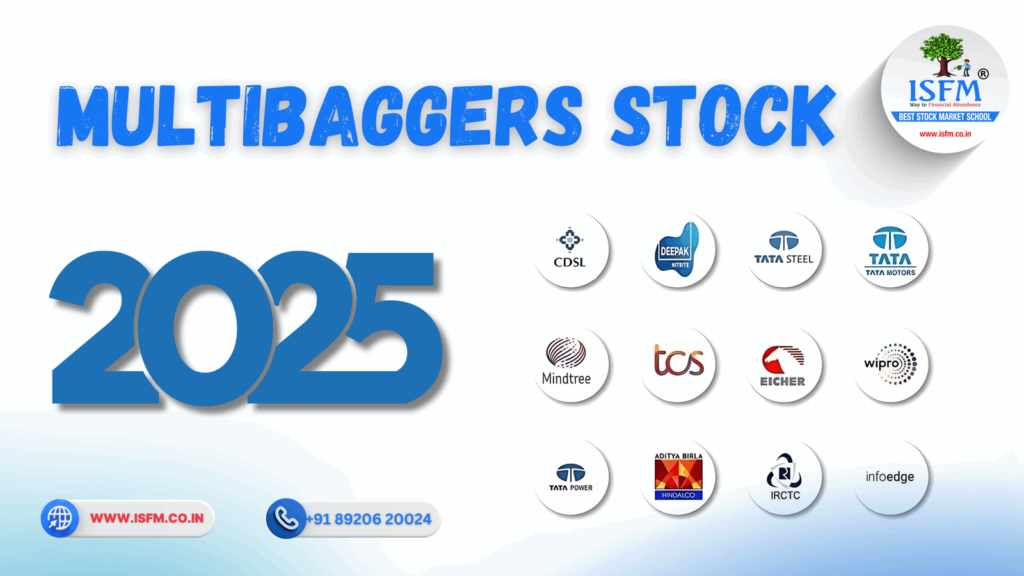
100 Time Multibaggers in the Last 10 Years: How ₹1 Lakh Became ₹1 Crore

Have you ever dreamed of turning a small ₹1 lakh investment into ₹1 crore? While this might sound like a fantasy, India’s stock market has made it possible—thanks to a rare breed of stocks known as 100-time multibaggers. These are not mythical stories, but real-world examples of visionary businesses, patient investors, and the power of compounding. In this blog, we’ll explore: What is a Multibagger Stock? A multibagger stock refers to a share that multiplies its value many times over the purchase price. The term was popularized by investor Peter Lynch and later expanded by Christopher Mayer’s concept of a “100-Bagger”—a stock that gives 100 times return on your initial investment. For example, if you had invested ₹1 lakh in Waaree Renewable Technologies ten years ago, it would have grown to ₹4.94 crore as of 2025. That’s a staggering 494-fold return! Methodology to Identify 100x Multibagger Stocks Identifying a potential 100-bagger requires more than luck. Here’s a proven methodology: 1. Focused Core Business Avoid overly diversified companies. Look for businesses with a strong focus on one product or service, like Jyoti Resins & Adhesives. 2. High Earnings Growth + High ROE Stocks like Bajaj Finance showcased consistent 20–30% CAGR growth with ROE exceeding 20–30%—key metrics to track. 3. Low Debt Levels Debt-free or low-debt companies weather economic downturns better and grow more consistently. 4. Undervalued at Entry Point Most 100x stocks were undervalued when they were discovered. Low P/E ratios and low market cap are green flags. 5. Visionary, Skin-in-the-Game Management Companies like Eicher Motors succeeded under promoters who had significant personal stakes. To learn how to identify such patterns, check our Fundamental Analysis Course or Technical Analysis Training. List of 100-Time Multibaggers (2015–2025) Here’s a curated table of 14 Indian companies that multiplied investors’ wealth over 100x in just a decade: Company Name Sector Market Cap (₹ Cr) Price (2015) Price (2025) ₹1L Became (₹ Cr) Total Return (%) Waaree Renewable Tech. Renewable Energy Small Cap ₹1.00 ₹494.00 ₹4.94 49,400% Lloyds Metals & Energy Metals & Mining Small Cap ₹1.00 ₹376.00 ₹3.76 37,600% Jyoti Resins & Adhesives Chemicals Small Cap ₹0.57 ₹1,265.30 ₹22.20 2,221,788% Refex Industries Industrial Gases Mid Cap ₹1.00 ₹238.00 ₹2.38 23,800% Tips Music Media & Music Mid Cap ₹1.00 ₹144.00 ₹1.44 14,400% Algoquant Fintech Fintech Small Cap ₹1.00 ₹128.00 ₹1.28 12,800% Hazoor Multi Projects Infra Small Cap ₹1.00 ₹165.00 ₹1.65 16,500% Tanfac Industries Chemicals Mid Cap ₹1.00 ₹156.00 ₹1.56 15,600% Magellanic Cloud IT Services Small Cap ₹1.00 ₹152.00 ₹1.52 15,200% Indo Thai Securities Financials Small Cap ₹1.00 ₹127.00 ₹1.27 12,700% Clenon Enterprises Miscellaneous Small Cap ₹1.00 ₹109.00 ₹1.09 10,900% Jaykay Enterprises Conglomerate Small Cap ₹1.00 ₹106.00 ₹1.06 10,600% Dynacons Systems & Solutions IT Services Small Cap ₹1.00 ₹101.00 ₹1.01 10,100% Things to Watch Out for While Hunting Multibaggers While chasing multibaggers can be exciting, here are key red flags and cautions: To understand stock screening better, explore our Chartered Stock Trading Expert Course – designed for serious investors and traders. Final Thoughts: Start Your 100-Bagger Journey Today Investing in multibaggers isn’t a game of luck—it’s a game of knowledge, mindset, and discipline. If you’re serious about mastering this craft: 💬 Want a free counselling session? Register Now or visit us at: 📍 ISFM, Plot No. 152P, Sec 38, Gurgaon📞 Call: +91 8882000233 | 🌐 Visit: www.isfm.co.in

Outlook-Business-Magazine
Blog

Why Outlook Business Magazine is a Must-Read for Serious Investors in India

In the ever-evolving world of finance, staying informed is not just an advantage—it’s a necessity. For serious investors in India, Outlook Business magazine stands out as a trusted source of market intelligence, corporate insights, and long-term investment perspectives. Whether you’re a retail trader, a professional analyst, or a student pursuing a stock market course, this publication offers valuable content that sharpens decision-making and enhances financial knowledge. In this blog, we explore why Outlook Business is a must-read for India’s investor community, its key features, the pros and cons, and how market participants can benefit from it. Key Features of Outlook Business Magazine 1. In-Depth Corporate Coverage Unlike generic business news platforms, Outlook Business dives deep into company profiles, management strategies, earnings quality, and industry trends. This enables investors to understand the “story behind the stock.” 2. Long-Term Investment Focus The magazine emphasizes value investing, sustainable business models, and long-term wealth creation—an ideal mindset for serious investors, not just speculators. 3. Expert Columns & Opinions Renowned analysts, fund managers, and economists share their insights regularly. These expert opinions help readers decode complex market movements and economic trends. 4. Data-Driven Research Outlook Business backs its stories with strong data analytics, financial ratios, and sector-wise comparisons, making it a great supplementary tool for students and professionals. 5. Special Editions & Annual Issues Its annual editions—like the “Richest Indians,” “Best CEOs,” or “40 Under 40”—offer high-quality curated content and interviews that showcase leadership in action. Importance for Investors in India – Informed Decision Making Investors who read Outlook Business regularly can better evaluate opportunities and risks in the Indian equity markets. Whether it’s spotting turnaround stories or avoiding overhyped IPOs, this magazine nurtures a data-centric mindset. – Understanding Market Sentiment Through sectoral analysis, macroeconomic trends, and corporate interviews, readers gain insights into market sentiment—a crucial component of timing and risk management. – Learning from Success & Failures Real-life case studies and CEO interviews provide valuable lessons on what works in business and what doesn’t, helping investors align with successful strategies. Pros of Reading Outlook Business Cons to Consider How Market Participants Can Benefit 1. Retail Traders Use the insights to build conviction in medium- to long-term trades. It helps separate noise from real opportunities. 2. Students & Learners Stock market training aspirants can use the articles for case studies, project research, and practical understanding of financial ratios and business strategies. 3. Fund Managers & Advisors Gain peer perspectives, new ideas, and macro insights to enrich portfolio strategy and client communication. 4. Corporate Professionals Understand the inner workings of industries, competition, and leadership dynamics to position themselves better in their own careers or startup ventures. Where to Access It You can subscribe to Outlook Business digitally or in print via their official website. It’s also available through various magazine platforms and libraries. For those pursuing professional training at institutes like ISFM, reading this magazine can be a recommended parallel learning habit. Final Thoughts In a country with over 100 million active Demat accounts and growing interest in equity markets, Outlook Business plays a critical role in creating financially aware and responsible investors. If you’re serious about making informed investment decisions and understanding the ‘why’ behind stock price movements, then this publication deserves a permanent spot in your reading list.

Scroll to Top