
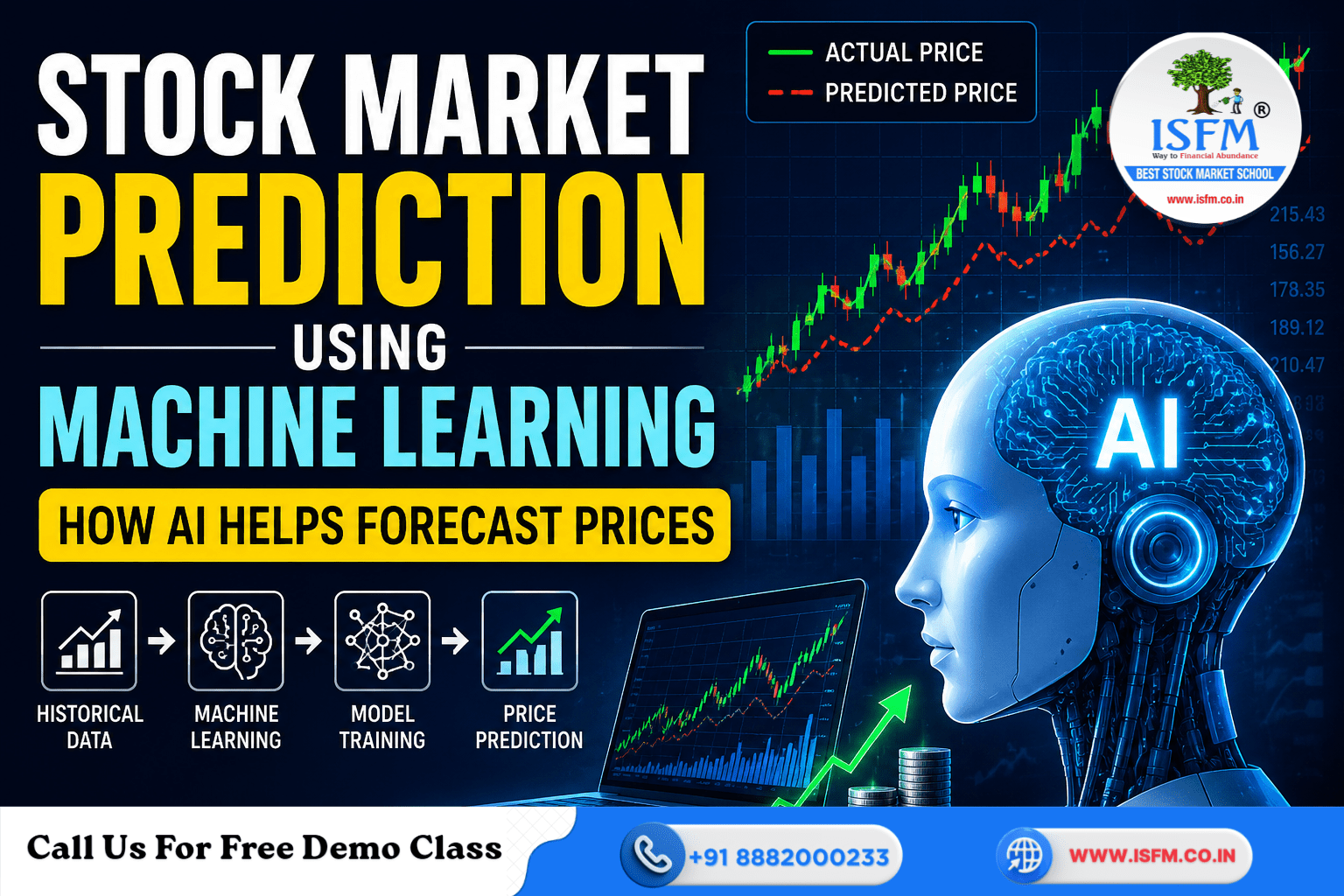
Stock Market Prediction Using Machine Learning: How AI Helps Forecast Prices
Stock market prediction has always fascinated traders, investors, researchers, and financial analysts. The ability to forecast future stock prices can help investors make better decisions, manage risks, and identify potential opportunities in the market. Traditionally, analysts relied on technical analysis, fundamental analysis, and economic indicators to predict market movements. However, with the advancement of Artificial Intelligence (AI) and Machine Learning (ML), stock market forecasting has become more data-driven and sophisticated.
Machine learning uses historical market data such as Open, High, Low, Close (OHLC), and Volume to identify hidden patterns and trends that may help forecast future price movements. While no model can predict the market with complete accuracy, ML provides valuable insights that can support investment and trading decisions.
Stock Price Prediction Chart (Actual vs Predicted Prices)
Why Predicting the Stock Market is Challenging
Predicting stock prices is difficult because financial markets are influenced by numerous factors. Company earnings, interest rates, inflation, government policies, geopolitical events, investor sentiment, and breaking news can all impact stock prices.
Markets are also highly dynamic and influenced by human psychology. Fear and greed often cause sudden price fluctuations that are difficult for traditional mathematical models to capture. Even the most advanced algorithms can struggle during unexpected market events or economic crises.
As a result, stock market prediction should be viewed as a probability-based exercise rather than a guaranteed forecasting method.
How Machine Learning Helps
Machine Learning excels at identifying patterns within large datasets. Instead of manually analyzing thousands of data points, ML algorithms can process historical market information and discover relationships that may not be visible to the human eye.
Machine learning models can:
- Analyze massive amounts of market data quickly
- Detect hidden patterns and trends
- Automate forecasting processes
- Learn from historical behavior
- Improve performance through continuous training
Popular data sources used in stock market prediction projects include Yahoo Finance, Alpha Vantage, Quandl, and other financial databases.
For traders who want to strengthen their analytical skills, learning concepts from a professional Technical Analysis Course can complement machine learning techniques by providing a deeper understanding of market behavior.
Step-by-Step Process for Stock Price Prediction Using ML
Building a machine learning-based stock prediction system typically follows several important steps.
1. Collect Historical Data
The first step involves gathering stock market data, including:
- Open Price
- High Price
- Low Price
- Close Price
- Trading Volume
Historical data serves as the foundation for model training.
2. Clean and Normalize Data
Raw market data often contains missing values, inconsistencies, or different scales. Data cleaning and normalization help improve model performance and stability.
3. Split Data into Training and Testing Sets
A common approach is to use 90% of the data for training and 10% for testing. This allows the model to learn from past data and then evaluate its performance on unseen data.
4. Create Training Sequences
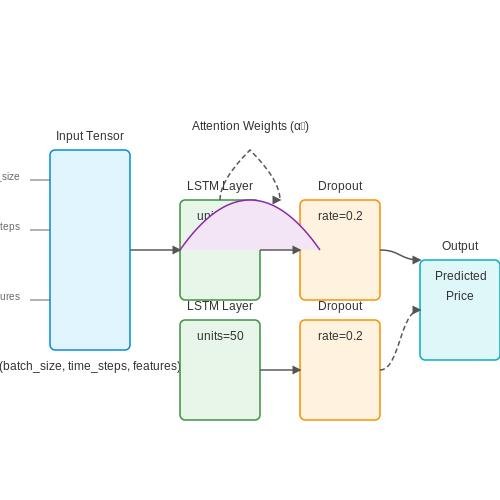
For time-series models such as LSTM, sliding windows are created. For example, the previous 60 trading days may be used to predict the next day’s closing price.
5. Build and Train the Model
Different machine learning algorithms can be used depending on the objective. The model learns patterns from historical data during the training process.
6. Test and Evaluate
After training, predictions are compared with actual market prices to measure accuracy and effectiveness.
7. Visualize Results
Visualization is crucial. Plotting actual prices against predicted prices helps determine whether the model is effectively capturing market trends and price movements.
Machine Learning Workflow for Stock Prediction
For learners interested in combining technology and financial markets, an Algo Trading Course can provide practical exposure to automated trading systems and quantitative strategies.
Key Machine Learning Models Used
Linear Regression
Linear Regression is one of the simplest machine learning models. It establishes relationships between variables and serves as an excellent baseline model for stock prediction projects.
LSTM (Long Short-Term Memory)
LSTM is a specialized deep learning model designed for sequential and time-series data. Since stock prices depend heavily on previous market behavior, LSTM has become one of the most popular models for stock forecasting.
Random Forest
Random Forest combines multiple decision trees to improve prediction accuracy and reduce overfitting. It works well for identifying complex relationships within market data.
Support Vector Machine (SVM)
SVM is often used for classification problems, such as predicting whether a stock will move up or down.
XGBoost
XGBoost is a powerful boosting algorithm widely used in financial modeling because of its speed and predictive performance.
Logistic Regression
Although primarily used for classification tasks, Logistic Regression can help predict directional market movements.
Students interested in developing advanced market forecasting skills may also explore an Options Trading Course, where probability-based decision-making plays a crucial role.
Limitations and Risks
Machine learning models are powerful, but they are not perfect. Historical patterns do not always repeat in the future.
Unexpected events such as:
- Economic crises
- Political developments
- Corporate scandals
- Regulatory changes
- Global conflicts
can significantly affect stock prices and reduce prediction accuracy.
Therefore, machine learning should be used as a decision-support tool rather than a guaranteed profit-generating system.
How Beginners Can Start Learning
Beginners can start by learning Python programming and exploring libraries such as:
- Pandas
- NumPy
- Matplotlib
- Scikit-learn
- TensorFlow
- Keras
Free stock market data is available through Yahoo Finance and Alpha Vantage APIs.
Start with simple projects using Linear Regression before progressing to advanced models like LSTM and XGBoost. Practice building prediction models, evaluating results, and visualizing forecasts.
Those seeking structured financial market education can begin with a comprehensive Stock Trading Course covering technical analysis, derivatives, and practical market applications:
Conclusion
Machine Learning has transformed the way stock market analysis and forecasting are performed. By leveraging historical market data, ML models can identify patterns, automate analysis, and provide valuable insights into potential future price movements. However, stock markets remain influenced by countless unpredictable factors, making perfect prediction impossible.
For beginners, the best approach is to focus on learning, experimentation, and continuous improvement. Machine learning should be viewed as a powerful analytical tool that enhances decision-making rather than a shortcut to guaranteed profits.