
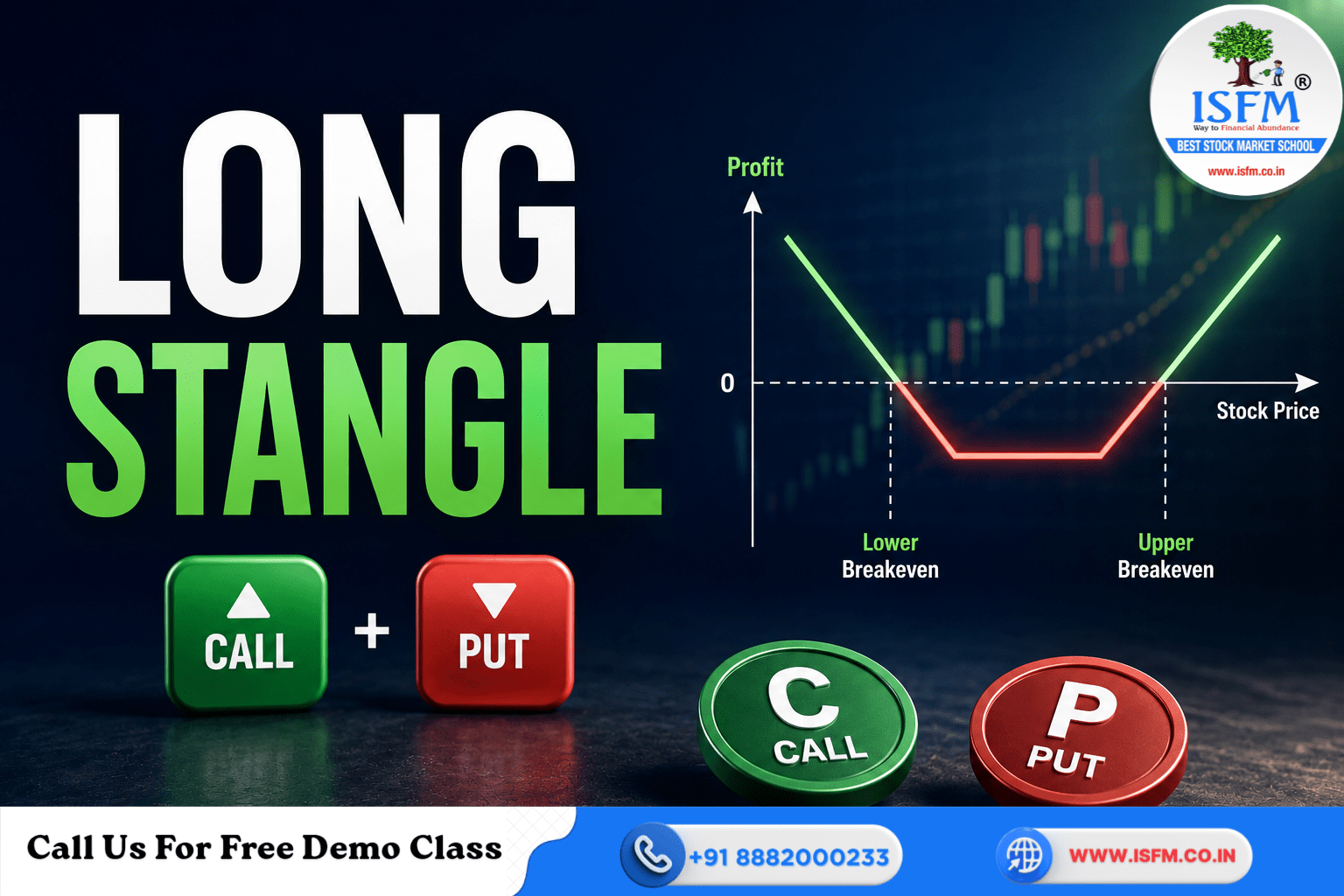
Long Strangle Strategy: Low-Cost Volatility Play for NSE Traders
In the Indian stock market, major events like RBI policy announcements, Union Budget, or global news can trigger sharp moves in Nifty and stocks. But predicting direction is often difficult. This is where non-directional strategies come into play.
Watch the video tutorial here: https://youtu.be/aD9PFPIQWZY?si=wjprF6iTDJHh0YyY
The Long Strangle Strategy is a popular volatility options strategy in NSE that allows traders to benefit from large price movements in either direction—while keeping costs lower than a straddle.
If you are new to such strategies, it is advisable to first build a strong base through an options trading course to understand option pricing and volatility concepts.
What is Long Strangle Strategy?
A Long Strangle involves:
- Buying an Out-of-the-Money (OTM) Call Option
- Buying an Out-of-the-Money (OTM) Put Option
- Same underlying (e.g., Nifty), same expiry
It is a non-directional volatility strategy. You don’t need to predict whether the market will go up or down—only that it will move significantly.
How Long Strangle Works (OTM Call + OTM Put Combination)
In this strategy:
- The OTM Call profits if the market moves sharply upward
- The OTM Put profits if the market falls sharply
Since both options are OTM, they are cheaper than ATM options. This makes the Long Strangle a cheaper straddle alternative.
However, because strikes are further away, the market must move more to reach profitability.
Why Use This Cost-Effective Volatility Strategy?
Traders prefer the Long Strangle India setup because:
- Lower premium compared to Long Straddle
- Suitable for event-based trading (Budget, RBI policy, earnings)
- Unlimited profit potential on both sides
- Defined risk (limited to total premium paid)
But remember:
- Breakeven points are wider
- Requires 2–3%+ move in Nifty typically
- Time decay (theta) works against you
To master such event-based strategies, many traders upgrade their skills through advanced derivatives training.
Setup: Strike Selection, Expiry Choice, Capital Requirements
Strike Selection (OTM Distance):
- Choose strikes ~1–2% away from spot
- Example: If Nifty is 24,000 → 24,300 CE & 23,700 PE
Expiry Choice:
- Weekly expiry for event trading
- Monthly expiry for positional trades
Capital Required:
- Only the premium paid (net debit)
- Lower than straddle due to OTM options
Step-by-Step Numerical Example
Let’s understand with a simple example:
- Nifty Spot: 24,000
- Buy 24,300 CE @ ₹80
- Buy 23,700 PE @ ₹70
- Total Premium Paid = ₹150
Breakeven Points:
- Upper Breakeven = 24,300 + 150 = 24,450
- Lower Breakeven = 23,700 – 150 = 23,550
Expiry Scenarios:
1. Big Up Move (Nifty = 24,800)
- CE gains heavily
- PE expires worthless
- Net profit = High
2. Big Down Move (Nifty = 23,200)
- PE gains sharply
- CE expires worthless
- Net profit = High
3. Moderate Move (Nifty = 24,200)
- Neither option crosses breakeven
- Partial loss
4. Flat Market (Nifty = 24,000)
- Both options expire worthless
- Maximum loss = ₹150
When to Use Long Strangle in Indian Markets
This OTM options strategy is best used when:
- You expect big movement but uncertain direction
- IV is relatively low before an event
- ATM straddles are too expensive
Real-World Scenario
Before events like the RBI Monetary Policy or Union Budget, implied volatility (IV) rises, making ATM options costly. Instead of buying an expensive straddle, traders opt for a Long Strangle.
For example:
- Nifty at 24,000
- ATM straddle cost = ₹300
- Strangle cost = ₹140–₹160
Traders save capital while still capturing large moves during Nifty event trading.
For traders who want to systematically learn such setups and execution timing, structured programs like a stock market course in Gurgaon can be highly beneficial.
Key Risks and Management Techniques
Despite being cheaper, risks are real:
- High probability of loss (~70–75%)
- Requires larger move than straddle
- Time decay erodes premium quickly
- Volatility crush after events reduces option value
Risk Management Tips:
- Avoid holding till expiry if move doesn’t come
- Enter when IV is relatively low
- Use strict capital allocation (small % of portfolio)
- Prefer high-impact events only
To gain better control over risk and execution, traders often prefer mentorship-based learning like the Chartered Stock Trading Expert Course.
When to Exit the Position
Exit discipline is critical:
- Book profits when one side doubles/triples
- Exit before IV crush post-event
- Cut losses if time decay accelerates
- Avoid holding both legs till expiry without movement
Quick Recap and Takeaway
- Long Strangle is a non-directional volatility strategy NSE traders use
- It is a cheaper straddle alternative using OTM options
- Profit comes from big moves, not small fluctuations
- Risk is limited, but probability of profit is lower
- Best suited for event-driven trades in India
If used correctly, the Long Strangle can be a powerful tool for capturing explosive moves while managing capital efficiently.
If you found this blog helpful, You might also like: What separates a profitable trader from a losing trader?