
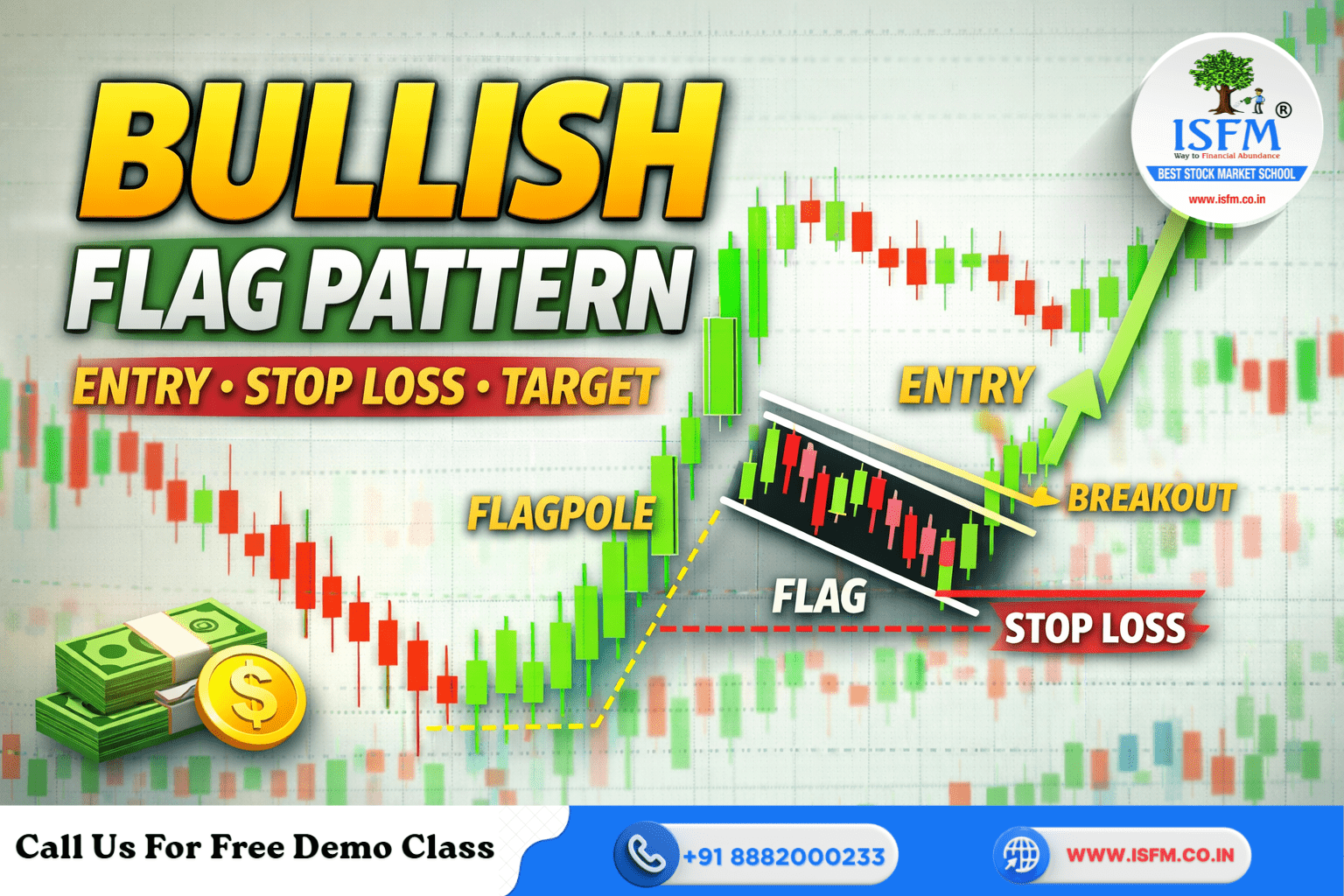
What is Bullish Flag Pattern – Entry, Stop Loss, and Target Rules
Chart patterns are powerful tools that help traders understand price behavior and make informed decisions. Among these, the bullish flag pattern is widely used because it signals trend continuation after a strong upward move. It forms when price pauses briefly before resuming its upward direction, offering traders a low-risk entry opportunity.
This pattern is widely taught in professional technical analysis courses, as it helps traders identify high-probability setups in trending markets.
What is the Bullish Flag Pattern?
The bullish flag pattern is a continuation pattern that appears after a strong uptrend. It consists of two main parts: the flagpole and the flag.
The flagpole represents a sharp price rise, usually supported by high trading volume. This indicates strong buying interest and momentum. After this surge, the price enters a consolidation phase called the flag.
When the price breaks above the upper boundary of the flag with increased volume, it signals the continuation of the previous uptrend.
How to Identify It Accurately
To identify a bullish flag pattern correctly, focus on these key signs:
- Strong prior uptrend with sharp price movement
- A downward or sideways parallel channel forming the flag
- Decreasing volume during consolidation phase
- A clean breakout above the upper trendline
Avoid trading this pattern in sideways or choppy markets, as false breakouts are common.
Entry Rules
Entering at the right time is critical for success in the bullish flag pattern:
- Enter when price breaks above the flag’s upper trendline
- Confirm breakout with strong volume
- Wait for candle close (safer approach)
- Aggressive traders can enter near higher lows
Stop Loss Placement
Proper risk management is essential:
- Place stop loss below the lower boundary of the flag
- Or below the recent swing low
Risk management is one of the most important skills covered in professional options trading courses, where traders learn position sizing and capital protection techniques.
Profit Target Rules
Profit targets are calculated using the flagpole height:
- Measure the flagpole move
- Add it to breakout point
- Maintain minimum 1:2 risk-reward
Real Trading Example
Consider Reliance Industries:
- Move: ₹2500 → ₹2800 (₹300 flagpole)
- Consolidation: ₹2750–₹2800
- Breakout: ₹2810
- Stop Loss: ₹2740
- Target: ₹3110
This is a classic example often discussed in professional stock market training programs where real case studies are used to build practical trading skills.
FAQs
Q1: How reliable is the Bullish Flag?
It works well in strong trends with proper volume confirmation and disciplined execution.
Q2: Best timeframe?
Works across 15-min, hourly, and daily charts.
Q3: What invalidates it?
Breakdown below the flag structure before breakout.
Final Thoughts
The bullish flag pattern is a powerful continuation setup that can deliver consistent results when combined with proper risk management and discipline.
If you want to go beyond theory and actually trade like a professional, learning through structured programs like stock market courses in Gurgaon can accelerate your growth massively.