• About WordPress
    • WordPress.org
    • Documentation
    • Learn WordPress
    • Support
    • Feedback
  • Log In
  • Register
  • Home
  • Courses
    • Share Market
      • One To One Mentorship
      • Chartered Stock Trading Expert
      • Technical Analysis Course
      • Advance Derivatives / FNO Trading Course
      • Algo Trading Course
      • Arbitrage Trading Course
      • Fundamental Analysis Course
      • Options Trading Course
      • Stock Market Astrology
      • Diploma in Stock Trading
      • Commodity Trading Course
      • Currency Trading Course
    • Career Oriented
      • Chartered Financial Market Expert- FMX
      • NISM Certifications Training
      • Mutual Fund Certification
      • Certified Financial Planner – CFP
      • Diploma in Banking & Finance
    • Wealth Management
      • BASIC
  • Online Courses
    • Pro Trading Course
    • Technical Analysis Course Full
    • Professional Trading Setups
    • Candlestick Bible Course
  • About Us
    • Know Your Mentors
    • Group Company
  • NISM Education
    • NISM Certifications
    • NISM Books
    • Free Financial Literacy Seminar
    • Important Links
  • Trading School
    • Live Stock Selection Sheet
    • Options Trading School
    • Trading Tools Kit
    • Stock Trading Competition
  • Training Partner
    • Training Partner Form
    • Franchise
  • Placement
    • Placement Booster Program
    • How to Make Career in Stock Market
  • Contact
  • Blog
  • +91 8882000233
  • (+91) 8168573253
  • (+91) 7015237224
  • info@isfm.co.in
  • Online Class
Facebook Twitter Linkedin Instagram Youtube
Free Demo
ISFM
  • Home
  • Courses
    • Share Market
      • One To One Mentorship
      • Chartered Stock Trading Expert
      • Technical Analysis Course
      • Advance Derivatives / FNO Trading Course
      • Algo Trading Course
      • Arbitrage Trading Course
      • Fundamental Analysis Course
      • Options Trading Course
      • Stock Market Astrology
      • Diploma in Stock Trading
      • Commodity Trading Course
      • Currency Trading Course
    • Career Oriented
      • Chartered Financial Market Expert- FMX
      • NISM Certifications Training
      • Mutual Fund Certification
      • Certified Financial Planner – CFP
      • Diploma in Banking & Finance
    • Wealth Management
      • BASIC
  • Online Courses
    • Pro Trading Course
    • Technical Analysis Course Full
    • Professional Trading Setups
    • Candlestick Bible Course
  • About Us
    • Know Your Mentors
    • Group Company
  • NISM Education
    • NISM Certifications
    • NISM Books
    • Free Financial Literacy Seminar
    • Important Links
  • Trading School
    • Live Stock Selection Sheet
    • Options Trading School
    • Trading Tools Kit
    • Stock Trading Competition
  • Training Partner
    • Training Partner Form
    • Franchise
  • Placement
    • Placement Booster Program
    • How to Make Career in Stock Market
  • Contact
  • Blog

    Blog

    • Home
    • Blog
    • Blog
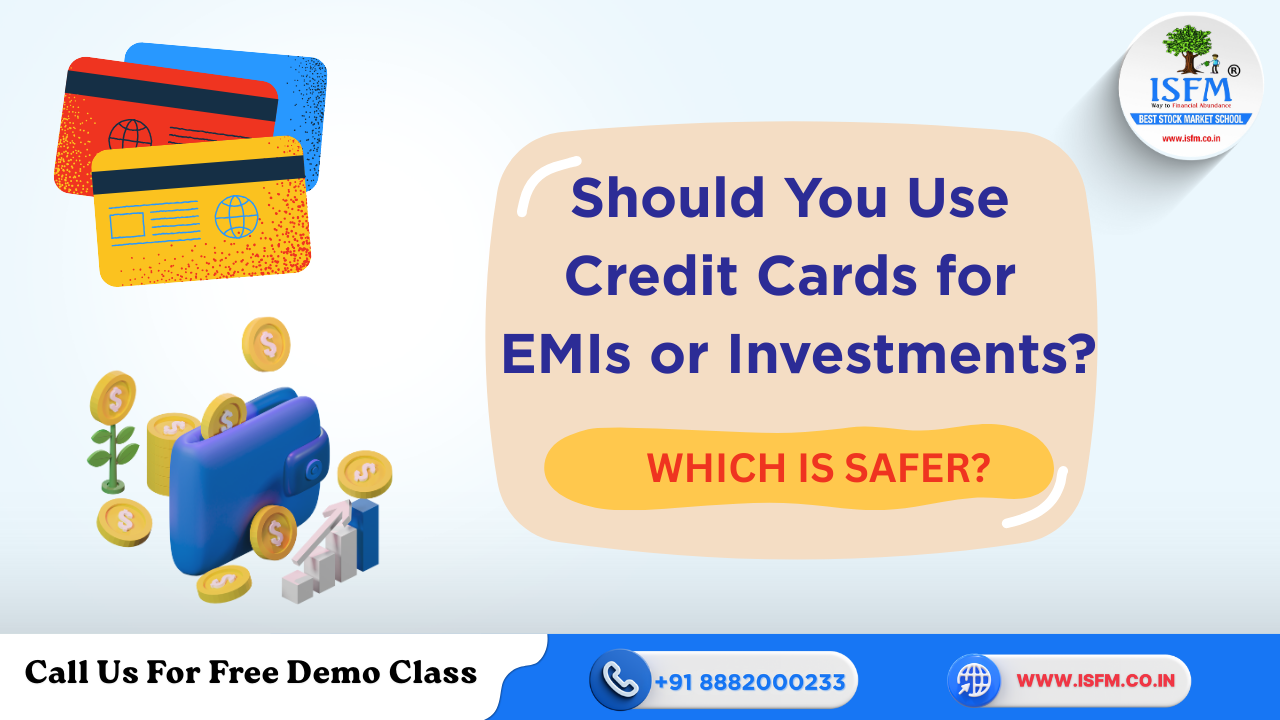
    • Should You Use Credit Cards for EMIs or Investments? Pros, Risks and Safer Alternatives

    Should You Use Credit Cards for EMIs or Investments? Pros, Risks and Safer Alternatives

    • Posted by Mr. Sushil Alewa
    • Categories Blog
    • Date December 24, 2025
    • Comments 0 comment
    Should You Use Credit Cards for EMIs or Investments

    Using credit cards for EMIs, SIPs, or investments may look convenient—but it can quietly weaken your financial foundation.
    With banks and fintech apps now allowing credit cards for EMIs, SIP investments, insurance premiums, and subscriptions, many salaried professionals see this as a smart cash-flow hack. Reward points, delayed cash outflow, and one consolidated bill feel efficient.

    But beneath this convenience lies a risk most households underestimate: mixing long-term financial commitments with short-term unsecured debt.

    Why Credit Cards Feel Helpful at First

    Routing EMIs or investments through a credit card creates temporary breathing space. You get:

    • Up to 45–50 days of interest-free period
    • A single payment dashboard
    • Cashback or reward points
    • Short-term liquidity relief

    This is why younger earners and first-time investors often use cards as a “bridge” for monthly obligations or investments.

    However, what feels like flexibility can quickly turn into fragility.

    The Illusion of Cash-Flow Comfort

    When payments don’t leave your bank account immediately, expenses feel lighter. Problems begin when:

    • Salary is delayed
    • Emergency expenses appear
    • Multiple card-linked obligations pile up

    If you fail to clear the full credit card bill, interest rates of 30–45% annually kick in—far higher than:

    • Home loan EMIs
    • Personal loan costs
    • Expected investment returns

    One missed payment can erase months of disciplined saving.

    👉 Learn how credit card interest works and why it compounds fast:
    🔗 How Credit Card Interest Is Calculated (Internal Link)

    The Hidden Risk of Funding Investments with Debt

    Using a credit card for a SIP or recurring investment means you are:

    Borrowing money to invest

    This strategy is risky because:

    • Markets may fall when your bill is due
    • Investments may not grow fast enough to offset interest
    • Liquidity needs may force premature exits

    In volatile markets, this mismatch becomes dangerous. Even a good investment cannot compensate for high revolving credit interest.

    👉 Understand why investments should come from surplus income:
    🔗 Basics of SIP Investing for Long-Term Wealth (Internal Link)

    EMIs on Credit Cards: A Credit Score Trap

    Routing loan EMIs through credit cards doesn’t reduce your liability—it only shifts it.

    If something goes wrong:

    • A missed credit card payment impacts your credit score more severely than a delayed ECS
    • Card defaults are seen as behavioural risk signals by lenders
    • Your future loan eligibility and interest rates may suffer

    👉 Check how different defaults affect your credit profile:
    🔗 How Credit Score Is Impacted by Missed Payments (Internal Link)

    When Convenience Becomes a Long-Term Cost

    As more expenses move to the card:

    • Spending discipline weakens
    • Debt feels invisible
    • Savings become accidental, not intentional

    A high credit limit often creates a false sense of affordability. Over time, people invest not because they have surplus cash—but because the card allows it.

    That’s a red flag.

    Good financial planning is built on excess income, not deferred payments.

    The Safer Way to Use Credit Cards

    Credit cards are not bad—they are just misused.

    Use credit cards for:

    • Short-term planned expenses
    • Travel and online bookings
    • Cashback and reward optimisation
    • Expenses cleared within the same billing cycle

    Avoid using credit cards for:

    • EMIs
    • SIPs and long-term investments
    • Insurance premiums
    • Any recurring obligation spanning months

    A smarter structure:

    • Bank mandate (ECS) for EMIs and investments
    • Credit card for controlled, budgeted spending only

    This keeps borrowing and saving clearly separated.

    Final Takeaway

    Using credit cards for EMIs or investments may look modern, but it creates a silent financial mismatch.

    • Debt should not fund savings
    • Convenience should not replace discipline
    • Short-term tools should not drive long-term plans

    If you keep fixed commitments linked to your bank account and treat your credit card as a tactical payment tool, your finances remain stable—and your investments grow without hidden risk.

    Frequently Asked Questions (FAQs)

    Is it ever sensible to use a credit card for investments?

    Only if you pay the full bill every month and are using it purely for rewards. If there’s any chance of rolling over the balance, the interest cost outweighs all benefits.

    Can credit cards help manage temporary EMI cash-flow issues?

    Technically yes—but practically risky. One missed payment can trigger high interest and damage your credit score. EMIs should be planned around realistic monthly income.

    How do I keep credit card usage under control?

    • Set a personal limit below the bank limit
    • Pay bills before the due date
    • Avoid EMI conversions
    • Never use cards for long-term or recurring commitments

    Mr. Sushil Alewa

    Mr. Sushil Alewa (SEBI Registered Research Analyst, MBA, CFP ) having 12 year work experience in Trading, Training, and consultancy in the area of Securities / Financial Market mainly Investment management
    industry, Technical Analysis of Stock Market.
    He is Empanelled as 'Certified Trainer of Financial Education with SEBI & IICA - MCA (Securities & Exchange Board of India), the regulating authority, Govt. of India for the securities market; Involved in conducting workshops on 'Financial Literacy to various groups such as students, company executives, middle-income groups etc. Have individually conducted more than 1600+ Investor Awareness workshops on financial literacy in the last 10 years, with reputed Universities, management colleges, corporate houses and top schools.

    Previous post

    Instant Loan vs Credit Card Loan: How to Choose the Right Borrowing Option
    December 24, 2025

    Next post

    Vedanta Demerger Explained: What Investors Should Know?
    December 25, 2025

    You may also like

    head and shoulders pattern
    What is Head and Shoulders Pattern – Bullish & Bearish Breakouts Explained
    17 March, 2026
    Top 5 Bullish Candlestick Patterns in 2026
    Top 5 Bullish Candlestick Patterns to Spot Winning Stocks in 2026
    14 March, 2026
    Rajmarg Infra Investment Trust IPO
    Rajmarg Infra Investment Trust IPO Review 2026
    12 March, 2026

    Leave A Reply

    Your email address will not be published. Required fields are marked *

    Popular Courses

    Diploma in Stock Trading

    Diploma in Stock Trading

    ₹60,000.00 ₹40,000.00
    Chartered Stock Trading Expert

    Chartered Stock Trading Expert

    ₹60,000.00 ₹50,000.00
    Chartered Financial Market Expert- FMX

    Chartered Financial Market Expert- FMX

    ₹80,000.00 ₹60,000.00

    Latest Posts

    Nikhil Kamath
    Nikhil Kamath: Zerodha’s Co-Founder, Investment Mogul & Philanthropic Powerhouse
    03Jun2025
    impact of Union Budget on the Stock Market
    Impact of the Union Budget 2024 on the Stock Market: Key Highlights
    23Jul2024
    impact of Union Budget on the Stock Market
    ISFM – Best Stock Market Training School – Gurgaon is looking for Trainer Empanelment at pan India level
    04Feb2023

    Subscribe our Newsletter

    About ISFM

    ISFM has become a center for excellence of  stock market training in Gurgaon, Delhi / NCR. We have a very well designed 6 stage wise courses on securities market which covers from Equity, Derivatives, Commodity, Currency, Mutual Funds and Technical Analysis. 

    Company
    • Blog
    • About Us
    • Contact
    • Become a Trainer
    Quick Links
    • All Courses
    • Option Trading School
    • Free Literacy Workshop
    • Study Material
    Edit widget and choose a menu
    Contact Us
    • 0124-2200689
    • (+91) 8168573253
    • (+91) 8882000233
    • (+91) 7015237224
    • Email: info@isfm.co.in
    Recent Post

    What is Head and Shoulders Pattern – Bullish & Bearish Breakouts Explained

    March 17, 2026

    International School of Financial Market – ISFM © 2025. All Rights Reserved.

    WhatsApp us