
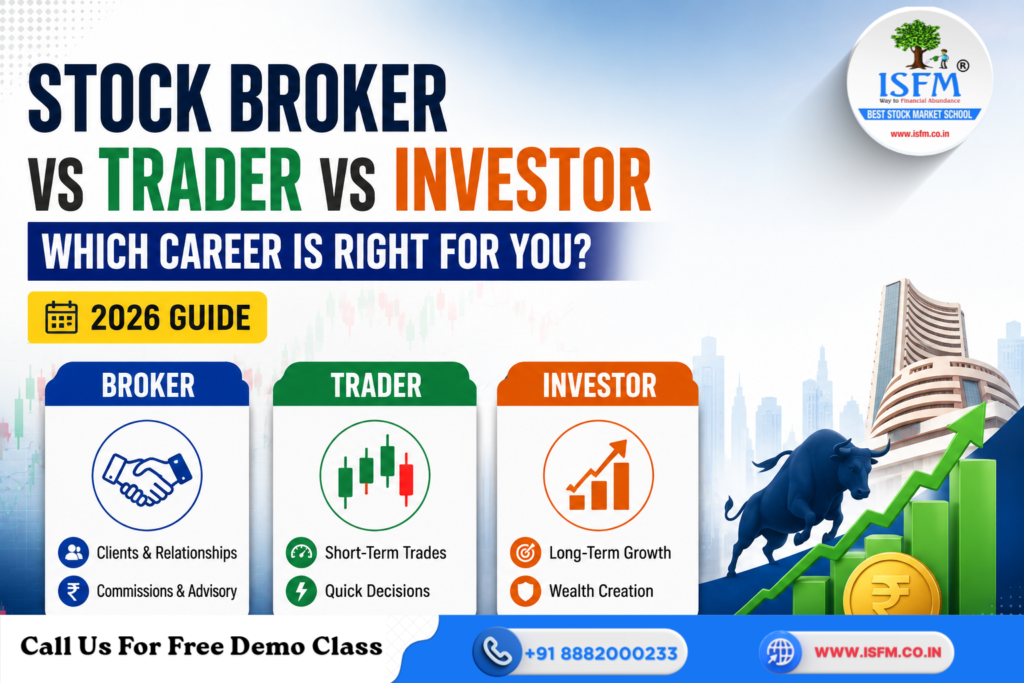
Stock Broker vs Trader vs Investor: Which Career Is Right for You? (2026 Guide)
Want to build a career in the stock market but confused whether you should become a broker, trader or investor? These three roles operate in the same financial market, but their responsibilities, skills, working styles and career paths are very different. According to Sushil Alewa, SEBI Registered Research Analyst (INH100009433), choosing a stock-market career should depend on your skills, temperament and long-term goals—not simply on how exciting the role appears from the outside. Let’s understand the difference between a stock broker vs trader vs investor and find out which path may suit you. What Does a Stock Broker Do? A stock broker acts as an intermediary between clients and the stock exchange. Brokers execute buy and sell orders and may provide market information, research or other permitted services. Their typical work includes: Brokers usually work with brokerage firms, banks or wealth-management companies. Their income can include salary, commissions and other permitted fees depending on their role and organisation. If you’re interested in building a foundation in financial markets, explore ISFM’s Stock Market Course. What Does a Trader Do? A trader focuses primarily on buying and selling financial instruments to benefit from price movements. Traders may work with: They can work for a trading firm, bank, brokerage or proprietary trading desk—or trade their own capital. Trading requires strong risk management, discipline, decision-making and emotional control. Technical analysis and derivatives knowledge can also be important depending on the trading role. For those interested in derivatives, ISFM offers an Options Trading Strategy Course. The official NISM Series VIII Equity Derivatives certification is also designed to establish a knowledge benchmark for specified associated persons working in equity derivatives. (NISM) What Does an Investor Do? An investor generally focuses on long-term wealth creation by owning assets or businesses for extended periods. Professional investors may work with: Their work involves studying companies, financial statements, industries, management quality, valuations and long-term growth potential. If you enjoy understanding businesses and analysing financial statements, ISFM’s Fundamental Analysis Course can help develop these skills. Broker vs Trader vs Investor Factor Broker Trader Investor Main Focus Clients & execution Price movements Long-term wealth Time Horizon Varies Minutes to months Years to decades Key Skill Communication Risk & decision-making Research & valuation Analysis Product + market Technical/quant Fundamental Stress Moderate–High High Moderate Income Salary + commissions Salary/bonus or P&L Salary + performance Best For People-oriented Fast decision-makers Patient researchers Which Stock Market Career Is Right for You? Choose Broker If: You enjoy talking to people, building relationships and explaining financial products. You should also be comfortable with sales targets and client interaction. Choose Trader If: You enjoy charts, fast decisions and market action and can handle losses, volatility and pressure without allowing emotions to control your decisions. Choose Investor If: You enjoy research, reading annual reports and understanding businesses. Patience and long-term thinking are essential. You don’t necessarily have to choose only one path. Many professionals start in one role and later move into research, advisory, trading, wealth management or portfolio management. Education and Certifications Common educational backgrounds include B.Com, BBA, Economics, Mathematics, Statistics, Engineering and MBA Finance. Relevant certifications depend on the role. NISM offers certifications covering areas such as equity derivatives, investment advisory and securities operations. For example, NISM Series VIII focuses on equity derivatives, while NISM Series X-A covers Investment Adviser Level 1. (NISM) You can also explore NISM Certification Training at ISFM for structured preparation. Reality Check: The Tough Side Frequently Asked Questions 1. Is a trader better than an investor? Neither is automatically better. Trading suits people comfortable with short-term decisions and risk, while investing suits those who prefer research and long-term compounding. 2. Can I become a stock broker without a finance degree? A finance degree can help, but it is not the only route. Relevant market knowledge, required certifications, regulatory requirements and practical skills are important. 3. Which career has the highest earning potential? There is no guaranteed highest-paying path. Income depends on experience, performance, organisation, client base, capital and role. 4. Which stock market career is best for beginners? For beginners, building a strong foundation in financial markets before choosing a specialisation is sensible. You can start with structured Technical Analysis training if you’re interested in trading, or fundamental analysis if you’re more interested in investing. Final Takeaway The real question isn’t “Broker vs Trader vs Investor—which is best?” It is: “Which role matches who I am?” According to Sushil Alewa, SEBI Registered Research Analyst (INH100009433),If you love people, consider broking. If you love fast decisions and price action, consider trading. If you enjoy research and patience, investing may be your path. Don’t choose a career because it looks exciting on social media. Choose the role where your natural strengths, interests and temperament match the day-to-day work.