
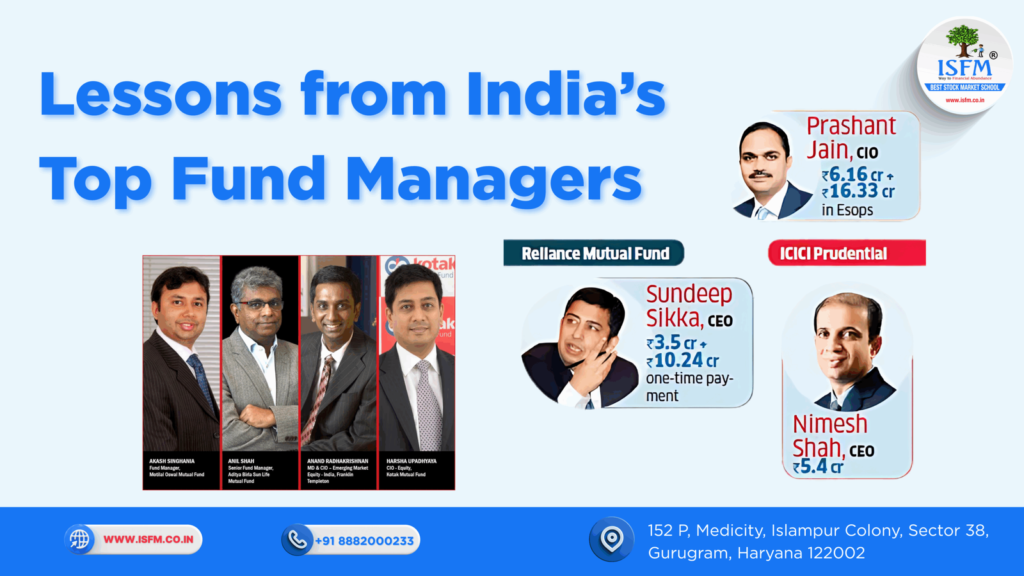
Lessons from India’s Top Fund Managers: How Discipline, Conviction, and Strategy Drive Superior Returns
Morningstar, a leading global investment research firm, has spotlighted some of India’s most successful mutual fund managers, revealing the key factors behind their consistent performance. The analysis underscores how long-term vision, fundamental research, contrarian thinking, and disciplined portfolio management help these fund managers outperform over time—even through volatile markets. Sankaran Naren – ICICI Prudential Mutual Fund Fund Managed: ICICI Prudential Value Discovery FundInvestment Style: Value-focused with a growth overlaySankaran Naren’s investment style blends value investing principles with selective growth opportunities, enabling his fund to navigate sectoral shifts effectively. In a notable instance during 2021–22, Naren drastically reduced exposure to IT—from 20% in early 2021 to just 9% by year-end—while increasing allocation to the energy sector at 11%, reflecting his ability to rotate sectors ahead of market moves. Another standout call was his contrarian investment in Vodafone Group Plc ADR in mid-2021. While the move initially underperformed, it paid off with a 15% return over the following year. His approach to investing is marked by deep introspection, learning from past mistakes, and making fewer errors rather than chasing perfect returns. Even in sectors like pharma, which entered a slump in 2023, Naren held on to his long-term conviction. As the sector rebounded in 2024, his patience proved profitable—showcasing his resilience and foresight in market cycles. Neelesh Surana – Mirae Asset Mutual Fund Role: Chief Investment Officer (CIO) – EquityApproach: Bottom-up stock picking with valuation disciplineNeelesh Surana has been a cornerstone of Mirae AMC since 2008, known for high-conviction investing and an aversion to hype-driven bets. His strategy centers on selecting scalable businesses with strong return ratios and robust management, avoiding overvalued or momentum stocks. Surana believes in alpha through stock selection, not sector timing. For instance, his calculated positions in Zomato (Eternal) and Policybazaar (PB Fintech)—though unprofitable in early valuation metrics—were limited to under 2% of the portfolio. These investments later turned multi-baggers in 2024, validating his foresight and restraint. He maintains a strict sell discipline, exiting stocks once target valuations are achieved—regardless of holding period. His success lies in a research-driven, fundamentals-first approach, paired with the courage to stay the course during temporary volatility. ️Suyash Choudhary – Bandhan Mutual Fund Domain: Fixed IncomePhilosophy: Macro-conscious, risk-averse, capital preservationKnown for his conservative stance, Suyash Choudhary avoids speculative credits, focusing on sovereign and AAA-rated debt instruments. This risk-averse style paid off especially during periods of economic turbulence, when his funds showed remarkable stability due to limited credit exposure. Suyash excels in managing fixed-term strategies, combining macroeconomic awareness with tactical judgment, making him one of the most reliable fixed-income managers in the Indian market. Shobhit Mehrotra – HDFC Mutual Fund Experience: Over two decades in fixed incomeInvestment Style: Conservative with a focus on income and risk-adjusted returnsShobhit Mehrotra, a stalwart in the debt market, brings a disciplined, research-heavy approach. His strategies focus on capital preservation, credit quality, and liquidity management. Notably, between 2021–2023, he shifted portfolios toward short- and medium-duration debt, anticipating rising interest rates amid global inflation and RBI tightening. His consistent income generation with minimal risk highlights his role as a stabilizing force in debt fund investing. Morningstar’s Key Insights: What Makes a Great Portfolio Manager? Morningstar concludes that while no fund manager is infallible, consistent success lies in aligning with a clear philosophy, having a long-term mindset, and demonstrating an honest self-assessment process. These traits—evident in the work of Naren, Surana, Choudhary, and Mehrotra—can serve as timeless lessons for both investors and aspiring fund professionals.