
Author name: Mr. Sushil Alewa

Sushil Alewa is the Founder & Director of ISFM – International School of Financial Market, established in July 2014 with the aim of bridging the gap between academic finance and real, practical market participation. A Certified Financial Planner - CFP from US (Reg. No. IN 51734) and SEBI Registered Research Analyst (Reg. No. INH100009433) with an MBA in finance, Sushil has spent more than 16 years in the Indian capital markets. His career spans equity advisory and research at Sharekhan, India Infoline, Indiabulls and Religare, followed by HNI portfolio advisory at Anand Rathi Wealth Management — experience that shaped the practitioner-first approach ISFM is known for today. He is an active trader and researcher, and his teaching draws directly from live market work rather than theory alone. His areas of focus include technical analysis, derivatives and options strategies, equity research and fundamental analysis, and investor awareness. Sushil is currently a PhD scholar researching options trading strategies, and regularly conducts investor awareness and financial literacy programs for students, professionals and corporate audiences.

nse vs bse
Blog

NSE vs BSE: A Comprehensive Comparison of India’s Leading Stock Exchanges

India’s stock market ecosystem revolves around two major exchanges—the National Stock Exchange (NSE) and the Bombay Stock Exchange (BSE). These two platforms facilitate stock trading, derivatives, and various financial instruments, playing a crucial role in India’s economic growth. If you’re an investor, trader, or market enthusiast, understanding the key differences between NSE and BSE will help you make informed decisions. What is NSE? The National Stock Exchange (NSE) was founded in 1992 and became operational in 1994. It was the first exchange in India to introduce electronic trading, eliminating the traditional paper-based system. NSE is known for its advanced technology, liquidity, and efficiency, making it the preferred choice for traders and institutional investors. Key Features of NSE ✔ Benchmark Index: Nifty 50, comprising 50 of the largest and most liquid stocks.✔ Technology-Driven Trading: Fully automated electronic trading platform.✔ High Liquidity: Preferred by high-frequency traders and institutional investors.✔ Derivatives Market: NSE dominates the derivatives market, offering futures and options trading.✔ Faster Trade Execution: Due to advanced infrastructure and high trading volumes. What is BSE? The Bombay Stock Exchange (BSE) was established in 1875, making it Asia’s oldest stock exchange. It played a pivotal role in shaping India’s stock market and remains one of the largest exchanges in the world in terms of listed companies. While it offers advanced electronic trading, it is often seen as more retail-investor friendly. Key Features of BSE ✔ Benchmark Index: SENSEX (Sensitive Index), consisting of 30 blue-chip companies.✔ Largest Number of Listed Companies: Over 5,500 companies are listed on BSE.✔ Investor-Friendly: Preferred by beginners and long-term investors.✔ Fastest Exchange: With a trading speed of 6 microseconds.✔ Diversified Product Offerings: Includes mutual funds, SME platform, and debt instruments. NSE vs BSE: A Head-to-Head Comparison Feature NSE (National Stock Exchange) BSE (Bombay Stock Exchange) Year Founded 1992 1875 Benchmark Index NIFTY 50 SENSEX Total Listed Companies 2,000 5,500 Trading Volume Higher Lower Market Share 90% in Derivatives Lower than NSE Trading Speed Faster Execution 6-microsecond response time Liquidity High Moderate Best for Day traders & institutional investors Retail investors & beginners Which One Should You Choose – NSE or BSE? ✔ If you’re a day trader or investor looking for high liquidity and fast execution, NSE is the better choice.✔ If you’re a long-term investor or want access to a wider range of stocks, BSE offers more options.✔ For derivatives trading, NSE dominates with higher trading volumes. Conclusion Both NSE and BSE are vital to India’s financial markets, each offering unique advantages. While NSE leads in trading volume and derivatives, BSE remains the go-to for retail investors and long-term players. Understanding their differences helps traders and investors make well-informed decisions aligned with their financial goals.
etf vs mutual funds
Blog

ETF vs Mutual Funds: Which Investment Option is Right for You?

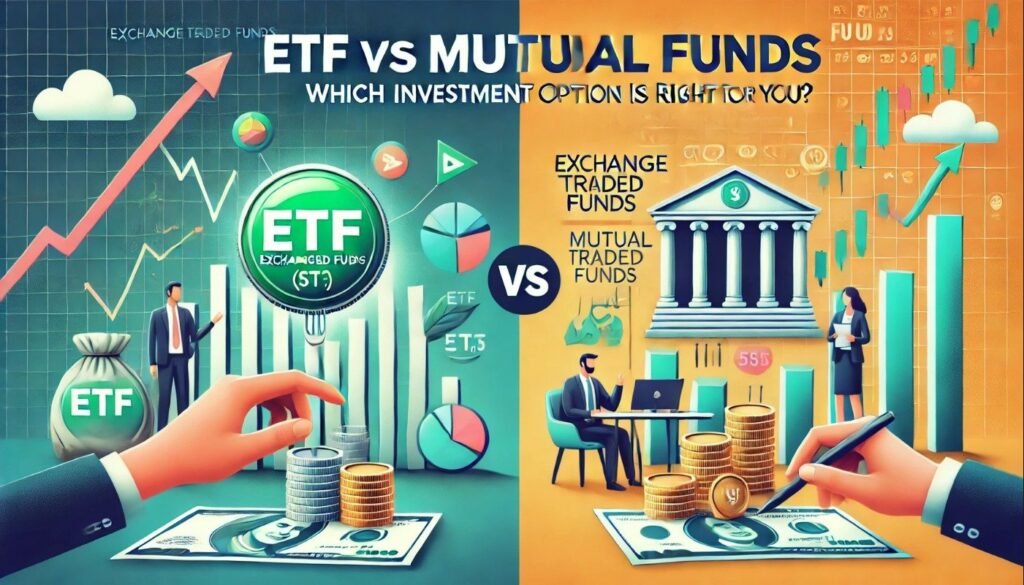
In the world of investing, two popular options that often come up in discussions are Exchange-Traded Funds (ETFs) and Mutual Funds. While both can provide a diversified portfolio, they operate quite differently and offer unique advantages and disadvantages. If you’re an investor looking to choose between these two, this guide will help you understand the key differences, the benefits of each, and how to determine which one aligns best with your financial goals. What is an ETF? An Exchange-Traded Fund (ETF) is a type of investment fund that holds a collection of assets, such as stocks, bonds, commodities, or a mix of these. Unlike mutual funds, which are bought or sold only at the end of the trading day, ETFs are traded on stock exchanges just like individual stocks. This means that you can buy or sell ETFs throughout the trading day at market prices that can fluctuate during market hours. Key Features of ETFs What is a Mutual Fund? A Mutual Fund is a pool of funds collected from various investors to invest in a diversified portfolio of stocks, bonds, or other securities. Mutual funds are managed by professional fund managers who make investment decisions on behalf of the fund’s investors. Mutual funds are bought or sold at the net asset value (NAV) price, which is determined at the end of each trading day. Key Features of Mutual Funds ETF vs Mutual Funds: Key Differences Features ETF’s Mutual Funds Trading Traded on stock exchanges Purchased or redeemed at NAV at end of the day Fees Lower expense ratios Higher fees, especially for actively managed funds Liquidity High, traded throughout the day Lower, only bought/sold at end of day Management Typically passively managed (though active ETFs exist) Actively or passively managed Investment Strategy Passively tracks an index or sector Active management or index tracking Investment Minimum No minimum, buy in shares Minimum investment varies, typically higher Transparency Daily disclosure of holdings Monthly or quarterly disclosures Dividends Paid periodically, reinvestment options available Typically paid out or reinvested automatically Pros and Cons of Mutual Funds Pros of Mutual Funds: Cons of Mutual Funds: Which is Better: ETF or Mutual Fund? Choosing between an ETF and a mutual fund depends on your investment goals, time horizon, and preferences. Conclusion Both ETFs and Mutual Funds offer excellent options for diversifying your portfolio and achieving long-term investment goals. While ETFs are cost-effective, flexible, and tax-efficient, Mutual Funds provide professional management and automatic investment options. Understanding the strengths and weaknesses of each will help you make an informed decision based on your individual needs. Whether you are a seasoned investor or just starting, both options can be valuable tools for growing your wealth over time. So, which will you choose: ETFs or Mutual Funds? The right choice comes down to your investment strategy, risk tolerance, and personal preferences. Either way, investing in either of these options can set you on the path to financial success.

etf vs index funds
Blog

ETF vs Index Funds: Which One Should You Choose?

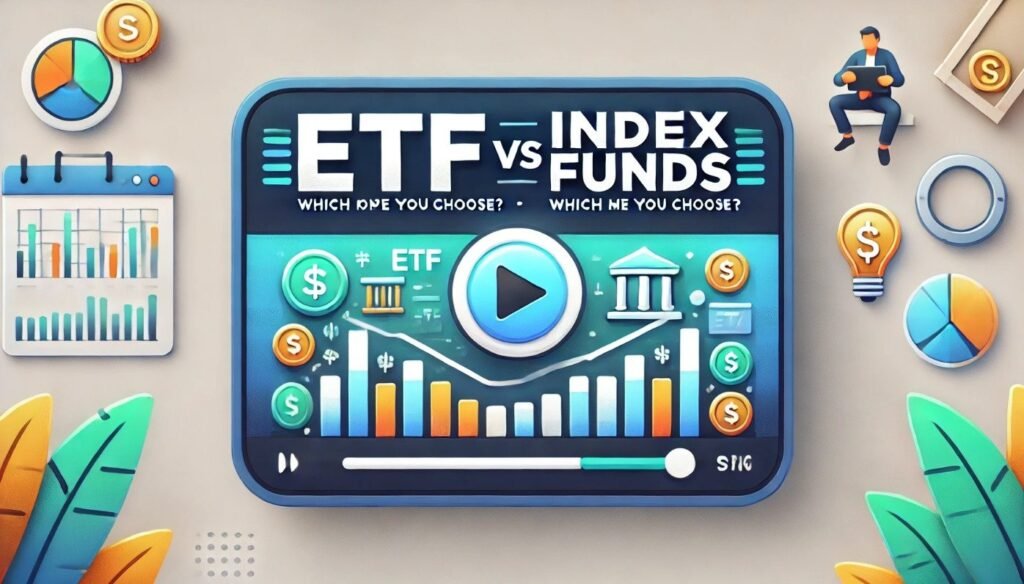
Investing in the stock market can be overwhelming, especially with so many options available. Two of the most popular investment vehicles for passive investors are Exchange-Traded Funds (ETFs) and Index Funds. While they share many similarities, key differences set them apart. This article will compare ETFs and Index Funds, helping you decide which one best suits your financial goals. What are ETF’s? Exchange-Traded Funds (ETFs) are investment funds that trade on stock exchanges, similar to individual stocks. They are designed to track the performance of a specific index, sector, commodity, or asset class. Some common types of ETFs include: ETFs can be bought and sold throughout the trading day at market prices, offering high liquidity and flexibility. What are Index Funds? Index Funds are mutual funds that aim to replicate the performance of a specific stock market index. Unlike ETFs, Index Funds are not traded on exchanges throughout the day. Instead, they are bought and sold at the fund’s Net Asset Value (NAV), which is determined at the end of the trading day. Index Funds provide diversification, lower costs, and a passive investment strategy, making them ideal for long-term investors. Key Difference Feature ETF’s Index Funds Trading Mechanism Traded on stock exchanges like shares Bought and sold at NAV at the end of the day Liquidity High – can be traded anytime during market hours Lower – executed only once per day Expense Ratio Generally lower than index funds Slightly higher due to operational costs Minimum Investment Can buy as little as one share Often have a minimum investment requirement Tax Efficiency More tax-efficient due to in-kind creation/redemption process Less tax-efficient as capital gains may be triggered by fund manager actions Flexibility More flexible – allows intraday trading and stop-loss orders Less flexible – only allows buying and selling at day’s NAV Dividend Reinvestment May require manual reinvestment of dividends Often offers automatic dividend reinvestment Which one is right for you? Choose ETFs if: ✔️ You want the flexibility of trading throughout the day.✔️ You prefer lower expense ratios and tax efficiency.✔️ You like the ability to use stop-loss and limit orders. Choose Index Funds if: ✔️ You are a long-term investor and don’t need intraday trading.✔️ You prefer automatic dividend reinvestment.✔️ You want a simple, hassle-free investment strategy. Conclusion Both ETFs and Index Funds are excellent choices for passive investors looking for low-cost, diversified investments. Your choice depends on your trading style, investment goals, and tax preferences. If you want flexibility and intraday trading, ETFs might be the better option. However, if you prefer a hands-off approach and long-term investing, Index Funds are a great choice. Looking to invest smartly? Whether you choose ETFs or Index Funds, start your investment journey with a well-researched strategy and a clear financial goal. Happy investing! 🚀

small cap vs. large cap
Blog

Small-Cap vs. Large-Cap Funds: Which One Should You Invest In?

Investing in mutual funds can be overwhelming, especially when choosing between small-cap and large-cap funds. Both fund categories cater to different risk appetites, investment goals, and time horizons. In this blog, we will explore the key differences between small-cap and large-cap funds, their benefits, risks, and which one might be the right fit for your portfolio. What Are Small-Cap and Large-Cap Funds? Small-cap funds invest in companies ranked below the top 250 in terms of market capitalization. These are companies with a market cap of less than ₹5,000 crore in India. They are known for their high growth potential but also come with increased volatility and risk. Large-cap funds invest in the top 100 companies by market capitalization. These companies have a market cap of over ₹20,000 crore and are well-established, financially stable, and less volatile compared to small-cap stocks. Key Differences Between Small-Cap and Large-Cap Funds Factors Small-Cap Funds Large-Cap Funds Risk Level High Low Return Potential High (can generate multi-bagger returns) Moderate but stable Volatility High Low Time Horizon Long-term (5+ years) Medium to long-term (3+ years) Liquidity Lower High Market Conditions Sensitivity Highly sensitive Less affected by market fluctuations Pros and Cons of Small-Cap Funds Advantages Risks Pros and Cons of Large-Cap Funds Advantages Risks Who Should Invest in Small-Cap and Large-Cap Funds? 1. Small-Cap Funds Are Suitable For 2. Large-Cap Funds Are Suitable For Performance Comparison: Small-Cap vs. Large-Cap Funds Historically, small-cap funds have outperformed large-cap funds during bull markets, but they tend to suffer the most in bear markets. On the other hand, large-cap funds offer steady performance across market cycles, making them a safer bet for risk-averse investors. Which One Should You Choose? The choice between small-cap and large-cap funds depends on your financial goals, risk tolerance, and investment horizon. A balanced approach could be to diversify across both categories to mitigate risk while capturing growth opportunities. Final Thoughts Both small-cap and large-cap funds have their place in an investment portfolio. If you are an aggressive investor looking for high growth, small-cap funds may be the right choice. However, if stability and consistent returns are your priority, large-cap funds should be a part of your portfolio. Before investing, assess your risk tolerance, financial goals, and market conditions to make an informed decision.

union budget 2025
Blog

Union Budget 2025: Sector Allocation, Top Announcements, and Investment Opportunities

The Union Budget 2025 has been unveiled, and it brings with it a host of reforms, sector-specific allocations, and policy announcements that aim to bolster economic growth, infrastructure development, and social welfare. This blog will delve into the key highlights of the budget, sector-wise fund allocation, and the top announcements that could shape India’s economic trajectory. Additionally, we will recommend the top 5 stocks from each sector that could benefit from these announcements. Finally, we will decode the new tax regime for individuals and corporate houses with live examples. Key Highlights of India Budget 2025 Sector-wise Allocation of Funds Sector Allocation (in ₹ crore) Key Focus Areas Infrastructure 11,11,000 Roads, railways, airports, smart cities Renewable Energy 35,000 Solar, wind, green hydrogen Healthcare 2,23,00 Universal health coverage, Ayushman Bharat Education 1,12,000 Skill development, digital education Agriculture 1,87,000 Doubling farmers’ income, technology adoption Defense 5,94,000 Indigenous manufacturing, modernization Digital India 14,903 Broadband connectivity, startup promotion MSMEs 22,138 Credit access, technology upgradation Top Announcements in India Budget 2025 Top 5 Stocks to Watch in Each Sector 1. Infrastructure 2. Renewable Energy 3. Healtcare 4. Agriculture 5. Defense Also Read: The Indian Automobile Industry: A Pillar of Economic Growth For Individuals The new tax regime offers lower tax rates but removes most exemptions and deductions. Here’s a comparison: Income Slab Old Tax Rate New Tax Rate Up to 2.5 lakh 0% 0% 2.5–5 lakh 5% 5% 5–7.5 lakh 20% 10% 7.5–10 lakh 20% 15% 10–12.5 lakh 30% 20% 12.5–15 lakh 30% 25% Above 15 lakh 30% 30% For Corporate Houses The corporate tax rate has been reduced to 22% for existing companies and 15% for new manufacturing companies (without exemptions). Example: A company with a taxable income of ₹10 crore would pay ₹2.2 crore under the new regime, compared to ₹3 crore earlier. Conclusion The India Budget 2025 is a forward-looking blueprint that aims to accelerate economic growth, promote sustainability, and improve the quality of life for citizens. Investors can capitalize on the opportunities presented by sector-specific allocations, while individuals and businesses can benefit from the simplified tax regime. Stay tuned to Budget 2025 Official Website for more updates.

indian automobile industry
Blog

The Indian Automobile Industry: A Pillar of Economic Growth

The Indian automobile industry stands tall as a key driver of the nation’s economic growth. By 2024, this sector has emerged as a cornerstone of India’s industrial framework, significantly contributing to GDP, employment, and foreign investment. Economic Contribution The automobile sector contributes a robust 7.1% to India’s GDP, underscoring its pivotal role in the economy. With 5.27% of total Foreign Direct Investment (FDI) inflows, it remains a magnet for global capital. From April 2023 to March 2024, India produced approximately 28.43 million vehicles, encompassing passenger cars, commercial vehicles, two-wheelers, and three-wheelers. This impressive production volume positions India among the world’s leading automotive manufacturers, particularly excelling in tractors and two-wheelers. Employment Generation As a massive job generator, the Indian automotive industry provides direct employment to over 1.5 million people. Additionally, it supports a sprawling network of ancillary industries, creating millions of indirect jobs. With the Automotive Mission Plan (2016-2026) aiming to add 3.2 million more jobs by 2026, the sector is poised for further expansion in workforce opportunities. Market Dynamics The Indian automotive market showcases remarkable diversity: This transformation is fueled by evolving consumer preferences and supportive government initiatives promoting sustainable transportation. Future Outlook The Indian automobile industry’s growth prospects are bolstered by several favorable factors: Top 10 Automotive Stocks to Watch Investing in the Indian automotive sector offers lucrative opportunities. Based on H1 FY25 financial performance, here are ten recommended stocks: Conclusion The Indian automobile industry exemplifies the country’s economic dynamism and immense growth potential. As urbanization accelerates, disposable incomes rise, and sustainability takes center stage, the sector is set to experience sustained expansion. For investors, the time is ripe to explore opportunities within this vibrant sector. Whether through traditional vehicles or the burgeoning EV segment, the Indian automotive industry offers promising avenues for returns. Staying informed about market trends and technological innovations will be crucial for making smart investment decisions in this transformative era.

groww
Uncategorized

Groww Sets Stage for $1 Billion+ IPO: Engages Five Top Investment Banks

India’s leading retail stock trading platform, Groww, is gearing up for a blockbuster IPO valued at over $1 billion. The Bengaluru-based fintech unicorn, backed by prominent investors such as Peak XV Partners, Tiger Global, Ribbit Capital, and Microsoft CEO Satya Nadella, is set to make its public debut. Plans are underway to file draft documents by April-May 2025 and list by the end of the year or early FY26. Investment Banks Onboard Groww has roped in Kotak Mahindra Capital, JP Morgan, Axis Capital, Citi, and Motilal Oswal to manage the IPO. The offering is expected to include a mix of offer for sale (OFS) by existing investors and a primary issue, allowing the company to raise fresh capital. Strategic IPO Valuation Industry sources reveal that Groww aims to achieve a valuation between $7–$8 billion, with some discussions even targeting a $10 billion cap, depending on market dynamics and regulatory clarity. A key focus for Groww’s founders is ensuring investors gain significant value post-listing. The final valuation will be decided closer to the IPO launch. Record Growth and Market Dominance Groww surpassed its closest competitor, Zerodha, in active investor numbers last year. As of December 2024, the platform boasts 1.3 crore active investors, outpacing Zerodha’s 81 lakh and Angel One’s 78 lakh. With over 50 lakh new users added in 2024 alone, Groww is steadily widening its lead in India’s retail investing space. Financial Performance Groww’s operational profit surged 17% year-on-year, reaching ₹535 crore for the fiscal year ending March 2024, compared to ₹458 crore in FY23. The company reported consolidated revenue of ₹1,435 crore in FY23, reflecting strong growth. Evolution of Groww Founded in 2017 by four former Flipkart employees — Lalit Keshre, Harsh Jain, Ishan Bansal, and Neeraj Singh — Groww initially started as a direct mutual fund distribution platform. By 2020, the platform expanded its offerings to include stocks, digital gold, ETFs, intraday trading, and IPOs, addressing user demand. Groww’s strategic move to relocate its registered office from Delaware, US, to Bengaluru signals its readiness for a domestic listing. A New Chapter for Groww With its strong market position, robust financials, and a loyal user base, Groww is poised to redefine India’s fintech landscape through this highly anticipated IPO. The listing will mark a significant milestone for the company as it transitions from a high-growth startup to a publicly traded powerhouse.

elss funds
Blog

Maximizing Wealth with Tax-Saving Investment Strategies: A Deep Dive into ELSS Funds

Tax planning is an essential component of a successful financial strategy, and tools like tax loss harvesting and tax gain harvesting can significantly enhance portfolio efficiency. While tax loss harvesting helps investors offset capital losses to reduce tax liabilities, tax gain harvesting allows them to realize profits within tax-free limits, fostering long-term financial growth. Meet Rohan Mehta, a 30-year-old IT professional from Bengaluru, working in the city’s bustling Electronic City. Despite earning a lucrative salary, Rohan found himself struggling with financial planning and overspending on lifestyle luxuries. “I was earning well, but I had no idea where my money was going,” he admits. Realizing the need for a solid investment plan, Rohan explored multiple options before discovering Equity-Linked Savings Schemes (ELSS). Understanding ELSS Funds: A Smart Investment Choice ELSS funds offer a dual advantage of tax savings and wealth creation. They qualify for tax deductions under Section 80C of the Income Tax Act, 1961, allowing investors to save up to ₹1.5 lakh annually. Compared to traditional tax-saving options like fixed deposits and Public Provident Fund (PPF), ELSS funds stand out due to their shorter lock-in period of just three years and potential for higher returns. Under the previous tax regime, taxpayers could claim deductions under Section 80C; however, with the introduction of the new tax regime in Union Budget 2023, such provisions have been omitted. Despite this, ELSS funds continue to attract investors seeking long-term growth opportunities. Why ELSS Funds Are a Great Choice for Investors? Rohan decided to invest ₹1,00,000 annually in an ELSS fund with a solid track record and a low expense ratio. After five years, his investment grew to ₹6,75,283, yielding an impressive annual return of 14%, reinforcing his confidence in ELSS as a wealth-building tool. Performance Analysis of ELSS Funds ELSS funds have consistently shown robust returns across various time horizons: While ELSS funds may not outperform small-cap or mid-cap categories, they offer a balanced approach, providing both tax benefits and long-term wealth creation. Market Trends: AUM and Investment Patterns Investment in ELSS funds typically spikes in the first quarter of each financial year, driven by tax-saving motivations. For instance, in 2023, net inflows reached ₹1,390.50 crore in January, ₹952.24 crore in February, and ₹2,657.28 crore in March. The overall Assets Under Management (AUM) have also shown steady growth, rising from ₹1,62,361.69 crore in November 2022 to ₹2,48,534.94 crore in November 2024, reflecting investor confidence. Top ELSS Funds to Consider Conclusion: Is ELSS Right for You? Despite the evolving tax landscape, ELSS remains a viable investment avenue for wealth creation. With disciplined investing and a long-term perspective, these funds can help investors achieve financial goals while enjoying tax benefits. For those seeking flexibility, growth potential, and tax savings, ELSS funds offer an ideal solution.Stay tuned as we analyze the top-performing ELSS funds to help you make an informed investment decision.

Sunil Singhania
Blog

Sunil Singhania: The Ace Investor Shaping India’s Financial Landscape

Sunil Singhania, the founder of Abakkus Asset Management, LLP, has become a household name in India’s investment circles. His journey from a chartered accountant to one of the most respected figures in the Indian financial markets is nothing short of inspirational. Early Life and Education Born into a middle-class family, Sunil Singhania’s early life was marked by academic excellence. He graduated in commerce from Bombay University and went on to become an all-India rank holder in Chartered Accountancy from ICAI, Delhi. His thirst for knowledge didn’t stop there; he later earned the prestigious Chartered Financial Analyst (CFA) designation from the CFA Institute, USA. Singhania’s career trajectory took a significant turn when he joined Reliance Capital. As the Global Head of Equities and Chief Investment Officer (CIO) – Equities at Reliance Mutual Fund, now Nippon India Mutual Fund, he oversaw equity assets worth USD 11 billion. Under his leadership, the Reliance Growth Fund grew an astounding 100 times in less than 22 years. Founding Abakkus Asset Management In 2018, Singhania took a bold step by founding Abakkus Asset Management, LLP. Within just five years, Abakkus has grown to manage assets worth almost Rs 21,000 crores. The firm’s Emerging Markets and Growth Fund have been rated as the top two AIFs in terms of performance over a 3-year timeframe. Investment Philosophy Singhania’s investment strategy focuses on identifying quality companies with strong fundamentals and holding them for extended periods. He believes in a well-diversified portfolio, investing in both large and small firms with enormous potential. Some of Singhania’s notable investments include Sarda Energy & Minerals Ltd, Route Mobile Ltd, and Shriram Pistons & Rings Ltd. His recent acquisition of 8.5 million shares in Himatsingka Seide, a smallcap textile company, has caught the market’s attention. Achievements and Recognition Singhania’s expertise has earned him numerous accolades. He was rated among the Best Fund Managers by Outlook Business in 2016 and 2017. He became the first Indian to be appointed to the Global Board of CFA Institute, USA, serving from 2013 to 2019. Philanthropy and Social Contributions Beyond his professional achievements, Singhania is active in social and community work. He has served as the President of Goregaon Sports Club, Mumbai. His contributions to the financial community include founding the Indian Association of Investment Professionals (now CFA Society India) and serving as its President for eight years. Conclusion Sunil Singhania’s journey from a chartered accountant to a renowned investment guru is a testament to his sharp market insights and ability to spot growth prospects. His contributions to India’s financial landscape continue to inspire aspiring investors and shape the country’s economic future.

nemish shah
Uncategorized

Nemish Shah: The Quiet Titan of Indian Investing

Nemish Shah, co-founder of ENAM Holdings, is a name that resonates with success and wisdom in the Indian financial landscape. Let’s delve into the life and career of this investment veteran who has left an indelible mark on the stock market and beyond. The Man Behind the Investments From Mumbai to Mastering the Markets Nemish Shah’s journey began in Mumbai, where he completed his Bachelor of Commerce degree from Lala Lajpat Rai College, Mumbai University, in 1977. His early life laid the foundation for a career that would shape the Indian investment landscape. Rise to Prominence: Becoming a Dalal Street Veteran Shah’s ascent in the financial world started when he co-founded ENAM Securities in 1984. His keen eye for value and disciplined approach to investing quickly set him apart. As ENAM grew, so did Shah’s reputation as a savvy investor with a knack for identifying promising companies. Major Investments That Defined a Career Nemish Shah’s investment portfolio reflects his strategic vision and long-term thinking. Some of his notable holdings include: His investment strategy focuses on companies with high return on capital employed (ROCE), sustainable competitive advantages, and strong growth potential. Beyond the Boardroom: Personal Life and Family While Nemish Shah maintains a low profile, his dedication to his family is well-known. He is married and has children, though he keeps his personal life private. Shah is known for his spiritual inclinations, which his peers believe contribute to the balance in his investment approach. A Heart for Giving: Philanthropy and Achievements Nemish Shah’s impact extends far beyond the stock market. He is a devoted philanthropist, with a particular focus on education. His most significant contribution in this area is the establishment of the Foundation for Liberal and Management Education (FLAME) in 2004. FLAME University, born from this initiative, aims to provide world-class education grounded in Indian values. Shah’s philanthropic efforts have earned him respect not just as an investor, but as a visionary committed to societal progress. His approach to giving mirrors his investment strategy – thoughtful, long-term, and focused on creating lasting value. The Legacy of a Financial Maestro Nemish Shah’s journey from a commerce graduate to a respected figure in Indian finance is a testament to his acumen, discipline, and foresight. His success in the stock market is matched by his commitment to giving back to society, particularly through education. As we look at Nemish Shah’s career, we see not just a successful investor, but a man who has used his success to create opportunities for others. His story serves as an inspiration for aspiring investors and entrepreneurs, showing that true success lies not just in personal achievement, but in the positive impact one can have on society. In the ever-evolving world of finance, Nemish Shah stands as a beacon of wisdom, integrity, and philanthropy – a true titan of Indian investing.

Scroll to Top