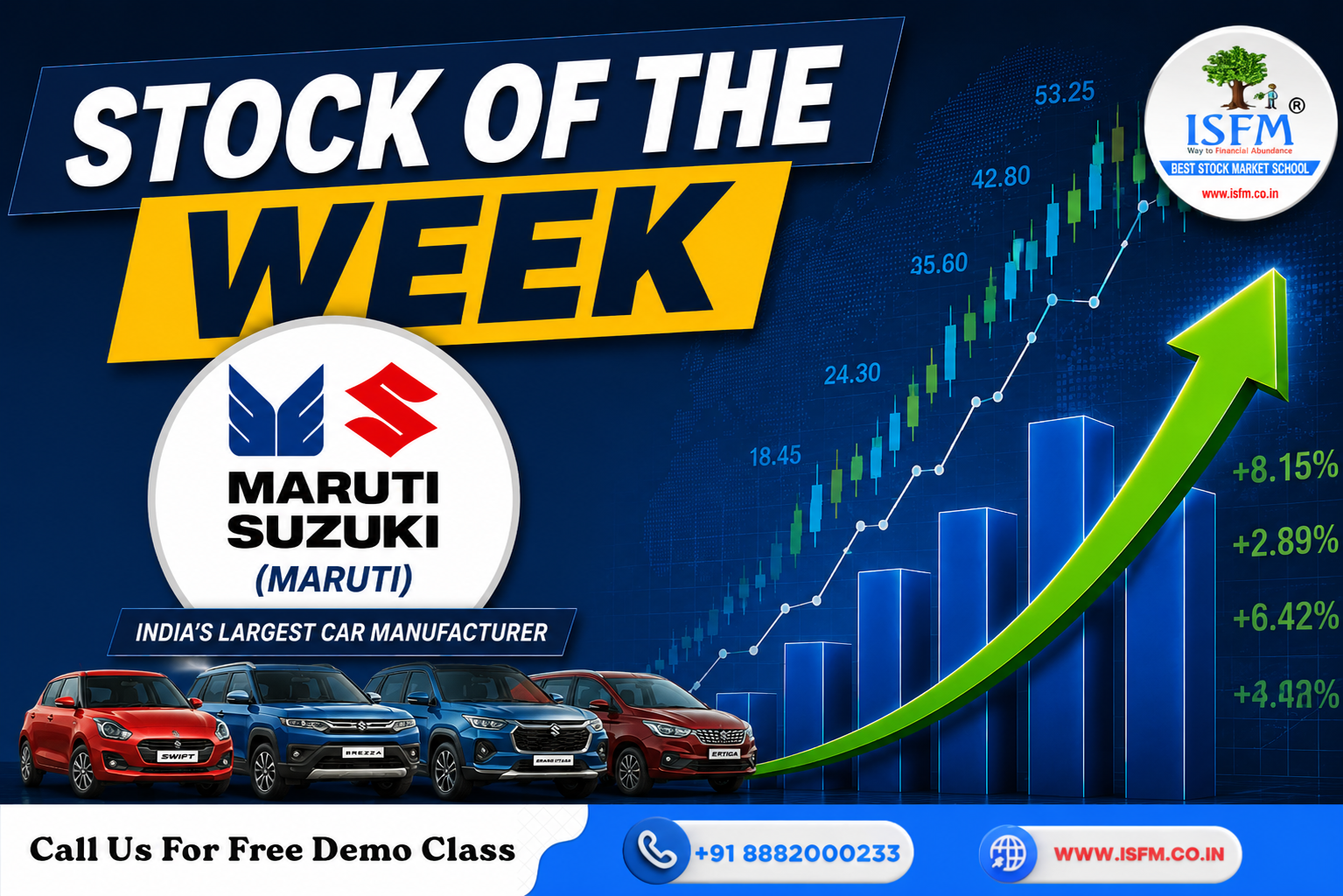
Maruti Suzuki India Ltd. has been the undisputed leader in India’s passenger vehicle market for decades. With a dominant market share, an extensive dealership network, and strong brand recall, the company continues to play a pivotal role in India’s automotive industry.
This week’s Stock of the Week focuses on Maruti Suzuki because the company is entering a new growth phase driven by SUV expansion, rising exports, electric vehicle (EV) initiatives, and capacity expansion. While short-term industry challenges remain, its long-term fundamentals continue to attract investor attention.
Before investing in any company, it is important to understand its business model, financial statements, and valuation. Investors who want to learn how professionals evaluate listed companies can explore ISFM’s Fundamental Analysis Course
Company Overview
| Particular | Details |
| Company | Maruti Suzuki India Ltd. |
| Industry | Passenger Vehicles (Automobile) |
| Sector | Automobile & Auto Components |
| Headquarters | New Delhi, India |
| NSE Symbol | MARUTI |
| BSE Code | 532500 |
| Market Capitalization | Approximately ₹4.3 lakh crore |
| Revenue (TTM) | Approximately ₹1.74 lakh crore |
| Net Profit (TTM) | Approximately ₹14,400 crore |
| Promoter Holding | Around 56.3% (Suzuki Motor Corporation) |
Financial figures are approximate and based on the latest publicly available financial information.
About the Company
Maruti Suzuki is India’s largest passenger vehicle manufacturer and a subsidiary of Japan-based Suzuki Motor Corporation. The company manufactures and sells hatchbacks, sedans, SUVs, MPVs, and commercial vehicles under popular brands such as Alto, Swift, Baleno, Brezza, Ertiga, Fronx, Grand Vitara, and Jimny.
Its extensive dealer network, robust after-sales service, and trusted brand make it one of India’s strongest consumer-facing businesses.
Business Model
Core Products
- Passenger Cars
- SUVs
- MPVs
- Commercial Vehicles
- Genuine Spare Parts
- Vehicle Servicing
- Accessories
- Financing & Insurance Partnerships
Industries Served
- Automobile
- Retail Consumers
- Fleet Operators
- Commercial Transportation
Position in the Value Chain
Maruti Suzuki operates as an integrated automobile manufacturer. It designs, manufactures, markets, distributes, and services vehicles through one of India’s largest dealership and service networks.
Competitive Advantages
- Largest passenger vehicle market share in India
- Strong nationwide sales and service network
- Trusted brand with decades of customer loyalty
- High manufacturing efficiency
- Strong balance sheet with negligible debt
- Growing export business
- Significant economies of scale
These advantages create high entry barriers for new competitors.
While business fundamentals determine long-term wealth creation, many investors also use price charts to identify better buying opportunities. Learning Technical Analysis helps investors understand trends, support and resistance, and market psychology.
Why This Stock Looks Attractive?
1. Leadership in India’s Growing Automobile Market
India continues to witness rising vehicle ownership driven by increasing disposable income, urbanization, and improving infrastructure. Maruti Suzuki remains one of the biggest beneficiaries of this structural growth.
2. Strong SUV Portfolio
SUVs have become India’s fastest-growing passenger vehicle segment. Maruti has significantly strengthened its presence through successful models like Brezza, Fronx, Grand Vitara, and Jimny.
3. Capacity Expansion
The company continues investing in new manufacturing facilities and expanding production capacity to meet rising domestic and export demand. This supports long-term volume growth.
4. Export Growth and EV Strategy
Maruti Suzuki has emerged as one of India’s leading passenger vehicle exporters. Simultaneously, it is preparing to expand its electric vehicle portfolio, positioning itself for future industry trends.
Financial Snapshot
| Metric | Value |
| Revenue | ~₹1.74 lakh crore |
| EBITDA | ~₹21,000 crore |
| Net Profit | ~₹14,400 crore |
| ROE | ~14.5% |
| ROCE | ~19.2% |
| Debt to Equity | Nearly Zero |
| Interest Coverage | Extremely Strong |
Values are indicative based on recent trailing financials.
Financial Health
Maruti Suzuki maintains one of the strongest balance sheets in the Indian automobile sector. The company generates healthy operating cash flows, has negligible debt, consistently earns attractive returns on capital, and enjoys strong liquidity. These characteristics provide resilience during economic slowdowns and support long-term investments in new technologies and manufacturing capacity.
Understanding financial ratios like ROE, ROCE, EBITDA, and Debt-to-Equity is essential for evaluating any company. Beginners looking to build these skills can start with ISFM’s comprehensive Stock Market Course
Valuation Analysis
Maruti Suzuki currently trades at a Price-to-Earnings (P/E) ratio of around 30x, broadly in line with its historical premium valuation among Indian automobile companies.
Historically, the company has commanded premium valuations because of:
- Market leadership
- Strong corporate governance
- Consistent profitability
- Low financial leverage
- Stable cash generation
Valuation View
The stock appears fairly valued rather than deeply undervalued. Investors continue assigning a premium because of its dominant market position, healthy balance sheet, and long-term growth prospects.
For investors interested in combining fundamental analysis, technical analysis, derivatives, and risk management into a structured investment framework, ISFM’s Chartered Stock Trading Expert (CSTX) program provides practical market-oriented learning.
Key Risks
1. Raw Material Price Volatility
Fluctuations in steel, aluminium, rubber, and semiconductor prices can impact operating margins.
2. Increasing Competition
Competition from Tata Motors, Mahindra & Mahindra, Hyundai, Kia, and emerging EV manufacturers continues to intensify.
3. Slow Passenger Vehicle Demand
Any slowdown in consumer spending or rising interest rates may affect vehicle demand.
4. EV Transition Risk
Although Maruti is entering the EV market, execution delays or aggressive competition in electric vehicles could affect future growth.
Final View
Maruti Suzuki remains one of India’s highest-quality automobile businesses. The company combines market leadership, operational excellence, healthy profitability, a trusted brand, and a virtually debt-free balance sheet.
Its long-term growth outlook remains supported by India’s expanding passenger vehicle market, SUV demand, export growth, manufacturing expansion, and upcoming EV launches. Although the stock currently trades at a premium valuation, this premium largely reflects the quality of the business and its consistent execution.
Investors should continue monitoring demand trends, competition, margin performance, and progress in the EV segment before making any investment decision.
If you want to learn how to analyse companies like Maruti Suzuki independently using professional techniques, explore ISFM’s complete range of Stock Market Courses designed for beginners, investors, and aspiring traders.
Frequently Asked Questions (FAQs)
1. Is Maruti Suzuki a good long-term company?
Maruti Suzuki is widely regarded as one of India’s strongest automobile companies due to its dominant market share, extensive distribution network, consistent profitability, strong cash flows, and robust balance sheet. However, investors should always evaluate valuation and business risks before investing.
2. What are the major growth drivers for Maruti Suzuki?
The company’s major growth drivers include increasing passenger vehicle demand, expansion of its SUV portfolio, export growth, manufacturing capacity additions, and its entry into the electric vehicle segment.
3. Is Maruti Suzuki fairly valued at current levels?
Based on its historical valuation multiples and business quality, Maruti Suzuki currently appears fairly valued. Future earnings growth and successful execution of its EV strategy will play an important role in determining long-term shareholder returns.
Disclosure & Disclaimer
This article is intended solely for educational and informational purposes and should not be construed as investment advice, financial advice, or a recommendation to buy or sell any security. The financial information presented is based on publicly available sources and may change over time. Investors should conduct their own research, assess their financial goals and risk tolerance, and consult a qualified financial advisor before making any investment decisions. Past performance is not indicative of future results.