Choosing the right certification is one of the first decisions for anyone planning a career in the Indian stock market. Whether you’re a student, a working professional, or someone looking to become a mutual fund distributor or research analyst, you’ve probably come across two popular names—NISM and NCFM.
This often leads to a common question: Which certification is better—NISM or NCFM?
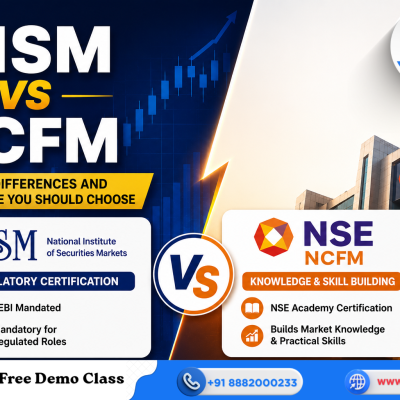
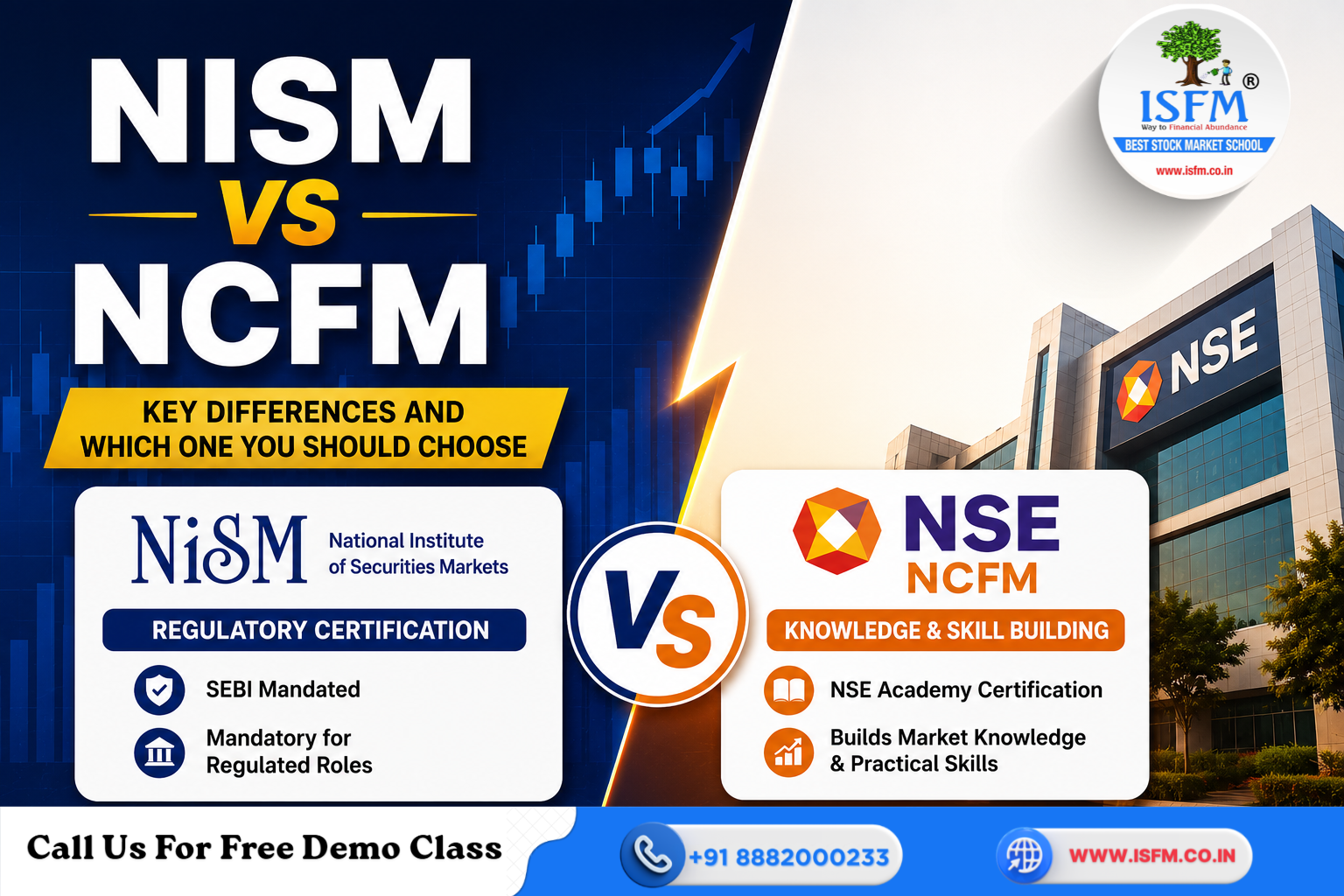
The truth is that NISM and NCFM are not competitors. They serve different purposes and are designed for different career goals. Understanding these differences will help you make the right choice without getting influenced by marketing claims.
If you’re planning to build a long-term career in financial markets, exploring professional stock market courses alongside certifications can give you practical exposure that goes beyond theoretical learning. ISFM offers a range of Share Market Courses designed for beginners as well as aspiring market professionals.
What Is NISM?
NISM (National Institute of Securities Markets) is an educational institution established by the Securities and Exchange Board of India (SEBI).
Its primary objective is to improve the quality and professionalism of India’s securities markets through education, training, and certification.
Many roles regulated by SEBI require candidates to hold specific NISM certifications before they can legally work in those positions.
Some examples include:
- Mutual Fund Distributors
- Equity Derivatives Dealers
- Research Analysts
- Investment Advisers
- Depository Operations Professionals
For these regulated roles, obtaining the relevant NISM certification is not optional—it is a regulatory requirement.
If you’re preparing for these exams, enrolling in a structured NISM Certification Course can help you understand the syllabus, exam pattern, and practical applications more effectively.
What Is NCFM?
NCFM (NSE Certification in Financial Markets) is offered by NSE Academy, the educational arm of the National Stock Exchange (NSE).
Unlike NISM, NCFM focuses on developing practical knowledge and skills across various financial market subjects.
Popular NCFM modules include:
- Technical Analysis
- Fundamental Analysis
- Equity Markets
- Derivatives
- Mutual Funds
- Risk Management
NCFM certifications demonstrate your knowledge in a particular subject and can strengthen your resume, especially when applying for internships or entry-level jobs.
However, NCFM does not replace NISM certifications wherever SEBI has made NISM mandatory.
When Should You Choose NISM?
You should prioritize NISM certification if your career goal involves working in regulated financial market roles.
Examples include:
- Becoming a SEBI Registered Investment Adviser
- Working as a Research Analyst
- Becoming a Mutual Fund Distributor
- Joining a stock broker as an Associated Person
- Working in Equity Derivatives dealing
- Applying for jobs where employers specifically mention a NISM Series certification
An Associated Person is someone who performs regulated market activities on behalf of a registered intermediary like a stock broker.
If the job legally requires certification, it is almost always a NISM certification.
Students planning a complete career in financial markets often complement their certification with a comprehensive Financial Market Expert (FMX) program, which covers multiple market segments beyond the certification syllabus.
When Should You Choose NCFM?
NCFM is ideal if your objective is learning rather than regulatory compliance.
Choose NCFM if:
- You’re a finance student exploring capital markets.
- You want structured learning in Technical or Fundamental Analysis.
- You’re preparing for internships.
- You want to improve your CV.
- You already have NISM certification and wish to expand your expertise.
For candidates interested in chart reading and market analysis, pairing NCFM with a practical Technical Analysis Course helps bridge the gap between theory and real-market application.
Can You Do Both?
Many successful finance professionals hold both NISM and NCFM certifications because they complement each other.
For example:
- A Research Analyst may complete the NISM Research Analyst Certification while also earning NCFM certifications in Technical Analysis and Fundamental Analysis.
- A Trader may complete the NISM Equity Derivatives Certification and supplement it with NCFM modules covering derivatives strategies and risk management.
Think of it this way:
- NISM gives you regulatory eligibility.
- NCFM adds additional knowledge and specialization.
Together, they create a stronger professional profile.
Professionals interested in becoming full-time traders can also benefit from specialized Options Trading Courses, which provide practical insights into derivatives strategies and risk management.
Conclusion
The debate between NISM vs NCFM isn’t about which certification is better—it’s about which one aligns with your career goals.
If your objective is to become legally eligible for regulated roles such as a Research Analyst, Mutual Fund Distributor, or Investment Adviser, NISM should be your first priority.
If you’re looking to build market knowledge, improve your resume, and deepen your understanding of financial markets, NCFM is an excellent learning credential.
For professionals planning a long-term career in India’s capital markets, combining NISM for regulatory compliance with NCFM for additional expertise can be a smart strategy. Alongside these certifications, gaining practical knowledge through structured stock market courses can further strengthen your skills and career prospects.
Choose your certification based on where you want your career to go—not on hype or popular opinion.