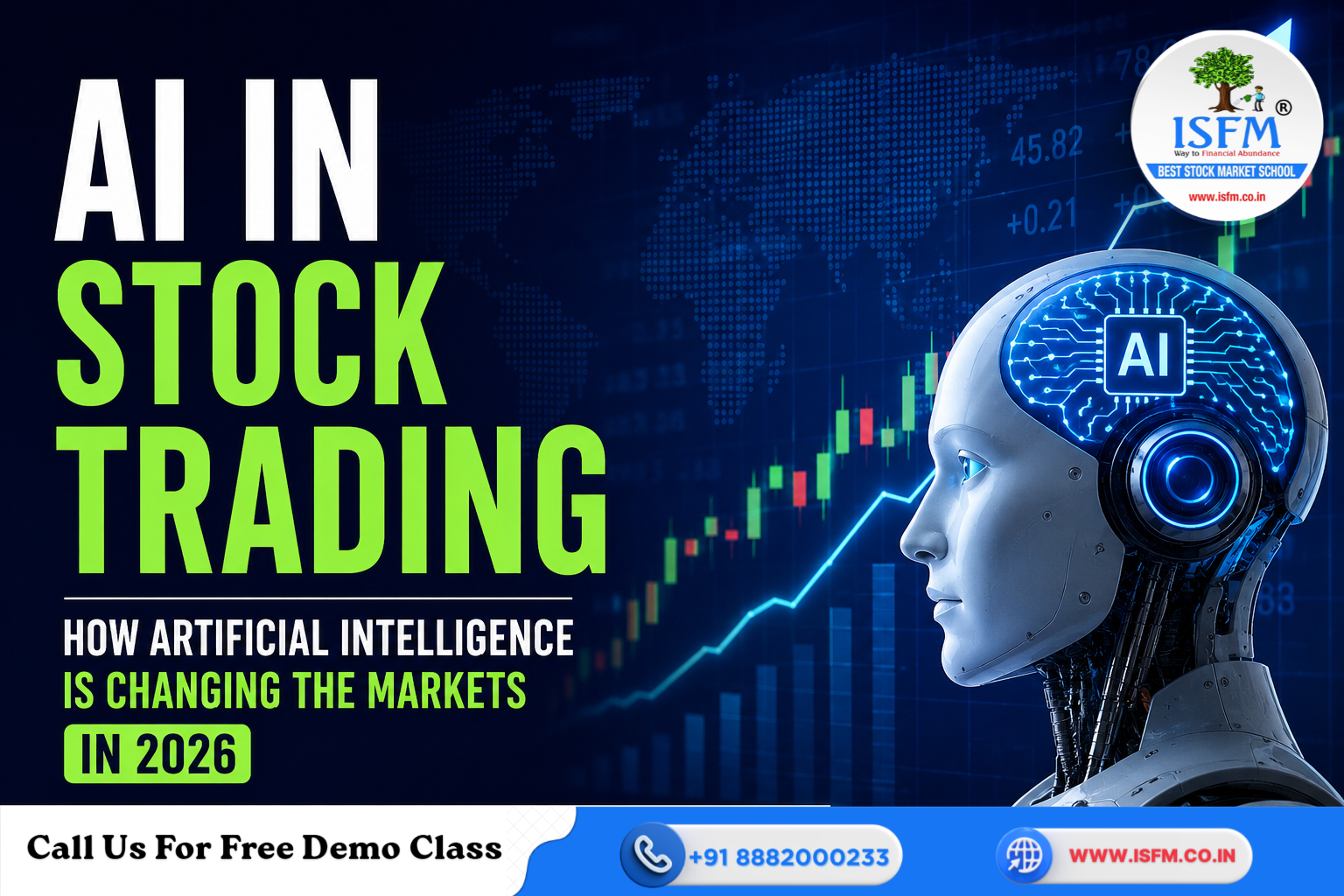
Artificial Intelligence (AI) is no longer a futuristic concept—it has become an integral part of modern stock trading. From analysing millions of data points in seconds to executing trades automatically, AI is transforming how financial markets operate. While large institutions have relied on AI-powered trading systems for years, affordable trading platforms and advanced software have made these technologies increasingly accessible to retail traders in 2026.
Before using AI tools, it’s important to understand how financial markets work. Building a strong foundation through a Technical Analysis Course can help traders interpret AI-generated signals more effectively.
But despite the excitement, AI isn’t a shortcut to guaranteed profits. It’s a powerful tool that enhances decision-making when combined with sound trading knowledge and risk management.
What Does AI in Stock Trading Really Mean?
In stock trading, AI refers to computer systems that use machine learning, data analysis, and predictive algorithms to identify trading opportunities and support investment decisions.
Unlike traditional software that follows fixed instructions, AI systems can learn from historical market data and improve their predictions over time.
AI is commonly used for:
- Screening stocks based on technical and fundamental criteria
- Predicting market trends and volatility
- Algorithmic (automated) trading
- Portfolio optimization
- Risk management
However, it’s important to remember that AI works with probabilities, not certainties. Markets are influenced by unexpected events that no algorithm can predict perfectly.
How AI Is Used in Stock Trading?
1. Smart Stock Screening
Instead of manually checking hundreds of stocks, AI-powered screeners analyse:
- Price movements
- Trading volume
- Technical indicators
- Company earnings
- Financial news
- Social media sentiment
Within seconds, AI can identify stocks that match specific trading strategies, helping traders save valuable time.
2. Predictive Market Analysis
Machine learning models study years of historical price data to recognize recurring market patterns.
These systems attempt to forecast:
- Short-term price direction
- Volatility changes
- Trend strength
- Probability of breakouts or reversals
Although predictions are never perfect, AI provides traders with additional insights that support better decision-making. Traders interested in learning how these models are built can explore ISFM’s Algo Trading Course, which covers algorithmic and automated trading concepts.
3. Algorithmic Trading
Algorithmic trading combines predefined trading rules with AI models to execute trades automatically.
For example, an AI trading system can:
- Enter trades instantly
- Exit positions based on targets or stop-losses
- Monitor multiple stocks simultaneously
- Eliminate emotional decision-making
Institutional investors use these systems extensively, and many retail brokers now offer AI-assisted algorithmic trading platforms.
4. Risk Management and Portfolio Optimization
One of AI’s biggest strengths is managing risk.
Modern AI tools help traders by:
- Calculating position size
- Suggesting portfolio diversification
- Detecting abnormal market conditions
- Rebalancing investments automatically
Understanding derivatives and hedging techniques can further strengthen risk management. ISFM’s Advanced Derivatives Course explains practical strategies used by professional traders.
Benefits of AI in Stock Trading
Faster Analysis
AI processes enormous volumes of market data in seconds—something impossible for humans to do manually.
Emotion-Free Decisions
Fear and greed often cause trading mistakes. AI follows predefined rules consistently without emotional bias.
Better Pattern Recognition
Machine learning can discover relationships between different market variables that may not be obvious to human traders.
Greater Accessibility
In 2026, AI-powered charting platforms, APIs, and trading assistants are available even to individual traders, making advanced analysis more affordable than ever.
Many professional traders combine AI with structured trading education, such as ISFM’s Chartered Stock Trading Expert (CSTX) program, which covers technical analysis, derivatives, and practical market applications.
Risks, Limitations, and Common Myths
Despite its advantages, AI has important limitations.
Models Depend on Historical Data
AI learns from past market behaviour. When completely new events occur, predictions may become unreliable.
Overfitting
Some AI systems perform exceptionally well during backtesting but fail in live markets because they have memorized historical data instead of learning general patterns.
Black-Box Decisions
Many AI models provide recommendations without clearly explaining why. Blindly following such systems can be risky.
Technical Risks
Poor-quality data, software bugs, internet failures, or execution delays can negatively affect automated trading strategies.
Common Myths
- AI guarantees profits
- AI can predict every market crash
- AI removes all trading risk
The reality is that AI improves decision-making—it doesn’t eliminate uncertainty.
How Retail Traders Can Start Using AI Responsibly?
If you’re new to AI, there’s no need to build complex trading algorithms immediately.
Instead:
- Start with AI-powered stock screeners.
- Use AI-based market sentiment tools.
- Backtest every strategy thoroughly.
- Practice through paper trading before investing real money.
- Allocate only a small portion of your capital to AI-assisted strategies.
- Maintain a trading journal to evaluate whether AI is actually improving your performance.
Before relying on AI, traders should also understand market regulations and industry standards. Pursuing NISM Certification Training can strengthen your financial market knowledge and improve your credibility.
The Future of AI in Stock Trading
The future looks promising.
Over the next few years, traders can expect:
- Smarter broker platforms with built-in AI assistants
- Better integration between AI and algorithmic trading
- More personalized portfolio recommendations
- Stronger regulatory oversight for AI-driven trading systems
- Improved transparency in AI decision-making
Rather than replacing traders, AI is likely to become a trusted partner that helps analyse information faster while humans continue making strategic decisions.
Conclusion
Artificial Intelligence is reshaping stock trading by improving market analysis, trade execution, and risk management. It enables traders to process information more efficiently and identify opportunities that might otherwise go unnoticed.
However, AI is not a magic formula for success. Markets remain unpredictable, and no algorithm can guarantee consistent profits. The traders who succeed in 2026 and beyond will be those who combine technology, market knowledge, disciplined execution, and effective risk management.
Treat AI as a powerful assistant—not a replacement for your own judgment.