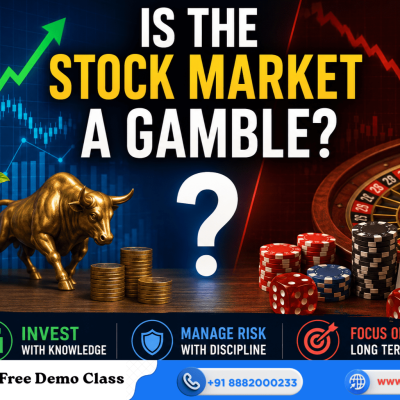
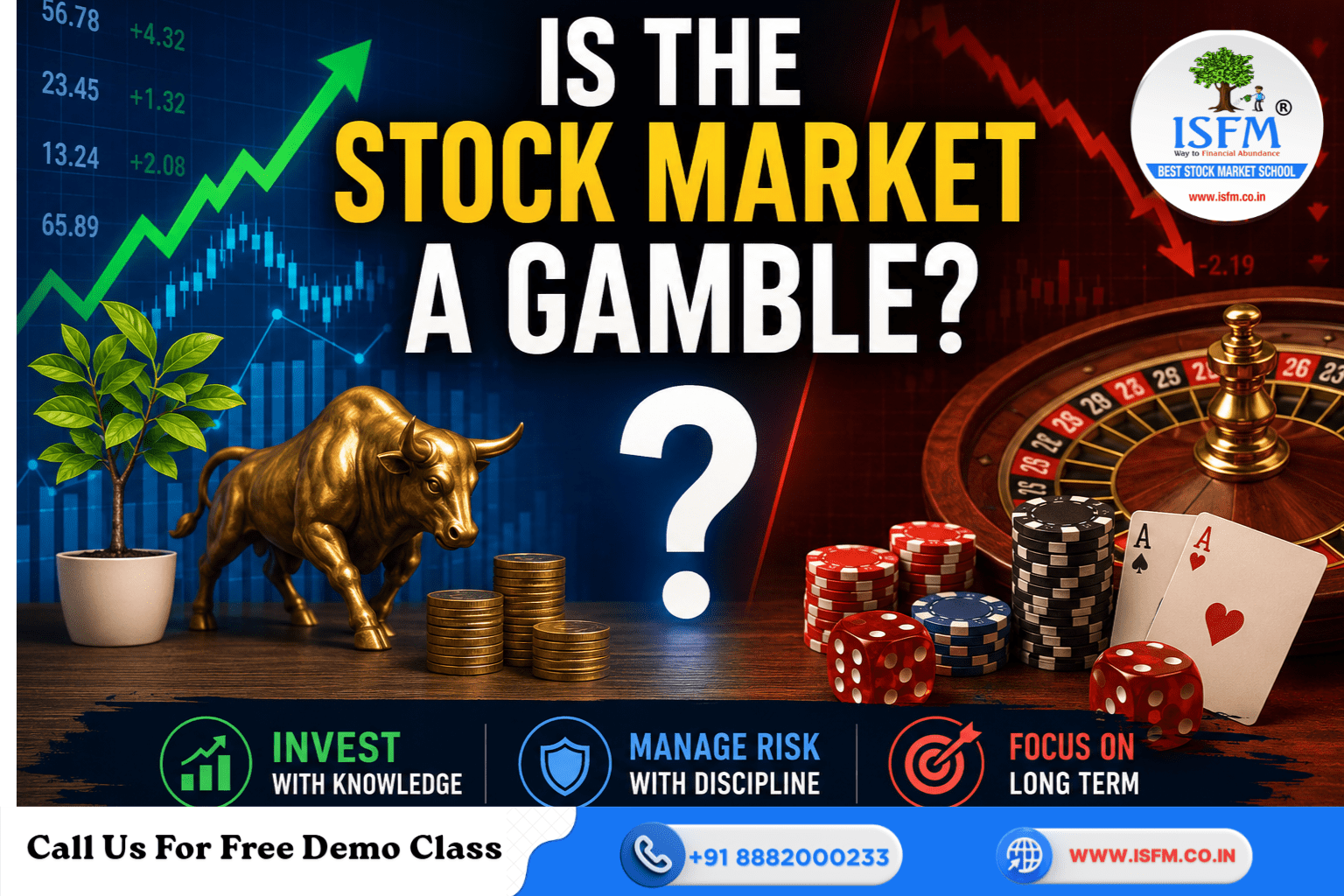
Many people ask, “Is the stock market a gamble?” The question often comes up after hearing stories of people making huge profits overnight or losing their savings during market crashes. Since stock prices can rise and fall quickly, it is easy to understand why some people compare the stock market to gambling.
However, the truth is more balanced. The stock market itself is not gambling. Whether it becomes a disciplined investment or a risky gamble depends largely on how a person participates. Someone who researches companies, manages risk, and invests with patience is very different from someone who buys stocks based on rumors or emotions.
Let’s understand the difference between investing, trading, and gambling.
What Does Gambling Mean?
Gambling is an activity where money is placed on an uncertain outcome, with the result depending mostly on luck or chance. Examples include casino games, lotteries, sports betting, and betting on random events where participants have very little control over the outcome.
In gambling:
- The outcome is mostly unpredictable.
- Decisions rely more on luck than research.
- The odds usually favor the organizer or the house.
- There is little opportunity to improve results through analysis.
Although skill may play a role in some forms of gambling, chance remains the biggest factor.
What Is Stock Market Investing?
Investing means buying shares of companies with the expectation that they will grow over time. When you purchase a stock, you become a partial owner of that business.
Successful investors do not depend on luck. Instead, they carefully study factors such as:
- Company earnings
- Business growth
- Financial health
- Industry trends
- Valuation
- Future opportunities
Long-term investors also diversify their portfolios to reduce risk and allow businesses enough time to grow. Many of the world’s successful investors have built wealth through patience and disciplined investing rather than chasing quick profits.
If you’re new to investing, learning the basics through a Stock Market Investment Course can help you understand how to evaluate companies, build a diversified portfolio, and make informed investment decisions.
What Is Stock Market Trading?
Trading is different from investing because it focuses on short-term price movements. Traders buy and sell stocks over days, hours, or even minutes to earn profits from market fluctuations.
Instead of focusing only on company fundamentals, traders often use:
- Price charts
- Technical analysis
- Market trends
- News events
- Trading volume
- Risk management strategies
Professional traders follow trading plans and use tools like stop-loss orders to manage losses. They understand that protecting capital is just as important as earning profits.
Learning chart analysis through a Technical Analysis Course can help traders make logical decisions based on market data instead of emotions.
Why People Compare the Stock Market to Gambling
There are several reasons why people believe the stock market is gambling.
First, stock prices can move sharply due to earnings announcements, economic data, interest rate changes, or global events.
Second, many beginners enter the market expecting quick money. They often:
- Follow social media tips.
- Buy stocks based on rumors.
- Ignore company research.
- Take excessive risks.
- Panic during market volatility.
These behaviors increase the chances of losses and make investing feel like gambling.
Many people also confuse speculation with investing. Speculation focuses on predicting short-term price movements with limited information, while investing is based on business performance and long-term wealth creation.
Why the Stock Market Is Not the Same as Gambling
Although both involve uncertainty, there are several important differences.
Stocks represent ownership in real businesses that manufacture products, provide services, generate profits, and create value over time.
Successful companies can:
- Increase revenue and earnings.
- Expand into new markets.
- Pay dividends to shareholders.
- Create long-term wealth for investors.
Unlike gambling, investors can improve their chances of success by studying financial statements, understanding industries, diversifying investments, and managing risk effectively.
History has shown that disciplined long-term investing has rewarded patient investors despite short-term market volatility.
When the Stock Market Becomes Gambling-Like
The stock market starts resembling gambling when people ignore basic investment principles.
Common mistakes include:
- Buying stocks without research.
- Chasing overnight profits.
- Investing money they cannot afford to lose.
- Following unverified market tips.
- Using excessive leverage.
- Trading emotionally.
- Ignoring stop-loss levels.
Similarly, options and derivatives trading without proper education can become highly speculative. Before participating in these segments, traders should understand market mechanics and risk management through an Options Trading Course.
How to Reduce Risk in the Stock Market
Every investment carries some level of risk, but risk can be managed with the right approach.
Here are a few practical ways to reduce risk:
- Learn the basics before investing.
- Research companies thoroughly.
- Diversify across different sectors.
- Invest with a long-term perspective.
- Use proper position sizing.
- Follow a disciplined risk management strategy.
- Set realistic financial goals.
- Avoid emotional buying and selling.
- Keep learning as markets evolve.
Education is one of the best investments you can make before risking your money. Joining a structured Stock Market Course can help beginners understand investing, trading, technical analysis, and practical risk management in a systematic way.
Conclusion
So, is the stock market a gamble? The answer is no—not when approached with knowledge, patience, and discipline.
Investing is based on research, business ownership, and long-term wealth creation. Trading is a professional skill that requires planning, analysis, and effective risk management. Both are fundamentally different from gambling when practiced responsibly.
However, the stock market can become gambling-like when people chase quick money, ignore research, follow rumors, or take reckless risks without a plan.
The stock market remains one of the world’s most powerful wealth-building tools. Those who respect risk, continue learning, and make informed decisions are far more likely to achieve long-term financial success than those who rely on luck alone.