
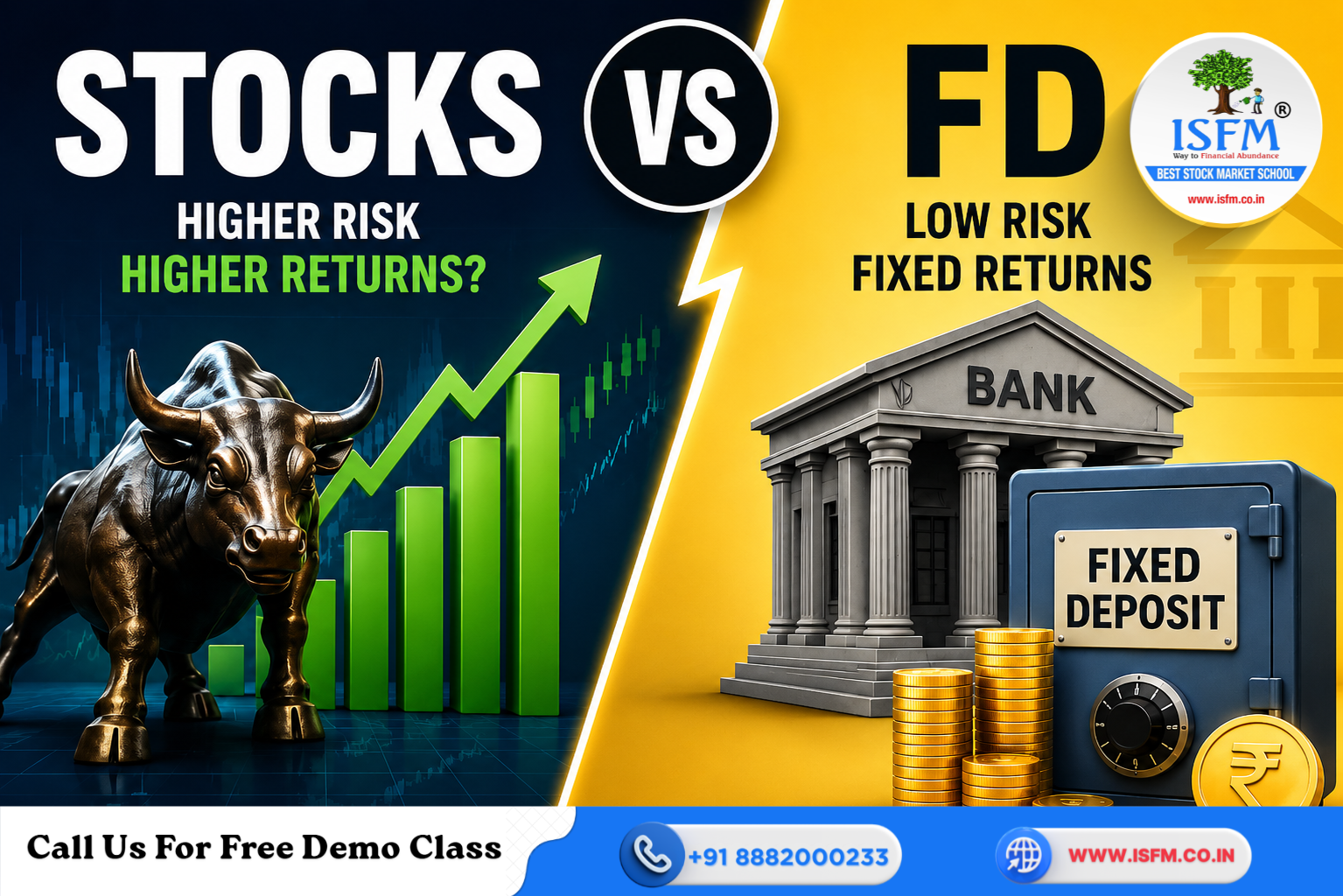
When it comes to investing, one question almost every beginner asks is: Should I invest in Stocks or Fixed Deposits (FDs)? While FDs offer safety and guaranteed returns, stocks provide the opportunity to build significant wealth over time—but with higher risk.
So, has the extra risk of investing in stocks been worth it? Let’s find out.
What are Stocks and Fixed Deposits?
Stocks (Equity) represent ownership in a company. As the company’s value grows, your investment can grow too. However, stock prices fluctuate daily based on market conditions and company performance. If you’re new to investing, learning the basics of company analysis through our Fundamental Analysis Course can help you make informed investment decisions.
A Fixed Deposit (FD) is a savings product offered by banks where you deposit money for a fixed period at a predetermined interest rate. Your returns are guaranteed, regardless of market movements.
Stocks vs FD: Key Differences
| Feature | Stocks | Fixed Deposit |
| Risk | High | Very Low |
| Returns | 10–15%+ (long term, not guaranteed) | Around 7% (fixed) |
| Liquidity | Can sell anytime during market hours | Premature withdrawal may attract penalties |
| Inflation Impact | Usually beats inflation over time | May struggle to beat inflation |
| Taxation | Lower long-term capital gains tax | Interest taxed as per your income slab |
Risk Comparison
FDs are considered one of the safest investment options. Your principal remains secure, and eligible bank deposits are insured by DICGC up to ₹5 lakh per depositor per bank.
Stocks, however, carry market risk. Prices can rise or fall due to economic events, company performance, or investor sentiment. In the short term, you may even lose part of your investment. Learning to read price trends and market sentiment through Technical Analysis can help investors manage risk more effectively. Explore our course here.
Returns: Which Creates More Wealth?
Let’s compare a ₹1,00,000 investment over 10 years.
- FD at 7%: Approximately ₹1.97 lakh before tax. After tax (30% slab), effective returns reduce significantly.
- Stocks at 12%: Approximately ₹3.11 lakh before taxes.
Although stock returns are never guaranteed, Indian equity markets have historically delivered higher long-term returns than FDs.
Tax and Inflation Matter
FD interest is fully taxable according to your income tax slab, reducing your actual earnings.
Stocks enjoy more favorable taxation for long-term investors, making post-tax returns more attractive.
Inflation is another important factor. If inflation averages 6%, an FD earning 7% barely increases your purchasing power. Stocks, on the other hand, have historically outpaced inflation over long periods, helping investors grow real wealth.
Has the Extra Risk Been Worth It?
Historically, yes—but only for patient investors.
If your investment horizon is 10 years or longer, stocks have generally rewarded investors with substantially higher returns than FDs.
However, for short-term goals of one to three years, market volatility can lead to losses. In such cases, FDs remain the safer option.
Time in the market matters more than timing the market.
Who Should Choose What?
Choose Fixed Deposits if you:
- Need guaranteed returns
- Have short-term financial goals
- Prefer capital safety over higher returns
Choose Stocks if you:
- Want long-term wealth creation
- Can tolerate market fluctuations
- Have a 5–10 year investment horizon
For investors who want to build strong investing and trading skills with practical live-market experience, ISFM’s Chartered Stock Trading Expert (CSTX) program covers technical analysis, derivatives, fundamental analysis, and risk management. Learn more here.
Final Thoughts
There is no single “best” investment for everyone.
FDs provide stability and peace of mind, while stocks offer superior long-term wealth creation at the cost of higher short-term volatility. A balanced portfolio often works best—use FDs for safety and stocks for growth. Invest according to your financial goals, risk tolerance, and investment horizon.
Disclaimer
Stock market investments are subject to market risks. Past performance does not guarantee future returns. Always conduct your own research or consult a qualified financial advisor before investing.