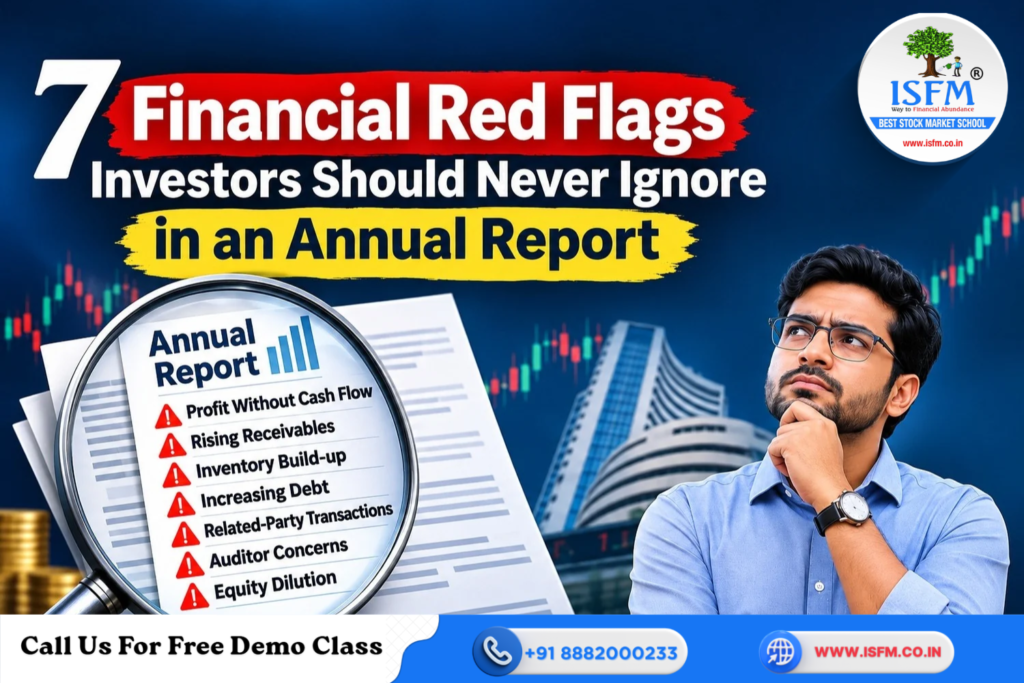
7 Financial Red Flags Investors Should Never Ignore in an Annual Report
A company reports 25% profit growth, its share price rises, and investors become optimistic. However, a closer look at its annual report reveals negative operating cash flow, rapidly increasing receivables, and sharply rising debt. Is strong reported profit enough to justify investing in a company? According to Sushil Alewa, SEBI Registered Research Analyst (INH100009433), MBA and CFP, investors should look beyond headline earnings and examine the quality of financial performance before making investment decisions. Analysing cash flows, balance sheets, auditor observations, and financial disclosures is essential to understanding the actual financial health of a business. An annual report contains valuable information beyond revenue and profit. Understanding these financial red flags can help investors make informed decisions when analysing NSE and BSE-listed companies. Profit Without Operating Cash Flow One of the biggest financial red flags is consistent profit growth without sufficient cash generation. Net profit represents accounting earnings, whereas operating cash flow shows how much actual cash a company generates through its core business activities. Watch for situations where profits increase for several years but operating cash flow remains weak or negative. This may indicate delayed customer payments, rising inventory, or aggressive revenue recognition. For example, a company reports ₹100 crore in net profit but generates only ₹15 crore in operating cash flow. If this gap continues for several years, investors should investigate why reported earnings are not converting into cash. Investors interested in understanding these financial statements can explore ISFM’s Fundamental Analysis Course. Receivables Growing Faster Than Revenue Trade receivables represent money customers owe a company for goods or services already delivered. When receivables grow significantly faster than revenue, it may indicate delayed payments, aggressive credit sales, or weakening collection efficiency. For example, revenue increases from ₹500 crore to ₹550 crore (10%), while receivables rise from ₹80 crore to ₹112 crore (40%). This difference deserves attention. Investors should examine debtor days, overdue payments, and provisions for doubtful debts. Inventory Rising Faster Than Sales Inventory includes raw materials, work-in-progress, and finished goods held by a company. If inventory increases much faster than sales, it may indicate slowing demand or inefficient inventory management. Other warning signs include declining inventory turnover, unsold finished goods, and repeated explanations from management about temporary inventory accumulation. Excess inventory can lock up cash and eventually lead to discounting, product obsolescence, or inventory write-downs. Rising Debt With Weak Cash Generation Borrowing money is not necessarily bad. Companies use debt for expansion, acquisitions, and working capital. The concern arises when borrowings increase without corresponding improvements in earnings and cash generation. Investors should examine total borrowings, debt-to-equity ratio, interest coverage ratio, finance costs, and debt repayment schedules. If interest expenses consume an increasing share of operating profits, the company may face financial pressure, particularly during an economic slowdown. Understanding financial ratios and company fundamentals is an important part of the Fundamental Analysis Course at ISFM. Opaque Related-Party Transactions Related-party transactions involve dealings between a company and entities connected to its promoters, directors, or group companies. Examples include purchasing materials from promoter-owned businesses, paying royalties to related entities, providing loans to group companies, or giving guarantees for related businesses. These transactions are not automatically inappropriate. However, unusually large, recurring, or poorly explained transactions deserve attention. Investors should check whether transactions are commercially reasonable, properly approved, transparently disclosed, and beneficial to the company rather than primarily to promoters. Auditor Concerns or Resignation The independent auditor’s report is one of the most important sections of an annual report. Investors should look for qualified opinions, adverse opinions, disclaimers of opinion, emphasis-of-matter paragraphs, and material uncertainty related to going concern. A qualified opinion indicates a specific reservation about financial statements, while an adverse opinion or disclaimer represents a more serious concern. An emphasis-of-matter paragraph highlights an important issue without necessarily modifying the auditor’s opinion. Unexpected auditor resignation, particularly following disagreements over accounting practices or access to information, also deserves serious investigation. Repeated Fundraising or Equity Dilution Companies raise capital through rights issues, preferential allotments, QIPs, and other equity instruments. Fundraising can support business expansion or reduce debt. However, repeated equity issuance may dilute existing shareholders. Watch for frequent fundraising without clear expansion plans, declining promoter shareholding, and repeated capital requirements to support operating losses. Investors should examine how the funds are utilised and whether additional capital is generating sustainable business growth. How to Investigate Financial Red Flags? Identifying a warning sign is only the beginning. Before making an investment decision: Investors who want to develop practical skills in evaluating company performance can explore ISFM’s Fundamental Analysis and Stock Market Courses. Frequently Asked Questions What are financial red flags in an annual report? They are warning signs such as weak cash flow, rising debt, increasing receivables, questionable related-party transactions, and auditor concerns. Is negative operating cash flow always a bad sign? Not necessarily. Growing companies may temporarily report negative operating cash flow due to expansion or working-capital requirements. Persistent negative cash flow needs investigation. Why are related-party transactions important? They help investors understand whether transactions involving promoters, directors, and group companies are transparent and commercially reasonable. Does an auditor’s qualified opinion mean a company is fraudulent? No. It indicates a specific reservation in the auditor’s opinion. Investors should understand the reason and its potential financial impact. Should investors sell a stock after identifying a red flag? Not automatically. A red flag is a reason to investigate further, compare historical performance, and evaluate the complete financial picture. Conclusion An annual report is more than a collection of financial statements. It provides insights into a company’s financial strength, cash generation, governance, and long-term sustainability. Strong reported earnings do not always mean a financially healthy business. Investors must examine the quality of profits, debt levels, cash flows, and management disclosures before making decisions. A good investor does not ignore red flags. They investigate them, understand the context, and decide only after the full picture is clear. Disclaimer: This article is for educational purposes only and does not constitute investment advice or a recommendation to buy, hold, or sell