
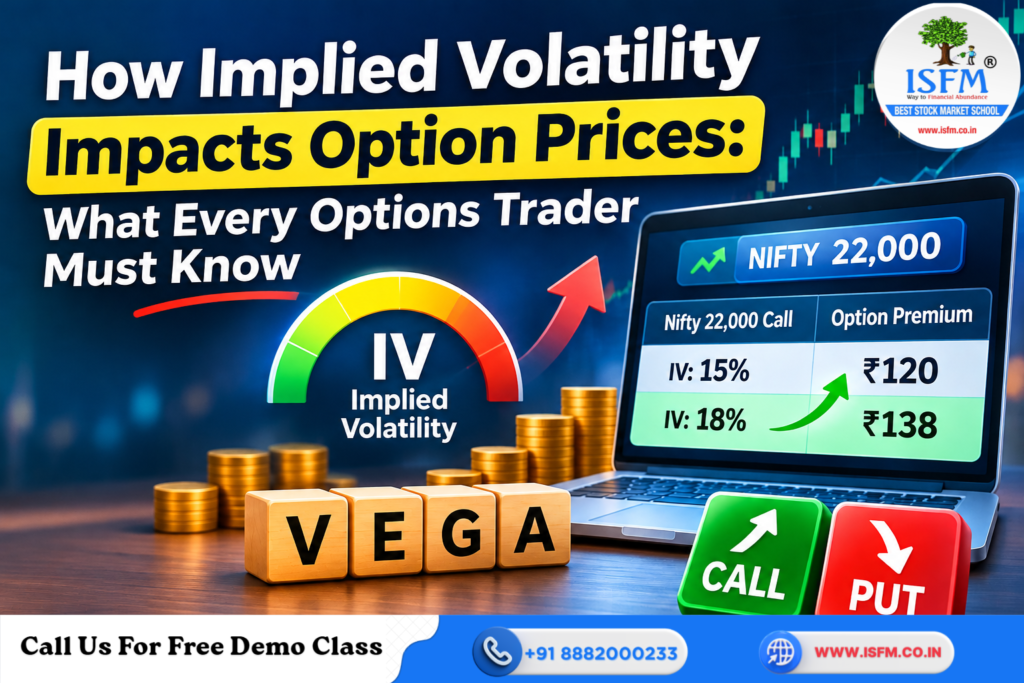
How Implied Volatility Impacts Option Prices: What Every Options Trader Must Know?
Imagine Nifty is trading at 22,000. A trader is watching a 22,000 Call option priced at ₹100. Suddenly, its premium increases to ₹130, even though Nifty has barely moved. Why? The answer is Implied Volatility (IV). According to Sushil Alewa, SEBI Registered Research Analyst (INH100009433), understanding implied volatility is essential because option premiums can change significantly even before the underlying stock or index makes a major move. For options traders, predicting market direction is not enough. Understanding how much movement is already priced into an option is equally important. What Is Volatility in Options Trading? Volatility measures how much an asset’s price fluctuates over time. In options trading, two types are important: IV reflects expected movement and uncertainty, not whether the market will move upward or downward. How IV Affects Option Premiums Implied volatility is an important component of option pricing. Generally, higher IV increases both Call and Put premiums, while falling IV reduces them, assuming other factors remain unchanged. For example: This is why the same strike and expiry can have different premiums at different times. Understanding these pricing factors is an essential part of a structured options trading course. What Is Vega in Options Trading? Vega measures how much an option’s premium may change when implied volatility changes by one percentage point. Consider a hypothetical example: If IV increases from 20% to 21%, the premium may increase approximately ₹5 to ₹105, assuming other factors remain constant. Similarly, if IV falls from 20% to 18%, the premium may decrease approximately ₹10 to ₹90. Vega is an estimate, not a guaranteed price movement. Traders learning option Greeks can explore advanced derivatives training. Why Are ATM Options More Sensitive to IV? At-the-money (ATM) options generally have higher Vega than comparable deep ITM or far OTM options. ATM options contain significant time value, making their premiums particularly sensitive to changes in expected future movement. Deep ITM options generally have lower Vega, while far OTM options often have lower absolute Vega. However, even a small premium change can represent a significant percentage of an inexpensive OTM option’s value. Combining volatility analysis with price behaviour through a technical analysis course can help traders develop a broader understanding of market conditions. Why Does IV Rise Before Major Events? Implied volatility often increases before important announcements because uncertainty rises. Common examples include: Traders may purchase options for speculation or portfolio protection, increasing demand and influencing option premiums. However, high IV does not guarantee a major move or predict its direction. What Is Volatility Crush? Volatility crush occurs when implied volatility falls sharply, often after an important event. Before an announcement, uncertainty can push IV higher. Once the announcement is released, uncertainty may decline, reducing option premiums. For example, a trader purchases a stock Call before quarterly results. The company announces positive results, and the stock rises by 2%. However, IV falls sharply after the announcement. The Call premium may still decline if volatility reduction and time decay outweigh the benefit of the underlying price movement. This explains why traders can predict the direction correctly and still lose money. How to Check IV Before Entering a Trade Before buying an option, consider these practical checks: Building a broader understanding of financial markets through a stock market investment course can help beginners strengthen their foundation. A Practical Nifty Options Example Suppose Nifty is trading at 22,000 and its 22,000 Call is priced at ₹120. Assume the option has a Vega of ₹6 and IV increases from 15% to 18%. The approximate premium impact would be: 3 × ₹6 = ₹18 Therefore, the theoretical premium could increase from ₹120 to ₹138, assuming other factors remain unchanged. Nifty has not moved, but the option has become more expensive because the market is pricing in greater expected movement. Common Mistakes Traders Should Avoid Common mistakes include buying options simply because IV is rising, assuming high IV predicts market direction, ignoring volatility crush, and purchasing expensive options without assessing the expected move. Traders should also avoid overlooking Theta, Delta, Gamma, Vega and liquidity when evaluating an option. Frequently Asked Questions 1. What happens to option premiums when IV increases? Generally, both Call and Put premiums increase because the market prices in potentially larger future movements. 2. Is high IV good or bad for option buyers? High IV makes options more expensive. If IV falls after entry, buyers may lose money even when the underlying moves in their expected direction. 3. What is the difference between Vega and implied volatility? IV represents expected future price fluctuations, while Vega measures the estimated premium change for a one-percentage-point change in IV. 4. Why do Nifty option premiums fall after major events? IV often declines after uncertainty is resolved. This volatility crush, combined with time decay, can reduce option premiums. Conclusion Volatility is not just a background indicator; it is a major factor that can change an option’s premium before the underlying moves. Understanding IV and Vega helps traders evaluate option prices and volatility-related risks. For structured learning across different trading concepts, explore the Chartered Stock Trading Expert (CSTX) course. Before entering an option trade, do not ask only which way the market may move. Ask how much movement is already priced into the premium—and whether volatility is likely to help or hurt you. Financial Risk Disclaimer: Options trading involves substantial risk and may result in significant financial losses. Examples are hypothetical and for educational purposes only. Consult a qualified financial adviser before making investment decisions.