Raamdeo Agrawal Success Story: The Man Behind Motilal Oswal and the QGLP Investing Philosophy
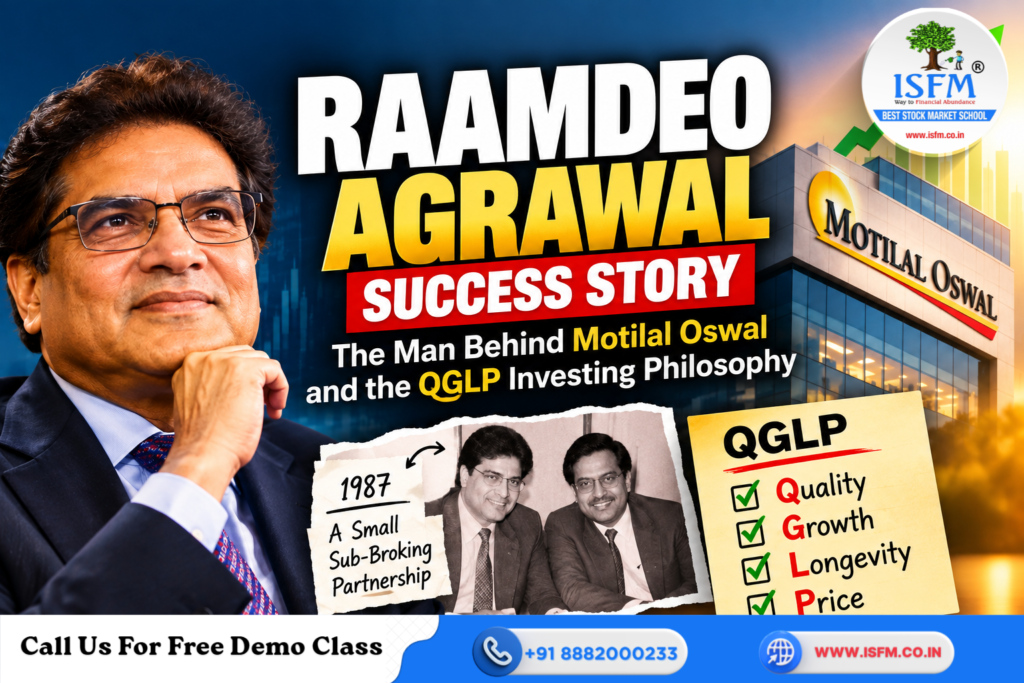
A small stock-market partnership started in 1987 with two people eventually grew into Motilal Oswal Financial Services, a diversified financial-services group with businesses across broking, wealth management, asset management, investment banking and other financial activities. At the centre of this journey was Raamdeo Agrawal, a Chartered Accountant and investor who developed a reputation for research-driven, long-term investing. According to Sushil Alewa, SEBI Registered Research Analyst (INH100009433), the most valuable part of the Raamdeo Agrawal success story is not simply his financial success, but the process behind it. His journey demonstrates how accounting knowledge, business understanding, disciplined research and patience can shape a long-term approach to investing. From Chartered Accountant to Stock Market Professional Raamdeo Agrawal’s professional foundation was accounting. He qualified as a Chartered Accountant, developing a strong understanding of financial statements, business performance and valuation. This background later became an important part of his investment approach. Instead of looking at stocks simply as prices moving up and down on a screen, Agrawal developed an interest in understanding the businesses behind those stocks. For investors, this is an important distinction. A share represents ownership in a business. Therefore, studying sales, profits, cash flows, management quality and competitive advantages can be more meaningful for a long-term investor than focusing only on short-term price movements. This is where Fundamental Analysis becomes important. Understanding balance sheets, profit and loss statements, cash flows and valuation can help investors analyse what they are actually buying. Meeting Motilal Oswal and Starting a Business Raamdeo Agrawal and Motilal Oswal met in Mumbai and discovered a shared interest in the stock market. In 1987, they began their partnership as a small sub-broking business. The environment was very different from today’s market. There were no mobile trading applications, instant financial websites or easily accessible digital research platforms. Building a financial-services business therefore required market knowledge, relationships, client service and professional discipline. Over the following decades, the business expanded into a diversified financial-services group. The journey from a small operation to a major financial institution became an important part of the Motilal Oswal founder story. Early Market Mistakes and Important Lessons Agrawal’s investing journey was not without mistakes. The dramatic bull market around 1990–92 and the market correction that followed provided important lessons about market cycles, risk and valuation. Like many market participants, he experienced periods when investment decisions did not work as expected. One important lesson that emerged was the danger of owning too many businesses without sufficient understanding or conviction. Over time, his approach became increasingly focused on identifying businesses that could be researched deeply and held for the long term. This does not mean every investor should concentrate their portfolio. Concentration can increase risk when research, position sizing and risk management are inadequate. How Warren Buffett Influenced His Investment Strategy? A major influence on Raamdeo Agrawal was Warren Buffett. Studying Buffett’s annual letters and investment philosophy encouraged Agrawal to think differently about stock ownership. Instead of treating shares primarily as short-term trading instruments, he increasingly viewed them as ownership interests in businesses. This thinking placed greater importance on business quality, sustainable growth, management, competitive advantages and valuation. The concept of compounding became particularly important. Imagine a business that steadily increases its earnings and reinvests capital productively. If that growth continues for many years, the value created can become significantly larger over time. For investors who also want to understand how market prices and trends behave, learning Technical Analysis provides a complementary perspective. Fundamental analysis studies the business, while technical analysis focuses primarily on price and market behaviour. Understanding the QGLP Investing Framework One of the most recognised elements of the Raamdeo Agrawal investment strategy is the QGLP framework. Q — Quality Quality refers to the strength of the underlying business. Investors may examine management quality, competitive advantages, financial strength, governance and the company’s ability to generate returns on capital. G — Growth A quality company also needs sustainable growth. Investors can examine whether sales, profits and cash flows can grow over time and whether the company’s market opportunity provides room for expansion. L — Longevity Growth becomes especially powerful when it can continue for many years. Longevity therefore focuses on whether the business can remain competitive, relevant and capable of compounding over a long period. P — Price Even a high-quality business can become an expensive investment if its valuation is too high. Price therefore completes the framework. Investors must consider what they are paying relative to the company’s quality, growth potential and risks. QGLP is a framework for thinking about businesses and valuations—not a guaranteed stock-picking formula. Concentration, Discipline and Risk Control Another important part of Agrawal’s philosophy is discipline. Rather than buying a large number of companies simply for the sake of diversification, his approach has emphasised having meaningful exposure to businesses that an investor understands well. However, concentration requires research and conviction. For investors who cannot spend significant time analysing businesses, appropriate diversification can remain an important risk-management tool. Risk control becomes even more important when investors move into derivatives. Options involve additional factors such as leverage, volatility, time decay and margin requirements. Investors interested in this area can build their understanding through a structured Options Trading Course before applying strategies in the live market. Agrawal has also emphasised avoiding unnecessary borrowing and excessive speculation. These principles highlight an often-overlooked part of wealth creation: protecting capital while allowing good investments time to compound. Lessons Investors Can Learn from Raamdeo Agrawal The Raamdeo Agrawal wealth creation journey provides several practical lessons for Indian investors: For investors who want to develop broader knowledge across equity, derivatives, technical analysis and fundamental analysis, the Chartered Stock Trading Expert (CSTX) program brings several important areas of market education together. Technology is also changing how modern investors analyse markets. Those interested in systematic and technology-driven strategies can explore Algo Trading as another area of financial-market education. Conclusion: The Power of Process and Patience Raamdeo Agrawal’s journey is not simply a story about becoming successful in the stock market. It