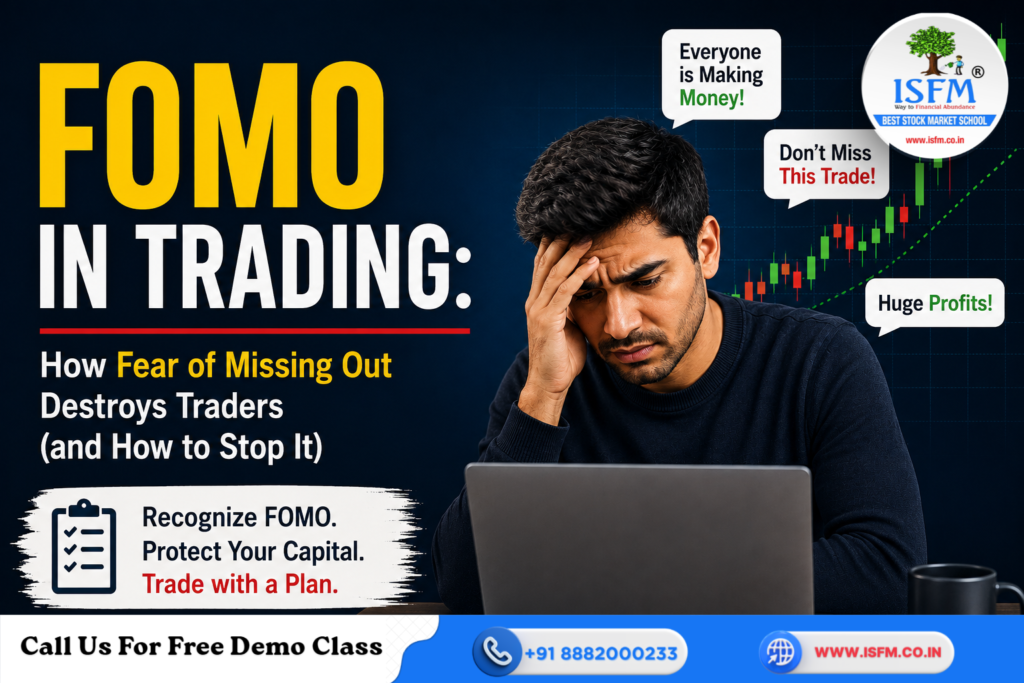
FOMO in Trading: How Fear of Missing Out Destroys Traders (and How to Stop It)
Have you ever watched a stock, crypto coin, or option skyrocket while your social media feed filled with screenshots of huge profits? Suddenly, you feel like you’re the only one not making money. Your heart starts racing, and you think, “If I don’t buy now, I’ll miss the opportunity forever.” That feeling is called FOMO (Fear of Missing Out), and it’s one of the biggest reasons traders lose money. FOMO in trading is the emotional urge to enter a trade simply because others appear to be profiting. Instead of following a strategy, traders let emotions take control. Learning proper market analysis through a Share Market Course can help traders make informed decisions rather than emotional ones. In this article, you’ll learn what FOMO really is, why it’s dangerous, and how to overcome it with disciplined trading habits. What Does FOMO in Trading Really Look Like? FOMO doesn’t always feel obvious. It often disguises itself as confidence or urgency. Here are some common examples: The truth is, FOMO isn’t caused by the market. It’s driven by comparison, impatience, and the fear of being left behind. To avoid emotional entries, traders should first understand chart patterns, trends, and price action through a Technical Analysis Course, which teaches traders to rely on data instead of emotions. Why FOMO Is So Dangerous for Traders FOMO can quietly destroy both your trading account and your confidence. 1. You Buy Near the Top Most traders who experience FOMO enter after a large price move has already happened. By then, professional traders may already be taking profits. 2. You Take Bigger Risks Instead of following proper position sizing, traders often risk more money hoping to “catch up.” This increases losses when the trade goes wrong. 3. You Lose Confidence A FOMO trade often ends in disappointment. Instead of learning from the mistake, many traders immediately chase another opportunity, creating a dangerous cycle: See profits → Chase trade → Lose money → Feel frustrated → Chase another trade Developing a disciplined trading mindset through structured education is often far more valuable than chasing the next hot stock tip. Signs You’re Trading with FOMO Ask yourself these questions: If you answered “yes” to several of these, FOMO may be influencing your decisions. Remember, recognizing the problem is the first step toward fixing it. Why Our Brain Falls for FOMO FOMO isn’t a weakness—it’s part of human psychology. Herd Behaviour People naturally feel safer doing what everyone else is doing. In financial markets, this often leads to buying after prices have already surged. Loss Aversion Psychologically, missing a profit feels almost like taking a loss. That emotional discomfort pushes traders into poor decisions. Social Proof When traders post winning trades online, it creates the illusion that everyone is making money except you. What you don’t see are the losses they never share. Ironically, markets often attract the largest number of emotional buyers near the end of a strong rally. Practical Ways to Beat FOMO in Trading 1. Create a Written Trading Plan Your trading plan should clearly define: Only take trades that match your plan—nothing else. If you actively trade derivatives, having predefined rules is essential. A professional Options Trading Course can help you develop a disciplined, strategy-driven approach. 2. Limit Market Noise Social media can be helpful, but it can also create unnecessary pressure. Instead of constantly checking Telegram groups or viral posts: Less noise means better decisions. 3. Decide Risk Before Entering Professional traders decide their risk before entering a trade. Never increase your position simply because others are making money. A good rule is to risk only a small percentage of your trading capital on any single trade. 4. Delay Emotional Decisions Whenever you feel an urgent need to buy immediately, pause. Wait: Many emotional trades disappear once the excitement fades. 5. Maintain a FOMO Journal Keep a separate journal for emotional trades. Record: After a month, you’ll notice repeating patterns that can dramatically improve your discipline. Many successful traders also use algorithmic trading strategies to remove emotional decision-making from their trading process. Learning the basics through an Algo Trading Course can help traders understand how rule-based systems eliminate emotional bias. Turning FOMO into a Trading Edge Experienced traders don’t just manage their own emotions—they observe the emotions of others. When everyone suddenly becomes excited about one stock, it often signals that the move is already mature. This doesn’t mean you should automatically trade against the crowd. Instead, use market sentiment as one additional piece of information alongside technical analysis, volume, and risk management. If you’re aiming to build long-term trading discipline and professional skills, consider enrolling in the Chartered Stock Trading Expert (CSTX) program, where trading psychology, technical analysis, and risk management form the foundation of every trading decision. Before entering any trade, ask yourself: “If I hadn’t seen anyone else’s profits, would I still take this trade?” If the answer is no, you’re probably reacting emotionally rather than strategically. Conclusion: Choose Discipline Over Hype FOMO is completely normal. Every trader experiences it at some point. The difference between successful and unsuccessful traders isn’t the absence of emotion—it’s the ability to manage it. The market will always provide another opportunity. There will always be another breakout, another rally, and another trending stock. Your goal isn’t to catch every move. Your goal is to protect your capital, continuously improve your knowledge, and consistently follow your trading plan. “In trading, missing one move is normal; missing your rules is what truly costs you.”